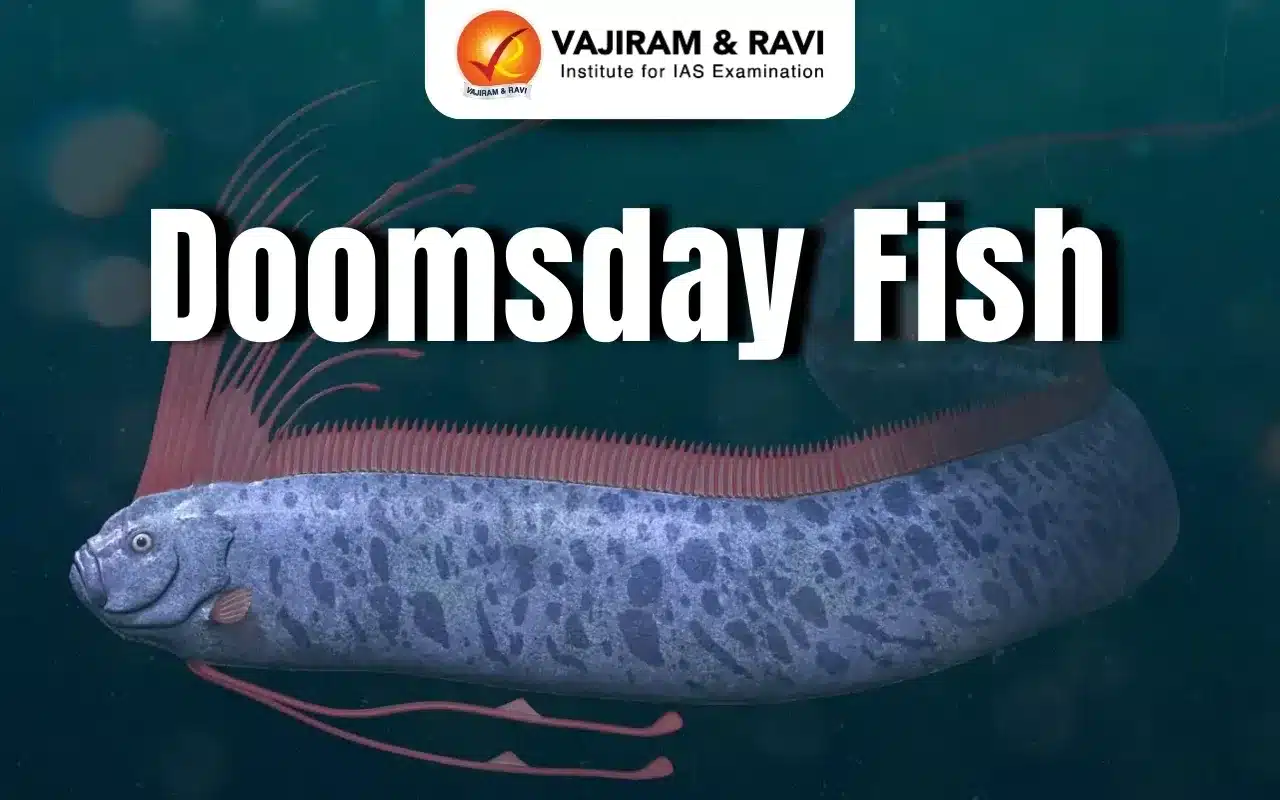
The Giant Oarfish is most commonly known as the Doomsday Fish. It is a rare deep sea species that has attracted global attention due to its unusual appearances near shorelines. Recently, two giant oarfish were spotted close to the coast of Cabo San Lucas, Mexico, an exceptionally rare event because this fish normally inhabits deep ocean waters. Its mysterious nature, enormous size and association with disaster folklore have made it one of the most discussed deep sea creatures in the world.
What is a Doomsday Fish?
The Doomsday Fish is among the ocean’s most unusual and least understood deep sea species.
- Names: The species is scientifically called Regalecus glesne and is commonly known as the Oarfish, Doomsday Fish, Orafish, or occasionally the “Sea Serpent” because of its extraordinary appearance.
- Habitat: These usually live between 200 and 1,000 meters deep near continental slopes, oceanic trenches and the mesopelagic zone.
- Distribution: Oarfish inhabit deep waters of the Pacific, Atlantic and Indian Oceans.
- Size: It is recognized as the longest bony fish in the world, reaching lengths of about 9 meters or 30 feet, while some records indicate individuals can grow up to 11 meters.
- Distinctive Appearance: The fish possesses a long ribbon like silver body with a bright red dorsal fin extending almost its entire length and red spines forming a crown like structure on its head.
- Camouflage Strategy: Oarfish often float vertically in the water column, using their reflective silver bodies as camouflage, helping them remain inconspicuous in deep sea environments.
- Feeding Behaviour: It is a filter feeder that survives mainly on krill, plankton and other small crustaceans, consuming tiny marine organisms drifting through ocean currents.
- Lifespan: Scientists estimate the species can live for nearly 20 years.
- Rarity: The direct observations of the fish has remained extremely limited because of its remote deep sea habitat.
Doomsday Fish Link to Natural Disaster
The Doomsday Fish is famous for its association with earthquakes, tsunamis and other natural disaster predictions.
- Japanese Folklore Connection: In Japanese mythology, the oarfish is called “Ryugu no tsukai,” meaning “Messenger from the Sea God’s Palace,” a belief that dates back to the 17th century and links the fish with future calamities.
- Harbinger of Disaster: Traditional folklore in several coastal communities considers the rare surfacing of oarfish a warning sign of impending earthquakes, tsunamis, destruction, or major disturbances beneath the ocean.
- Tohoku Earthquake Association: The legend gained international attention after around 20 oarfish reportedly washed ashore in Japan before the devastating 9.0 magnitude Tōhoku earthquake and tsunami of 2011.
- Recent Sighting: Concern resurfaced when rare oarfish were recently observed near Baja California Sur and Cabo San Lucas in Mexico, prompting renewed discussion about possible links to seismic activity.
- Seismic Sensitivity Theory: Some researchers suggest deep sea species may detect underwater vibrations, tectonic movements, or disturbances along fault lines before humans can identify them, causing unusual surfacing behaviour.
- Scientific Evidence Gap: Despite popular beliefs, no conclusive scientific proof has established a direct relationship between oarfish appearances and earthquakes, tsunamis, or other natural disasters.
- Findings of Scientific Studies: A 2019 study published in the Bulletin of the Seismological Society of America examined Japanese records and found no measurable correlation between oarfish sightings and earthquake occurrences.
- Alternative Explanations: Scientists believe sightings are more likely linked to illness, injury, disorientation, changing ocean currents, storms, underwater disturbances, or variations in water temperature and pressure.
- Influence of Climate Patterns: Large scale oceanic events such as El Niño may alter deep sea conditions and fish movements, potentially increasing the chances of oarfish reaching shallow coastal waters.
- Conservation Perspective: Knowledge about oarfish behaviour remains limited because they inhabit one of Earth’s least explored marine zones. Growing concerns over plastic pollution and deep sea ecosystem degradation highlight the need for stronger ocean conservation efforts.


Doomsday Fish in India
The Doomsday Fish has also been recorded in Indian waters, drawing significant public attention due to its rarity and disaster related folklore.
- Recent Indian Sighting: In 2025, fishermen off the coast of Tamil Nadu caught a rare giant oarfish, making it one of the most notable Doomsday Fish sightings reported from India in recent years.
- Size: Reports from Tamil Nadu described the fish as nearly 30 feet long. Its enormous ribbon like silver body and red crest attracted large crowds and widespread discussion.
- Scientific Perspective: Marine experts maintain that no proven evidence connects oarfish sightings with future disasters. Researchers suggest that illness, injury, changing ocean conditions, currents, or temperature variations are more likely reasons for their appearance near the surface.

 Last updated on Oct, 2026
→ UPSC 2027 Notification will be released on 13 January 2027 at upsconline.nic.in.
→ Asian Games 2026 are being held in Aichi-Nagoya, Japan, from 19 September to 4 October.
→ Check Nobel Prize 2026 Winners List here.
→ Download PIB PRiSM Monthly Magazine 2026 here.
→ Check UPSC Monthly Current Affairs Magazine The Recitals here.
→ Check out the latest UPSC Syllabus here.
→ Download UPSC Model Answers for Mains 2026
→ UPSC Mains Question Paper 2026 is out now for Essay & GS Paper 1, 2, 3 & 4.
→ UPSC Calendar 2027 has been released.
→ Enroll in Vajiram & Ravi’s UPSC Mains Test Series 2027 for structured answer writing practice, expert evaluation, and exam-oriented feedback.
→ Join Vajiram & Ravi’s UPSC Mentorship Program 2027 for personalized guidance, strategy planning, and one-to-one support from experienced mentors.
→ Go through the UPSC Mains Previous Year Papers to enhance your preparation.
→ UPSC has released UPSC Toppers List 2025 with the Civil Services final result on its official website.
→ Also check Best UPSC Coaching in India
Doomsday Fish FAQs
Q1. Which fish is commonly known as the “Doomsday Fish”?+
Q2. Why is the oarfish called the “Doomsday Fish”?+
Q3. In which ocean zone do oarfish mainly live?+
Q4. What is the typical body shape of an oarfish?+
Q5. Why is the oarfish considered unique among fishes?+
Tags: doomsday fish species in news species in news 2025-2026 upsc current affairs