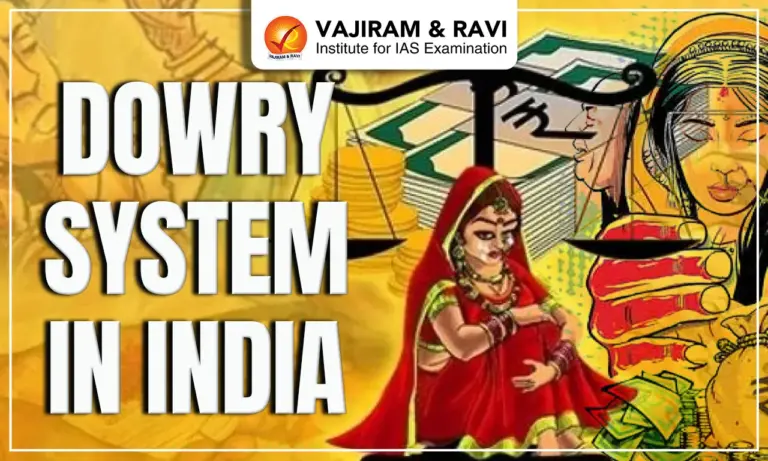
The Dowry System in India is one of the most enduring social practices rooted deeply in the country’s history, traditions, and patriarchal mindset. Originally meant as a voluntary gift to the bride from her family, dowry has over time evolved into a social menace that burdens families, fuels gender discrimination, and leads to violence against women. Despite being outlawed by the Dowry Prohibition Act of 1961, it continues to thrive across both urban and rural India.
Dowry System in India
The Dowry System in India refers to the transfer of wealth, property, or valuable items from the bride’s family to the groom’s family at marriage. According to Mahatma Gandhi, dowry was a social evil, he said- “Any young man, who makes dowry a condition to marriage, discredits his education and his country and dishonours womanhood”. Originally intended to support the bride, it has evolved into a major cause of gender discrimination and social injustice.
Dowry System in India Historical Background
The Dowry System in India has evolved over centuries from a social custom into a complex economic and legal issue.
- Ancient Period: Dowry began as “Stridhan” in Vedic times, intended as voluntary gifts to the bride for her financial security.
- Medieval Era: Gradually, it became a compulsory payment demanded by the groom’s family, especially in royal and upper-caste marriages.
- Colonial Period: British codification of property laws reinforced patriarchal inheritance, worsening dowry dependence.
- Post-Independence: Despite the Dowry Prohibition Act, 1961, the custom persisted, adapting to modern materialistic expectations.





Dowry System in India Causes
The persistence of dowry in Indian society can be attributed to several socio-economic and cultural factors responsible for Dowry System in India:
- Patriarchal Mindset: Women are still viewed as financial liabilities, reinforcing the demand for dowry as compensation for “taking care” of them.
- Economic Inequality: Rising income disparities have commercialized marriages, where dowry becomes a form of wealth transfer.
- Marriage as a Social Transaction: The notion of status and prestige leads families to compete through lavish dowry exchanges.
- Gender Bias: Preference for sons over daughters perpetuates the view that investing in a girl’s education or career is less valuable.
- Lack of Education and Awareness: In rural areas, ignorance of legal safeguards enables continued dowry practices.
- Social Pressure and Tradition: Families fear social ostracism if they refuse to give or accept dowry.
- Weak Law Enforcement: Inadequate implementation of anti-dowry laws allows offenders to escape punishment.
- Cultural Conditioning: Bollywood and media often romanticize wealth-based marriages, indirectly validating dowry expectations.
- Inheritance Inequality: Since women often do not inherit property, dowry is seen as their “share” of parental wealth.
- Rising Consumerism: Growing material aspirations in society fuel the demand for luxury goods as part of dowry.
Dowry System in India Impact
Dowry has far-reaching social, economic, and psychological consequences. It reinforces gender inequality and affects both individuals and society at large.
- Violence Against Women: Dowry-related harassment, torture, and deaths remain rampant. As per NCRB 2022, crimes under Section 498A (cruelty by husband or relatives) exceed 125,000 cases annually.
- Gender Imbalance: Dowry has contributed to the decline in India’s sex ratio (1020 males per 1000 females as per NFHS-5) due to the preference for male children.
- Financial Burden on Families: Families often incur heavy debts or sell property to meet dowry demands, leading to long-term economic distress.
- Delay and Denial of Marriage: Poor families face difficulties marrying their daughters, leading to social exclusion and psychological trauma.
- Psychological Impact: Continuous harassment affects women’s mental health, causing depression, anxiety, and, in extreme cases, suicide.
- Loss of Dignity and Status: Women are often humiliated and treated as commodities, reducing their self-worth.
- Intergenerational Cycle of Poverty: The dowry burden perpetuates economic hardship, especially in rural India where families take loans to pay dowry.
- Erosion of Moral Values: Dowry encourages greed and corruption within the marriage system.
Dowry System in India Legal Framework
The legal provisions against the Dowry System in India has been given below:
- The Dowry Prohibition Act, 1961: The cornerstone law that criminalizes giving, taking, or demanding dowry. Punishment includes imprisonment up to 5 years and a fine up to ₹15,000 or the value of the dowry.
- Bhartiya Nyay Samhita (BNS) Section 85: Dowry Death, earlier given under Indian Penal Code (IPC) Sections 304B and 498A:
- Section 304B (Dowry Death): Death of a woman within 7 years of marriage under suspicious circumstances is treated as dowry death.
- Section 498A: Protects women from cruelty and harassment by husbands and in-laws.
- Protection of Women from Domestic Violence Act, 2005: Extends legal protection to victims of dowry-related abuse within marital homes.
- Indian Evidence Act (Section 113B): Presumes the husband or his relatives responsible if a woman dies due to dowry harassment.
- Criminal Law (Amendment) Act, 1983: Strengthened legal provisions against dowry and cruelty within marriage.
Dowry System in India Case Laws
Various Case Laws that upheld and governed the rightful implementation of the safeguards as well as inhibit the misuse of the laws is given here:
- Rajesh and ORS v. State of Punjab (1992): The Court upheld clarification for evidentiary requirements.
- Preeti Gupta v. State of Jharkhand (2010): Supreme Court raised concerns about the potential for the misuse of Section 498A IPC
- S. Gopal Reddy v. State of Andhra Pradesh (1996): The Supreme Court clarified that dowry includes any demand made before or after marriage.
- Satbir Singh v. State of Haryana (2021): The Court reiterated that mental and physical cruelty linked to dowry qualifies as dowry harassment.
- Rajinder Singh v. State of Punjab (2015): The Supreme Court clarified the meaning of the phrase “soon before death” in the context of Section 304B IPC (dowry death) emphasizing that the cruelty or harassment must have a proximate and live link to the death of the woman.
- Arnesh Kumar v. State of Bihar (2014): Directed police to avoid arbitrary arrests under Section 498A, highlighting the misuse of dowry laws.
Dowry System International Framework
India is a signatory to several international conventions addressing gender-based violence and discrimination which indirectly supports the policies against the dowry system in India:
- Convention on the Elimination of All Forms of Discrimination Against Women (CEDAW), 1979
- Universal Declaration of Human Rights (UDHR), 1948
- Beijing Declaration and Platform for Action, 1995
Dowry System in India Government Policies
The Government of India has brought several initiatives and policies that promotes the eradication of the issue of Dowry System in India directly and indirectly:
- Beti Bachao Beti Padhao (2015): Aims to improve the status of girls by addressing gender bias and promoting education.
- Mahila Shakti Kendras (MSK): Empower rural women through training, awareness, and financial support.
- One Stop Centres (OSC): Provide integrated support to women facing violence, including dowry-related abuse.
- Sukanya Samriddhi Yojana: Encourages saving for girls’ education and future financial independence.
- National Commission for Women (NCW): Monitors implementation of laws protecting women’s rights.
- Ujjawala Scheme: Focuses on prevention, rescue, and rehabilitation of trafficked women.
Role of Society and Media against Dowry System
The media plays a crucial role in shaping social attitudes. Campaigns such as Stop Dowry System and Beti Bachao Beti Padhao have raised awareness. Cinema too, through films like Thappad and Fire, has challenged patriarchal norms. Civil society organizations like Jagori, SEWA, and Vimochana conduct grassroots campaigns and legal aid programs to help women resist dowry-related abuse.
Dowry Laws in India Misuse
While the Dowry Prohibition Act, 1961 and Section 498A of IPC (now Section 85 of BNS and other related sections) were introduced to protect women from harassment, misuse of these provisions has become a growing concern.
- According to the National Crime Records Bureau (NCRB), nearly 2 lakh people, including 47,951 women, were arrested in 2012 for dowry offences, but only 15% were convicted.
- The Supreme Court, in Preeti Gupta v. State of Jharkhand (2010) and Arnesh Kumar v. State of Bihar (2014), warned against arbitrary arrests under Section 498A IPC.
- The Atul Subhash case (2024) highlighted growing concern over men’s rights, mental health, and alleged misuse of anti-dowry and domestic violence laws.
- To prevent abuse, the Law Commission and Justice Malimath Committee recommended amendments in 2015 to make offences under Section 498A compoundable, promoting reconciliation.
- Despite some misuse, experts emphasize the need for a balanced approach—protecting genuine victims while ensuring fairness to the accused.
Stree-Dhan in Indian Law
Stree-dhan (Stridhan) refers to the property, gifts, or money a woman receives during her lifetime, before, during, or after marriage. Under Section 14 of the Hindu Succession Act, 1956, a woman has absolute ownership over her stree-dhan. It cannot be taken by her husband or in-laws.
- Includes gifts received from relatives, friends, or the husband.
- The Supreme Court in Pratibha Rani v. Suraj Kumar (1985) affirmed that stree-dhan remains the woman’s exclusive property.
- Misappropriation of stree-dhan can lead to prosecution under Section 316 BNS (criminal breach of trust)
Differences Between Dowry, Stree-Dhan and Alimony
Although these terms used relatively together, have different concepts of welfare and affirmation, which is often misused instead of safeguarding. The key difference between Dowry, Stree-Dhan and Alimony has been tabulated below:
| Differences Between Dowry, Stree-Dhan and Alimony | |||
| Basis | Dowry | Stree-Dhan | Alimony |
|
Nature |
Illegal transfer of money, goods, or property demanded by groom’s side |
Legal property exclusively owned by a woman during or after marriage |
Legal financial support granted after divorce or separation |
|
Purpose |
To satisfy demands at or after marriage |
To provide financial security and independence to the woman |
To ensure financial stability of dependent spouse post-divorce |
|
Timing |
Given before, during, or after marriage as part of social custom |
Received before, during, or after marriage voluntarily |
Paid after separation or divorce |
|
Control & Ownership |
Controlled by groom or his family (illegal possession) |
Remains under the woman’s absolute ownership (cannot be claimed by in-laws or husband) |
Decided by court based on income and needs |
|
Legality |
Prohibited under Dowry Prohibition Act, 1961 |
Protected under Hindu Succession Act, 1956 and upheld in Pratibha Rani v. Suraj Kumar (1985) |
Permitted under BNSS Section 144 and Hindu Marriage Act, 1955 |
|
Punishment for Misuse/Violation |
Up to 5 years imprisonment and fine |
Misappropriation is punishable under Section 316 BNS (criminal breach of trust) |
Not punishable; subject to judicial revision |
|
Recipient |
Groom’s family or relatives (illegal beneficiaries) |
Woman herself – full and independent rights |
Dependent spouse, usually wife |
|
Moral Standing |
Considered a social evil and punishable offence |
Considered sacred property ensuring women’s dignity and financial safety |
Considered a lawful right ensuring social justice |
|
Example |
Demanding cash or car as a condition of marriage |
Jewellery or gifts received by bride during marriage ceremonies |
Monthly maintenance or lump sum ordered by court |
Dowry System in India Challenges
Despite various reforms and policies along with legal safeguards, the Dowry System has been prevalent in India as a part of Marriages and Ceremonies.
Challenges
- Societal Acceptance: Dowry is often seen as tradition, making it socially acceptable.
- Weak Law Enforcement: Many cases go unreported or unpunished due to social stigma.
- False Cases: Misuse of anti-dowry laws has led to skepticism and delayed justice.
- Patriarchal Structures: Deep-rooted gender bias still normalizes dowry.
- Economic Pressure: Families use dowry as a tool to secure economic advantage.
Way Forward
- Strengthen awareness campaigns targeting schools and rural communities.
- Introduce pre-marriage counseling programs to promote gender equality.
- Encourage women’s property rights and financial independence.
- Implement social audits and public disclosure for dowry-related crimes.
- Foster collaboration between government, NGOs, and local panchayats to monitor dowry-free marriages.
Dowry System in India Current Status
Modern India presents a paradox, while laws and social reforms have improved women’s education and employment opportunities, dowry remains entrenched in cultural practice. As per the NITI Aayog’s 2023 Social Progress Index, nearly 75% of Indian marriages still involve some form of dowry transaction. However, rising female literacy, urbanization, and social media activism are gradually shifting public opinion against the practice.
Initiatives like “No Dowry Marriages” in Kerala and self-help groups promoting dowry-free weddings in Bihar and Tamil Nadu represent positive social change. The growing participation of women in the workforce and their access to education will remain the most powerful tools to eliminate dowry from Indian society.
Dowry System in India UPSC
Despite legislative bans, the practice remains prevalent. According to the National Crime Records Bureau (NCRB) 2022, India reported over 6,500 dowry-related deaths, accounting for nearly 19 deaths per day. States like Uttar Pradesh, Bihar, and Madhya Pradesh recorded the highest numbers. The National Family Health Survey (NFHS-5) also reveals that dowry continues to be an expected part of marriage negotiations, particularly in North India.
A United Nations Development Programme (UNDP, 2023) report states that dowry exchanges are more prevalent in regions where female literacy rates and workforce participation are low. Even among educated and urban populations, dowry remains a marker of social prestige, highlighting how modernization has failed to dismantle entrenched gender norms.

 Last updated on March, 2026
→ UPSC Final Result 2025 is now out.
→ UPSC has released UPSC Toppers List 2025 with the Civil Services final result on its official website.
→ Anuj Agnihotri secured AIR 1 in the UPSC Civil Services Examination 2025.
→ UPSC Marksheet 2025 is now out.
→ UPSC Notification 2026 & UPSC IFoS Notification 2026 is now out on the official website at upsconline.nic.in.
→ UPSC Calendar 2026 has been released.
→ Check out the latest UPSC Syllabus 2026 here.
→ UPSC Prelims 2026 will be conducted on 24th May, 2026 & UPSC Mains 2026 will be conducted on 21st August 2026.
→ The UPSC Selection Process is of 3 stages-Prelims, Mains and Interview.
→ Prepare effectively with Vajiram & Ravi’s UPSC Prelims Test Series 2026 featuring full-length mock tests, detailed solutions, and performance analysis.
→ Enroll in Vajiram & Ravi’s UPSC Mains Test Series 2026 for structured answer writing practice, expert evaluation, and exam-oriented feedback.
→ Join Vajiram & Ravi’s Best UPSC Mentorship Program for personalized guidance, strategy planning, and one-to-one support from experienced mentors.
→ Shakti Dubey secures AIR 1 in UPSC CSE Exam 2024.
→ Also check Best UPSC Coaching in India
Dowry System in India FAQs
Q1. What is the Dowry System in India?+
Q2. Is Dowry Legal in India?+
Q3. Which Indian states report the highest dowry cases?+
Q4. What are the key laws against the Dowry System in India?+
Q5. How can we eliminate the Dowry System in India?+
Tags: dowry system in india