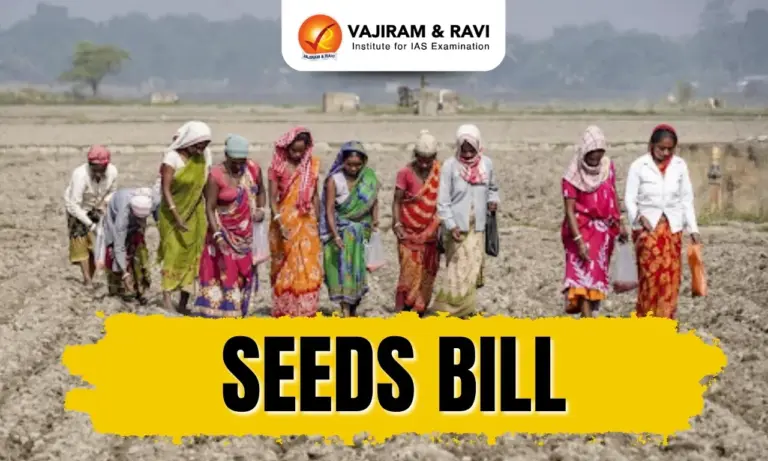
Seeds Bill Latest News
- The Union Agriculture Ministry has released the Draft Seeds Bill 2025, inviting public comments until December 11.
- The Bill aims to modernise seed regulation by amending the Seeds Act, 1966 and the Seeds (Control) Order 1983, ensuring quality seeds for farmers while reducing compliance burdens for the seed industry.
Context and Rationale Behind the Seeds Bill 2025
- India’s seed sector has undergone a massive transformation since the 1960s, through advances in biotechnology, hybridisation, commercial seed processing, and international trade.
- According to the Agriculture Ministry, in 2023-24, the national requirement for seeds was 462.31 lakh quintals, while availability reached 508.60 lakh quintals, creating a surplus of 46.29 lakh quintals.
- Industry associations have argued that the 1966 Act is outdated and ill-equipped to deal with new scientific and commercial realities.





Regulatory Architecture Proposed Under the Bill
- Clear Definition of Stakeholders
- The Bill defines key actors, farmer, dealer, distributor, and producer, as separate entities engaged in seed use and trade. This creates regulatory clarity across the supply chain.
- Central and State Seed Committees
- Two statutory bodies are proposed:
- Central Seed Committee (27 members)
- State Seed Committees (15 members)
- Two statutory bodies are proposed:
- The Central Committee will recommend standards such as:
- Minimum germination levels,
- Genetic and physical purity,
- Traits and seed health norms,
- Additional quality parameters.
- The State Committees will advise on the registration of seed producers, dealers, nurseries, and processing units.
Quality Control and Registration Systems
- Mandatory Registration of Seed Processing Units
- All processing units must register with the State government. This ensures quality control but may increase operational costs for small seed entrepreneurs.
- To ease compliance for companies operating across multiple States, a Central Accreditation System may be introduced, merit-based, transparent, and uniform.
- National Seed Variety Register
- The Bill creates the office of a Registrar responsible for maintaining a National Register of Seed Varieties under the Central Seed Committee.
- Field trials to determine the Value for Cultivation and Use (VCU) are also standardised in the Bill.
- Seed Testing Laboratories
- Central and State seed testing laboratories will be strengthened to:
- Analyse genetic purity,
- Assess germination and health parameters,
- Assist in compliance monitoring.
- Central and State seed testing laboratories will be strengthened to:
- Role of Seed Inspectors
- Seed inspectors will have search-and-seizure powers under the Bharatiya Nagarik Suraksha Sanhita, ensuring stronger enforcement against violations.
Offences and Penalties
- The new draft significantly revises the penalty framework compared to the 2019 draft.
- The Bill classifies offences as: Trivial, Minor, Major, with corresponding penalties.
- This stronger penal architecture reflects the government’s intent to curb seed fraud and maintain quality standards.
Farmers’ Rights and New Safeguards
- The Bill reiterates that farmers retain the right to save, use, exchange, and sell farm-saved seeds, except under a brand name. This aligns with long-standing protections under Indian law.
- The draft also links seed regulation to the Protection of Plant Varieties and Farmers’ Rights (PPV&FR) Act 2001, attempting to ensure that quality norms and intellectual property rights are harmonised.
Concerns Raised by Farmers’ Organisations
- Farmers’ unions, including the All India Kisan Sabha, have criticised the Bill for:
- Potential increase in seed costs, enabling large companies to engage in “predatory pricing.”
- Risk to seed sovereignty, as centralisation may favour multinational and domestic seed corporations.
- Dilution of biodiversity protections, arguing that the Bill conflicts with global treaties such as the CBD and the International Treaty on Plant Genetic Resources for Food & Agriculture.
- Creating a “corporatised regulatory structure” that may overshadow the PPV&FR Act’s progressive farmer-centric provisions.
- These groups demand that the Bill must complement, not undermine, India’s biodiversity and farmers’ rights legal architecture.
Source: TH

 Last updated on March, 2026
→ UPSC Final Result 2025 is now out.
→ UPSC has released UPSC Toppers List 2025 with the Civil Services final result on its official website.
→ Anuj Agnihotri secured AIR 1 in the UPSC Civil Services Examination 2025.
→ UPSC Marksheet 2025 is now out.
→ UPSC Notification 2026 & UPSC IFoS Notification 2026 is now out on the official website at upsconline.nic.in.
→ UPSC Calendar 2026 has been released.
→ Check out the latest UPSC Syllabus 2026 here.
→ UPSC Prelims 2026 will be conducted on 24th May, 2026 & UPSC Mains 2026 will be conducted on 21st August 2026.
→ The UPSC Selection Process is of 3 stages-Prelims, Mains and Interview.
→ Prepare effectively with Vajiram & Ravi’s UPSC Prelims Test Series 2026 featuring full-length mock tests, detailed solutions, and performance analysis.
→ Enroll in Vajiram & Ravi’s UPSC Mains Test Series 2026 for structured answer writing practice, expert evaluation, and exam-oriented feedback.
→ Join Vajiram & Ravi’s Best UPSC Mentorship Program for personalized guidance, strategy planning, and one-to-one support from experienced mentors.
→ Shakti Dubey secures AIR 1 in UPSC CSE Exam 2024.
→ Also check Best UPSC Coaching in India
Seeds Bill FAQs
Q1. What is the purpose of the Draft Seeds Bill 2025?+
Q2. Does the Bill restrict farmers’ rights to use or share seeds?+
Q3. What penalties does the Bill impose for violations?+
Q4. What new committees will be formed under the Bill?+
Q5. Why are farmers’ groups opposing the Bill?+
Tags: mains articles seeds bill upsc current affairs upsc mains current affairs