About Dragon Fruit:
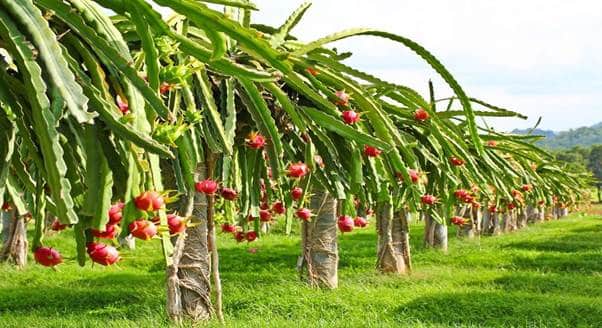
- Dragon Fruit is a herbaceous perennial climbing cactus widely known as Pitaya, has its origin in Southern Mexico, Central America and South America.
- Its flowers are hermaphrodites (male and female organs in the same flower) in nature and open at night.
- It grows in all kinds of soil and does not require much water.
- The plant sustains yield for more than 20 years, is high in nutraceutical properties (medicinal effects) and good for value-added processing industries.
- It is widely cultivated in South-East Asia, India, the USA, The Caribbean Islands, and Australia throughout the tropical and sub-tropical world.
- The world’s largest producer and exporter of dragon fruit is Vietnam, where the plant was brought by the French in the 19th century.
- In India, the cultivation of Kamalam Fruit is done in Karnataka, Kerala, Tamil Nadu, Maharashtra, Gujarat, Chhattisgarh, Odisha, West Bengal, Andhra Pradesh, Andaman & Nicobar Islands, Mizoram and Nagaland.
- In this endeavor under the Mission for Integrated Development of Horticulture (MIDH), a roadmap is being prepared for the cultivation of this crop.
Key facts about the Mission for Integrated Development of Horticulture (MIDH) Mission
- It is a Centrally Sponsored Scheme for the holistic growth of the horticulture sector covering fruits, vegetables, root & tuber crops, mushrooms, spices, flowers, aromatic plants, coconut, cashew, cocoa and bamboo.
- Under MIDH, the Government of India (GOI) contributes 60%, of the total outlay for developmental programmes in all the states except states in the North East and the Himalayas, and 40% share is contributed by State Governments.
- In the case of North Eastern States and Himalayan States, GOI contributes 90%.
- In the case of the National Horticulture Board (NHB), Coconut Development Board (CDB), Central Institute for Horticulture (CIH), Nagaland and the National Level Agencies (NLA), GOI contributes 100%.
Q1) What is the objective of the National Horticulture Board?
The main objectives of the NHB are to improve integrated development of the Horticulture industry and to help in coordinating, sustaining the production and processing of fruits and vegetables.






 Last updated on April, 2026
→ UPSC Final Result 2025 is now out.
→ UPSC has released UPSC Toppers List 2025 with the Civil Services final result on its official website.
→ Anuj Agnihotri secured AIR 1 in the UPSC Civil Services Examination 2025.
→ UPSC Marksheet 2025 is now out.
→ UPSC Notification 2026 & UPSC IFoS Notification 2026 is now out on the official website at upsconline.nic.in.
→ UPSC Calendar 2026 has been released.
→ Check out the latest UPSC Syllabus 2026 here.
→ UPSC Prelims 2026 will be conducted on 24th May, 2026 & UPSC Mains 2026 will be conducted on 21st August 2026.
→ The UPSC Selection Process is of 3 stages-Prelims, Mains and Interview.
→ Prepare effectively with Vajiram & Ravi’s UPSC Prelims Test Series 2026 featuring full-length mock tests, detailed solutions, and performance analysis.
→ Enroll in Vajiram & Ravi’s UPSC Mains Test Series 2026 for structured answer writing practice, expert evaluation, and exam-oriented feedback.
→ Join Vajiram & Ravi’s Best UPSC Mentorship Program for personalized guidance, strategy planning, and one-to-one support from experienced mentors.
→ Shakti Dubey secures AIR 1 in UPSC CSE Exam 2024.
→ Also check Best UPSC Coaching in India