Rocket-Sled Ejection Test Latest News
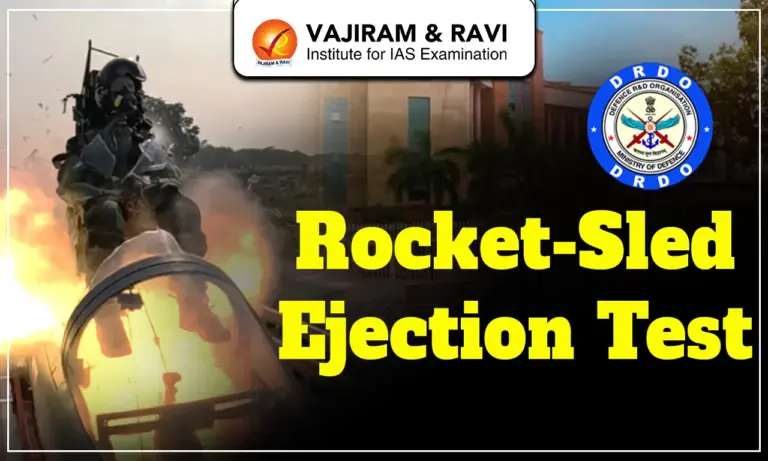
- The DRDO successfully conducted a high-speed rocket-sled test on December 2 to evaluate a fighter aircraft’s escape (ejection) system under controlled conditions.
- This milestone places India among the few nations with the capability to test such systems indigenously and at high speeds.
- The test demonstrates India’s growing self-reliance in advanced aerospace safety technologies and highlights the importance of having a dynamic test facility to validate and improve pilot-escape mechanisms essential for fighter aircraft operations.
How DRDO Conducted the Rocket-Sled Ejection Test
- The test was jointly carried out by DRDO, the Aeronautical Development Agency (ADA), and Hindustan Aeronautics Limited (HAL) at DRDO’s Rail Track Rocket Sled (RTRS) facility in Chandigarh.
- The rocket-sled system replicates high-speed, in-flight aerodynamic conditions on the ground.
- Using a dual-sled setup, the forebody of the indigenous LCA was mounted and accelerated along rail tracks.
- Through the phased firing of multiple solid rocket motors, the system achieved a precisely controlled speed of 800 km/h, enabling accurate evaluation of the aircraft’s escape system under realistic conditions.





Why Dynamic Ejection Tests Are More Challenging
- Dynamic ejection tests simulate real flight conditions, unlike static tests conducted at zero altitude and zero speed.
- They are the true benchmark for validating pilot escape systems because they must replicate complex, high-speed aerodynamic forces.
- These tests evaluate:
- Ejection seats powered by explosive cartridges and rocket motors
- Canopy severance systems that safely clear the cockpit before ejection
- Perfect sequencing of seat firing, stabilisation, and parachute deployment
- Survival depends on millisecond-level precision, making the process extremely sensitive.
Extreme Aerodynamic Forces and Real-World Scenarios
- Emergency ejections may occur during:
- Low or high altitude
- Zero speed or supersonic flight
- Aircraft spin or inverted flight
- The systems must function flawlessly across all conditions, as incorrect sequencing or timing can cause severe injuries.
- Hence, flight-like testing is essential to meet global safety standards.
Use of Human-Like Test Dummies for High-Fidelity Data
- The test employed instrumented anthropomorphic dummies equipped with sensors to measure:
- Physical loads
- Rotational forces (moments)
- Accelerations experienced during ejection
- This helps simulate the full sequence of pilot ejection and recovery under realistic conditions.
A Major Strategic Leap in Fighter Aircraft Safety
- India’s successful indigenous test of a fighter aircraft escape system marks a significant strategic milestone.
- Ejection systems are among the most critical life-saving mechanisms in combat aircraft, directly determining pilot survivability during emergencies.
Reduced Dependence on Foreign Testing Ecosystems
- Previously, India relied on foreign test facilities to assess ejection systems—an expensive and time-consuming process.
- Indigenous testing now costs one-fourth to one-fifth of overseas testing, making development more economical and efficient.
Faster Development and Certification for Current and Future Aircraft
- By possessing an in-house dynamic ejection test facility, India can now:
- Design and certify escape systems domestically
- Upgrade mechanisms for future fighter platforms
- Shorten development cycles and reduce external bottlenecks
- This enhances India’s aerospace self-reliance.
High-Fidelity Safety Data Through Realistic Simulation
- Instrumented anthropomorphic dummies allow India to precisely measure:
- Loads
- Accelerations
- Impact forces
- Such data is crucial for optimising pilot safety across different emergency scenarios.
Advanced RTRS Capabilities Already Supporting National Missions
- The Rail Track Rocket Sled (RTRS) at TBRL, operational since 2014, can test systems at supersonic speeds.
- Earlier in February, the facility successfully tested Gaganyaan drogue parachutes, firing two parachutes simultaneously to simulate real descent conditions.
- The upgraded escape system test facility now includes:
- High-speed cameras
- State-of-the-art measurement systems
- A dynamic test environment matching global benchmarks

 Last updated on April, 2026
→ UPSC Final Result 2025 is now out.
→ UPSC has released UPSC Toppers List 2025 with the Civil Services final result on its official website.
→ Anuj Agnihotri secured AIR 1 in the UPSC Civil Services Examination 2025.
→ UPSC Marksheet 2025 is now out.
→ UPSC Notification 2026 & UPSC IFoS Notification 2026 is now out on the official website at upsconline.nic.in.
→ UPSC Calendar 2026 has been released.
→ Check out the latest UPSC Syllabus 2026 here.
→ UPSC Prelims 2026 will be conducted on 24th May, 2026 & UPSC Mains 2026 will be conducted on 21st August 2026.
→ The UPSC Selection Process is of 3 stages-Prelims, Mains and Interview.
→ Prepare effectively with Vajiram & Ravi’s UPSC Prelims Test Series 2026 featuring full-length mock tests, detailed solutions, and performance analysis.
→ Enroll in Vajiram & Ravi’s UPSC Mains Test Series 2026 for structured answer writing practice, expert evaluation, and exam-oriented feedback.
→ Join Vajiram & Ravi’s Best UPSC Mentorship Program for personalized guidance, strategy planning, and one-to-one support from experienced mentors.
→ Shakti Dubey secures AIR 1 in UPSC CSE Exam 2024.
→ Also check Best UPSC Coaching in India
Rocket-Sled Ejection Test FAQs
Q1. What did DRDO’s rocket-sled ejection test achieve?+
Q2. How was the test conducted at the RTRS facility?+
Q3. Why are dynamic ejection tests essential?+
Q4. What strategic benefits does indigenous testing provide?+
Q5. How does the RTRS contribute to national missions?+
Tags: rocket-sled ejection test