DRDO Air Defence System Latest News
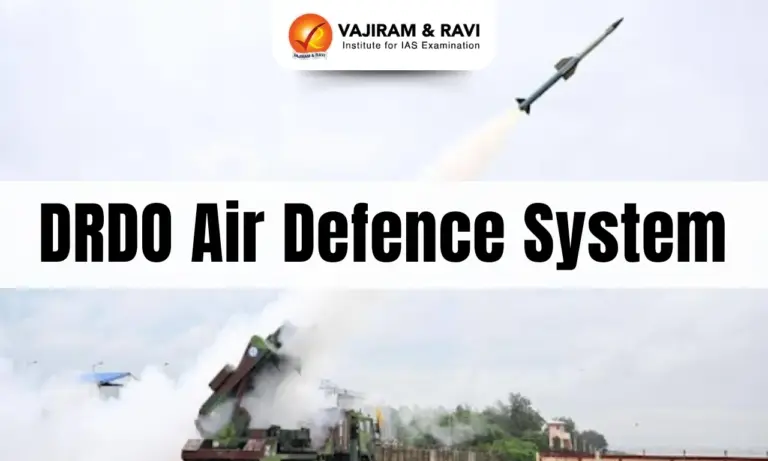
- The Ministry of Defence announced that the DRDO successfully carried out the first flight-tests of the Integrated Air Defence Weapon System (IADWS).
- Conducted off the coast of Odisha, the system demonstrated its capability by simultaneously destroying three targets at varying ranges and altitudes, marking a significant milestone in India’s indigenous defence technology.
Integrated Air Defence Weapon System (IADWS)
- The Integrated Air Defence Weapon System (IADWS) is a multi-layered defence system comprising three key components:
- Quick Reaction Surface-to-Air Missiles (QRSAMs);
- The advanced Very Short Range Air Defence System (VSHORADS) missiles;
- A laser-based Directed Energy Weapon (DEW).
- During recent flight-tests at Chandipur, all components successfully performed their roles, as confirmed by range instruments, showcasing the system’s capability to intercept and neutralise multiple aerial threats with precision.





Components of the Integrated Air Defence Weapon System (IADWS)
- The IADWS integrates three advanced weapon systems — QRSAM, VSHORADS, and DEW — controlled by a Centralised Command and Control Centre developed by DRDL, Hyderabad.
- Together, QRSAM, VSHORADS, and DEW make IADWS a multi-layered, mobile, and technologically advanced defence shield capable of countering a wide spectrum of aerial threats.
Quick Reaction Surface-to-Air Missile (QRSAM)
- Developer: DRDO
- Role: Provides a protective shield to moving Army armoured columns against enemy aerial threats.
- Range: 3–30 km
- Features: Configured on highly mobile platforms with the ability to search, track, and fire on the move.
- System Components: Automated command and control, two radars (Battery Surveillance Radar & Multifunction Radar, both with 360° coverage), and a launcher.
Very Short Range Air Defence System (VSHORADS)
- Developer: Research Centre Imarat (RCI), Hyderabad
- Type: Fourth-generation, man-portable air defence system (MANPAD).
- Range: 300 m – 6 km
- Capability: Neutralises drones, UAVs, and other aerial threats, usable by Army, Navy, and Air Force.
Directed Energy Weapon (DEW)
- Developer: Centre for High Energy Systems and Sciences (CHESS), Hyderabad
- Type: Vehicle-mounted Laser DEW MK-II(A)
- Range: < 3 km
- Recent Demonstration: In April, successfully destroyed UAVs and swarm drones by causing structural damage and disabling sensors.
- Significance: Places India among a select group of nations with operational directed-energy systems.
Strategic Significance of the IADWS
- The Integrated Air Defence Weapon System (IADWS) is strategically important as it can neutralise diverse aerial threats — from high-speed to low-speed, and fixed-wing to rotary-wing aircraft — within a 30 km range.
- Its indigenous command and control system and fully homegrown weapons mark a major milestone in India’s defence self-reliance.
- The maiden test demonstrated effective integration of missiles and directed energy weapons, strengthening India’s multi-layered air defence with faster response capability and reduced reliance on foreign systems.
- Officials view the test as both a strategic leap in indigenous defence capability and a stepping stone towards Mission Sudarshan Chakra.
- PM Modi has announced Mission Sudarshan Chakra, a multi-layered, networked defence system designed to protect India and its critical installations from diverse enemy attacks.
- The shield will integrate surveillance, cybersecurity, and air defence systems to provide layered protection against threats such as long-range missiles, aircraft, and unmanned aerial vehicles.
- Covering both border areas and vital national assets, the mission aims to create a comprehensive security framework capable of detecting, intercepting, and neutralising threats across multiple domains.
India’s Air Defence Success in Operation Sindoor Aftermath
- During the hostilities that followed Operation Sindoor, Indian air defences successfully intercepted Pakistani missiles and drones.
- Key systems such as the S-400 Triumf, Barak 8 MRSAM, and the indigenous Akash missile were deployed, while the Armed Forces activated an Integrated Counter-UAS Grid alongside other air defence measures.
- Together, these systems effectively neutralised enemy threats, underscoring the robustness of India’s layered air defence capability.

 Last updated on March, 2026
→ UPSC Final Result 2025 is now out.
→ UPSC has released UPSC Toppers List 2025 with the Civil Services final result on its official website.
→ Anuj Agnihotri secured AIR 1 in the UPSC Civil Services Examination 2025.
→ UPSC Marksheet 2025 is now out.
→ UPSC Notification 2026 & UPSC IFoS Notification 2026 is now out on the official website at upsconline.nic.in.
→ UPSC Calendar 2026 has been released.
→ Check out the latest UPSC Syllabus 2026 here.
→ UPSC Prelims 2026 will be conducted on 24th May, 2026 & UPSC Mains 2026 will be conducted on 21st August 2026.
→ The UPSC Selection Process is of 3 stages-Prelims, Mains and Interview.
→ Prepare effectively with Vajiram & Ravi’s UPSC Prelims Test Series 2026 featuring full-length mock tests, detailed solutions, and performance analysis.
→ Enroll in Vajiram & Ravi’s UPSC Mains Test Series 2026 for structured answer writing practice, expert evaluation, and exam-oriented feedback.
→ Join Vajiram & Ravi’s Best UPSC Mentorship Program for personalized guidance, strategy planning, and one-to-one support from experienced mentors.
→ Shakti Dubey secures AIR 1 in UPSC CSE Exam 2024.
→ Also check Best UPSC Coaching in India
DRDO Air Defence System FAQs
Q1. What is the Integrated Air Defence Weapon System (IADWS)?+
Q2. Which components make up the IADWS?+
Q3. Why is the IADWS strategically significant?+
Q4. Where was the IADWS tested?+
Q5. How did Indian air defence perform in Operation Sindoor aftermath?+
Tags: DRDO air defence system mains articles upsc current affairs upsc mains current affairs