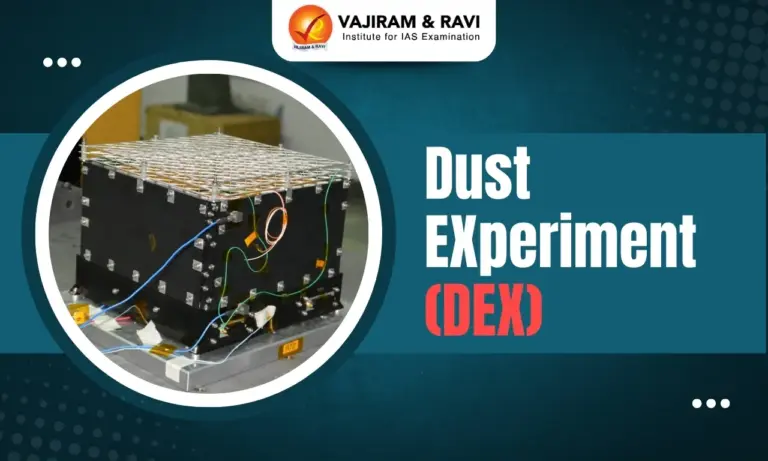
Dust Experiment (DEX) Latest News
Recently, the Indian Space Research Organisation confirmed through its first-ever Dust Experiment (DEX) that an interplanetary dust particle enters Earth’s atmosphere approximately every 1,000 seconds.
About Dust Experiment (DEX)
- It is the first Indian-made instrument to hunt for these high speed Interplanetary Dust Particles (IDPs).
- It is the first-of-its-kind instrument designed to detect such high-transient particles.
- It is developed by the Physical Research Laboratory, Ahmedabad.
- It was flown on PSLV Orbital Experimental Module (POEM) of the PSLV-C58 XPoSat Mission on January 1, 2024.





Features of Dust Experiment (DEX)
- It is a compact instrument tuned to hear impacts, capturing vital data.
- At the core of the experiment lies a 3-kilogram dust detector based on the cutting-edge hypervelocity principle designed to capture high-speed space dust impacts with only 4.5 W power consumption.
- It rocketed to an altitude of 350Km.
- DEX is a blueprint of the detector which can study the cosmic dust particle at any planet having an atmosphere or no atmosphere.
Significance of the Dust Experiment (DEX)
- Its data redefines our understanding of the universe and charts the path for safe human deep-space missions.
- Understanding and collecting data on interplanetary dust in Earth’s atmosphere will also be valuable for planning Gaganyaan missions.
What are Interplanetary Dust Particles (IDPs)?
- Interplanetary dust refers to micrometer-scale particles originating from the solar system.
- These are microscopic shrapnel from comets and asteroids that form our atmosphere’s mysterious “meteor layer”, and show up as “shooting stars” at night.
- These can be analyzed to gain insights into their origins, formation mechanisms, and the processes that occurred in early solar and presolar environments.
Source: IE

 Last updated on March, 2026
→ UPSC Final Result 2025 is now out.
→ UPSC has released UPSC Toppers List 2025 with the Civil Services final result on its official website.
→ Anuj Agnihotri secured AIR 1 in the UPSC Civil Services Examination 2025.
→ UPSC Marksheet 2025 is now out.
→ UPSC Notification 2026 & UPSC IFoS Notification 2026 is now out on the official website at upsconline.nic.in.
→ UPSC Calendar 2026 has been released.
→ Check out the latest UPSC Syllabus 2026 here.
→ UPSC Prelims 2026 will be conducted on 24th May, 2026 & UPSC Mains 2026 will be conducted on 21st August 2026.
→ The UPSC Selection Process is of 3 stages-Prelims, Mains and Interview.
→ Prepare effectively with Vajiram & Ravi’s UPSC Prelims Test Series 2026 featuring full-length mock tests, detailed solutions, and performance analysis.
→ Enroll in Vajiram & Ravi’s UPSC Mains Test Series 2026 for structured answer writing practice, expert evaluation, and exam-oriented feedback.
→ Join Vajiram & Ravi’s Best UPSC Mentorship Program for personalized guidance, strategy planning, and one-to-one support from experienced mentors.
→ Shakti Dubey secures AIR 1 in UPSC CSE Exam 2024.
→ Also check Best UPSC Coaching in India
Dust Experiment (DEX) FAQs
Q1. What is cosmic dust composed of?+
Q2. Where is cosmic dust commonly found?+
Tags: dust experiment (dex)