Earthquakes Latest News
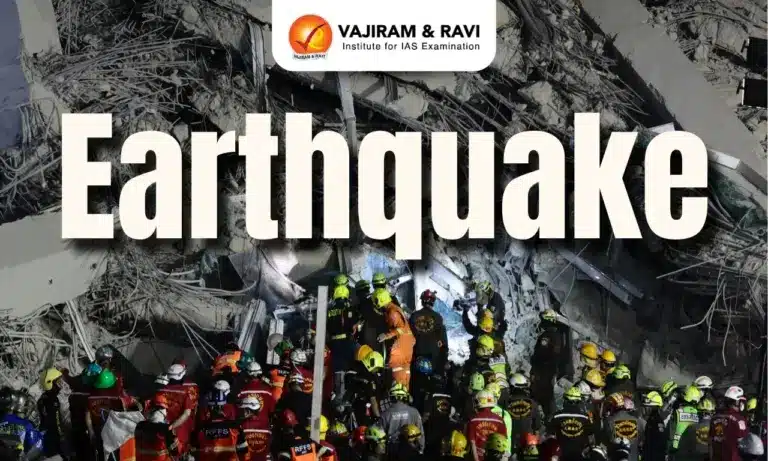
A 7.7-magnitude earthquake struck central Myanmar on March 29, 2025, causing significant destruction in Mandalay and claiming at least 144 lives.
About Earthquakes
- Earthquake: Sudden shaking or trembling of the Earth’s surface due to the release of stored energy in the Earth’s crust or upper mantle.
- Focus (Hypocentre): The point within the Earth where the earthquake originates.
- Epicentre: The point on the surface directly above the focus.
- Seismograph: An instrument used to detect and measure earthquakes.
- Isoseismic line: A line connecting points on the surface experiencing the same intensity.





Types of Seismic Waves
|
Type |
Description |
Speed |
|
Primary (P) Waves |
Fastest, travel through solids, liquids, and gases |
Fastest |
|
Secondary (S) Waves |
Travel through solids only, cause more damage |
Slower than P-waves |
|
Surface Waves |
Slowest, cause maximum destruction |
Slowest |
Causes of Earthquakes
- Fault zones: Most earthquakes occur along fault lines, where stress builds up due to tectonic movements.
- Major faults:
- Thrust faults (Convergent boundary) → Most powerful quakes (Magnitude 8+).
- Strike-slip faults (Transform boundary) → Horizontal movement (e.g., Sagaing Fault, San Andreas Fault).
- Normal faults (Divergent boundary) → Less intense quakes (Magnitude <7).
- Plate Tectonics: Tectonic movement at plate boundaries can trigger earthquakes:
- Convergent Boundaries → Subduction zones, causing megathrust earthquakes (e.g., 2004 Indian Ocean earthquake).
- Divergent Boundaries → Spreading ridges generate mild earthquakes.
- Transform Boundaries → Horizontal movement of plates leads to strike-slip earthquakes (e.g., Sagaing Fault, San Andreas Fault).
- Volcanic activity: Magma movement inside volcanoes can cause volcanic earthquakes.
- Myanmar has active volcanoes, contributing to seismic activity.
- Human-induced earthquakes: Mining, dam construction, and deep drilling can trigger artificial seismic activity.
Why Does Myanmar Experience Frequent Earthquakes?
- Tectonic Setting: Myanmar lies at the junction of three major tectonic plates:
- Indian Plate (moving northward)
- Eurasian Plate (moving southward)
- Burma Microplate (moving eastward)
- The Sagaing Fault, a strike-slip fault, runs north-south through central Myanmar, making it highly prone to seismic activity.
Earthquakes FAQs
Q1. What causes earthquakes?
Ans. Earthquakes are caused by the sudden release of energy due to the movement of tectonic plates along faults.
Q2. What is the difference between the Richter scale and the Mercalli scale?
Ans. The Richter scale measures earthquake magnitude (energy released), while the Mercalli scale measures the intensity and impact on people and structures.
Q3. What are the major earthquake-prone zones in India?
Ans. India has four seismic zones. Zone V (most active) includes regions like the Himalayas and the Northeast, while Zone II (least active) includes central and southern India.
Q4. What is the significance of the Ring of Fire in earthquakes?
Ans. The Ring of Fire is a highly seismically active zone in the Pacific Ocean where most of the world’s earthquakes and volcanic eruptions occur due to subduction zones.
Q5. What are the mitigation strategies for earthquakes?
Ans. Earthquake mitigation includes retrofitting buildings, enforcing seismic-resistant construction codes, early warning systems, and public awareness programs.
Source: IE

 Last updated on March, 2026
→ UPSC Final Result 2025 is now out.
→ UPSC has released UPSC Toppers List 2025 with the Civil Services final result on its official website.
→ Anuj Agnihotri secured AIR 1 in the UPSC Civil Services Examination 2025.
→ UPSC Marksheet 2025 is now out.
→ UPSC Notification 2026 & UPSC IFoS Notification 2026 is now out on the official website at upsconline.nic.in.
→ UPSC Calendar 2026 has been released.
→ Check out the latest UPSC Syllabus 2026 here.
→ UPSC Prelims 2026 will be conducted on 24th May, 2026 & UPSC Mains 2026 will be conducted on 21st August 2026.
→ The UPSC Selection Process is of 3 stages-Prelims, Mains and Interview.
→ Prepare effectively with Vajiram & Ravi’s UPSC Prelims Test Series 2026 featuring full-length mock tests, detailed solutions, and performance analysis.
→ Enroll in Vajiram & Ravi’s UPSC Mains Test Series 2026 for structured answer writing practice, expert evaluation, and exam-oriented feedback.
→ Join Vajiram & Ravi’s Best UPSC Mentorship Program for personalized guidance, strategy planning, and one-to-one support from experienced mentors.
→ Shakti Dubey secures AIR 1 in UPSC CSE Exam 2024.
→ Also check Best UPSC Coaching in India