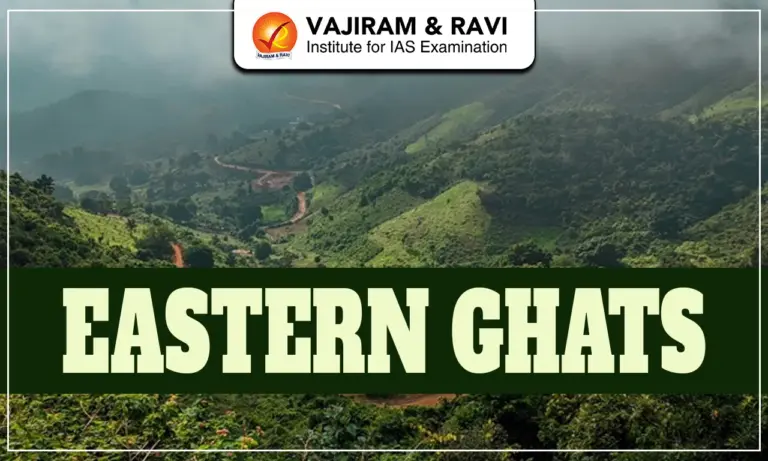
The Eastern Ghats is situated along the eastern coast of India stretching about 1750 km. It covers five states under the area roughly measuring to 160,000 km². It is a discontinuous chain of hills. The average elevation is around 600 m with the highest peak being Arma Konda (1,680 m). The geological uniqueness, ecological importance, and role as watershed for major rivers make it a crucial feature of peninsular India.
Eastern Ghats
The Eastern Ghats extend from north of the Mahanadi River in Odisha to the Vaigai River in Tamil Nadu in the south. It covers the states including Odisha, Andhra Pradesh, Telangana, Karnataka, and Tamil Nadu. Its width varies between 100-200 km. The eastern region slopes toward the Bay of Bengal, while the western region connects to the Deccan Plateau. The Ghats are characterised by a discontinuous, fragmented structure, with multiple hill blocks separated by major river valleys.
Eastern Ghats Geography
The Eastern Ghats are among India’s oldest mountain formations, with complex geological history.
- The range lies roughly between latitudes 18° 13′ 41” N, and longitudes about 82° 43′ 23” E.
- They are Precambrian (Archeozoic era) fold mountains, originally part of ancient continental assemblies.
- The primary rock types are charnockite, khondalite, granite, quartzite, calcium silicate and metamorphic rocks.
- The terrain shows many faults, thrusts and strike-slip movements, indicating tectonic reworking over geological time.
- Mineral deposits such as iron ore, bauxite, limestone and other minerals occur in various hill ranges.
- The soils found in the eastern ghats region are majorly Red, Black, Laterite and Alluvial.





Eastern Ghats Divisions
The Eastern Ghats can be broadly divided into northern, central, and southern segments:
- Northern section (Odisha): from Mahanadi basin to Andhra border; includes Similipal, Garhjat, Niyamgiri, with heights 900-1400 m and significant mineral wealth.
- Central section (Andhra Pradesh & Telangana): two parallel ranges separated by a 160 km gorge through which Godavari and Krishna flow; average height ~ 520 m.
- Southern section (Karnataka & Tamil Nadu): appears as fragmented hills (Nallamala, Javadi, Shevaroy etc.), with lower elevation and gentle slopes, merging into Nilgiri Hills where they meet Western Ghats.
Eastern Ghats Mountain Ranges
The discontinuous hills and plateaus form the notable ranges and peaks of Eastern Ghats including several important hill clusters.
- Major ranges of the Northern region of the Ghats include Similipal, Garhjat, Gandhamardan, Niyamgiri and Deomali (Odisha).
- Important ranges covering the Central to Southern region of the Ghats are: Nallamala, Veligonda, Palakonda, Javadi, Melagiri, Kambakkam, etc. (Andhra Pradesh/ Tamil Nadu/ Karnataka).
- The discontinuous nature is especially visible between the Godavari and Krishna rivers, where the hills nearly vanish, giving way to plateaus and Gondwana basins.
- Major Peaks of Eastern Ghats: Arma Konda (1,680 m) highest in Andhra Pradesh’s Araku Valley sector of Eastern Ghats; Mahendragiri (≈1,501 m) in Odisha’s northern section.
Eastern Ghats Rivers
Eastern Ghats have several important east-flowing rivers and tributaries as mentioned below:
- Major peninsular rivers: Godavari, Krishna, Mahanadi, and Kaveri cross the Ghats and drain into the Bay of Bengal.
- Numerous smaller rivers and streams originating in or passing through Eastern Ghats include Nagavali, Vamsadhara, Sabari, Champavathi, Penna, Gundlakamma, Swarnamukhi, etc.
- Many rivers have carved deep gorges and valleys through the Ghats, e.g. Godavari gorge (~ 65 km wide) between hills, facilitating river flow and creating unique topography.
- These rivers contribute significantly to irrigation, hydropower, and water supply for eastern coastal plains and Deccan region.
- The region also consists of numerous wetlands and large coastal lagoons eg: Chilika, Kolleru and Pulicat Lake.
Eastern Ghats Environment
The climate, rainfall and vegetation across Eastern Ghats reflect its fragmented terrain:
- The climate is generally tropical to subtropical, with hot, humid summers (up to 44 °C) and moderate winters (~20 to 25 °C).
- Rainfall distribution varies: northern hills receive 120-150 cm, southern sections 60-110 cm, largely from monsoon and occasional cyclones.
- Vegetation types include nine major forest categories: tropical evergreen, semi-evergreen, moist deciduous, northern dry deciduous, southern dry deciduous, thorn scrub, dry savannah, riverine forests and dry evergreen forests depending on altitude and rainfall.
- Evergreen patches occur in limited pockets (e.g. Shevaroy hills, parts of northern Andhra), while dry deciduous and scrub dominate in low rainfall or degraded zones.
Eastern Ghats Biodiversity
Eastern Ghats is ecologically rich with many endemic species and important protected areas.
- The Ghats harbour about 4500 flowering plant species, representing ~13% of India’s flowering plants.
- Commercial Tree species found are: Indian Rosewood, Teak, Mahogany and Red Sandalwood.
- Fauna includes Bengal tiger, Indian elephant, Indian wild dog, leopard, nilgai, Indian vulture, Indian bustards, Indian golden gecko, along with other species nearly 100 mammals, 425 birds, 99 reptiles,100 amphibians, 155 fishes and several diverse insects.
- Critically endangered and endemic species such as the Jerdon’s courser and several rare reptiles and amphibians are unique to Eastern Ghats.
- Protected areas include national parks, wildlife and bird sanctuaries, tiger & elephant reserves, spread across states, supporting conservation of Ghats biodiversity.
Eastern Ghats Significance
The Eastern Ghats play multiple roles including ecological, hydrological, cultural and economic as given below:
- They serve as a watershed for major east-flowing rivers which irrigate coastal plains and support agriculture.
- It provides minerals (iron ore, bauxite) supporting mining and industry sectors.
- It supports forest-based livelihoods of tribal and rural communities; forest produce, non-timber forest produce, traditional medicine sources.
- It acts as a biodiversity hotspot, preserving endemic species and ecological balance.
- It offers potential for ecotourism, trekking and sustainable development, linking culture, environment and economy.
Eastern Ghats Challenges
Human pressures and ecological changes pose serious threats to Eastern Ghats. The major challenges faced by the Eastern Ghats are:
- Deforestation and habitat loss due to logging, mining, shifting cultivation, monoculture plantations and illegal encroachments have degraded forests and biodiversity.
- Loss of biodiversity: endemic species under threat from habitat fragmentation and unsustainable exploitation.
- Decline in traditional livelihoods for tribal communities as forest produce collection reduces and forest-based income sources shrink.
- Mining and quarrying impacts: extraction of bauxite, iron ore and other minerals leading to soil degradation, deforestation, water pollution and ecological imbalance.
- Poor enforcement of protection laws and lack of community involvement, weakening conservation efforts.
Eastern Ghats Conservation
Effective conservation of Eastern Ghats requires integrated ecological, social and policy measures. The major steps that can be taken and have been carried out for the conservation of the biodiversity and environment of ghats are:
- Protected Area Expansion: Declare and expand protected areas: national parks, wildlife sanctuaries, biosphere reserves, including corridor conservation to support wildlife movement. Eg: Inclusion of Koundinya WLS, Sri Venkateswara NP, Gundla Brahmeswaram WLS to conserve elephants and endemic flora; supports the Asian Elephant Conservation Project.
- Community-Based Conservation (JFM Model): Promote community-led forest management and sustainable livelihoods for tribal and local communities to reduce pressure on natural resources. Eg: Joint Forest Management committees in Odisha and Andhra Pradesh manage buffer zones showing improvement in canopy density.
- Enforce mining, logging, and land-use regulations strictly, with rehabilitation and ecological restoration plans for degraded areas.
- Encourage sustainable ecotourism and environmental education, balancing development with conservation.
- Eco-Restoration (MoEFCC): Uses assisted natural regeneration, gap planting, and soil–moisture conservation. Applied in Seshachalam Hills to restore degraded Red Sanders forests after the surveys identified rapid decline.
- Special Species-Focused Measures: Formulating a unique measure to protect species, eg: The Andhra Pradesh ‘Red Sanders Anti-Smuggling Task Force’ (RSASTF, 2015) established to curb illegal smuggling and promote restoration with stricter patrol routes and GIS mapping.
- Monitoring: Biodiversity Monitoring (ZSI-BSI Surveys) for long-term species assessment across Similipal, Satkosia, Papikonda; Geospatial Monitoring (NRSC Hyderabad) for satellite-based tracking of forest fragmentation.

 Last updated on April, 2026
→ UPSC Final Result 2025 is now out.
→ UPSC has released UPSC Toppers List 2025 with the Civil Services final result on its official website.
→ Anuj Agnihotri secured AIR 1 in the UPSC Civil Services Examination 2025.
→ UPSC Marksheet 2025 is now out.
→ UPSC Notification 2026 & UPSC IFoS Notification 2026 is now out on the official website at upsconline.nic.in.
→ UPSC Calendar 2026 has been released.
→ Check out the latest UPSC Syllabus 2026 here.
→ UPSC Prelims 2026 will be conducted on 24th May, 2026 & UPSC Mains 2026 will be conducted on 21st August 2026.
→ The UPSC Selection Process is of 3 stages-Prelims, Mains and Interview.
→ Prepare effectively with Vajiram & Ravi’s UPSC Prelims Test Series 2026 featuring full-length mock tests, detailed solutions, and performance analysis.
→ Enroll in Vajiram & Ravi’s UPSC Mains Test Series 2026 for structured answer writing practice, expert evaluation, and exam-oriented feedback.
→ Join Vajiram & Ravi’s Best UPSC Mentorship Program for personalized guidance, strategy planning, and one-to-one support from experienced mentors.
→ Shakti Dubey secures AIR 1 in UPSC CSE Exam 2024.
→ Also check Best UPSC Coaching in India
Eastern Ghats FAQs
Q1. What is the major threat to the Eastern Ghats?+
Q2. Which species are a conservation priority in the Eastern Ghats?+
Q3. Which is the highest peak of Eastern Ghats?+
Q4. Which rivers flow through the Eastern Ghats?+
Q5. What are the protected areas in the Eastern Ghats?+
Tags: eastern ghats