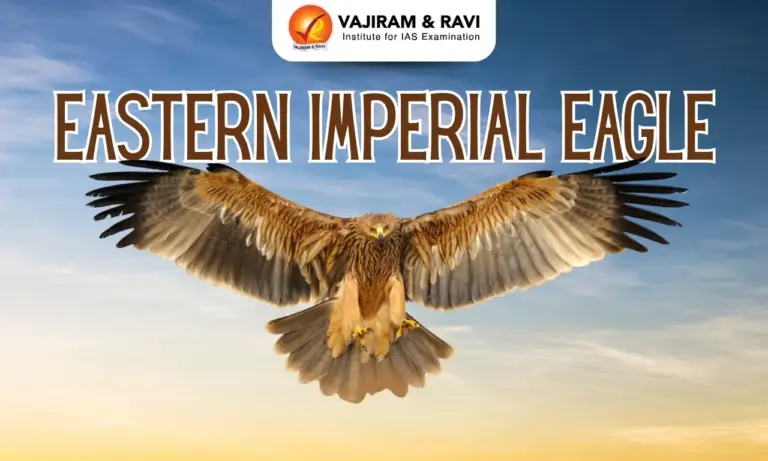
Eastern Imperial Eagle
Wildlife enthusiasts recently confirmed the presence of an Eastern Imperial Eagle visiting the Mudumalai Tiger Reserve (MTR) during the winter migratory season.
About Eastern Imperial Eagle
- It is a large bird of prey.
- Scientific Name: Aquila heliaca





Eastern Imperial Eagle Distribution
- It breeds in southeastern Europe and extensively through West and Central Asia.
- Most populations are migratory and winter in northeastern Africa, the Middle East and South and East Asia.
- Like all eagles, the eastern imperial eagle is a member of the family Accipitridae. Furthermore, its well feathered legs mark it as a member of the subfamily Aquilinae.
Eastern Imperial Eagle Features
- It is the second largest eagle to reside in Europe. It can grow to a length of about 0.92 meters.
- It can have a wingspan approaching 2.14 meters and have a mass of about 3.6 kilograms.
- The species displays reverse sexual dimorphism, as do most birds of prey, in which males are usually smaller than the females.
- Adults are black-brown in color. They have a pale golden crown and nape and a grey base that extends to the tail.
- Like other eagles, they have strong legs and feet. Their feet include long, curved talons that they use to seize, kill, and carry their prey.
- Average lifespan: 56 years
Eastern Imperial Eagle Conservation Status
It is classified as ‘Vulnerable‘ under the IUCN Red List.
Mudumalai Tiger Reserve (MTR)
- It is located in the Nilgiris District of Tamil Nadu, spread over 321 sq. km. at the tri-junction of three states, viz., Karnataka, Kerala, and Tamil Nadu.
- It lies on the northeastern and northwestern slopes of the Nilgiri hills, which is a part of the Western Ghats.
- It is part of the Nilgiris Biosphere Reserve, the first biosphere reserve in India.
- The name Mudumalai means ”the ancient hill range”. Indeed, it is as old as 65 million years, when the Western Ghats were formed.
- Habitat: A variety of habitats ranging from tropical evergreen forest, moist deciduous forest, moist teak forest, dry teak forest, secondary grasslands, and swamps are found here.
- River: The Moyar River runs through the reserve.
- The Oscar-winning ‘Elephant Whisperers’ was filmed at the Theppakadu Elephant Camp, located inside the Mudumalai Tiger Reserve.
- Flora:
- It has tall grasses, commonly referred to as “Elephant Grass”, bamboo of the giant variety, and valuable timber species like teak, rosewood, etc.
- It has wild relatives of cultivated plants, viz., wild rice, ginger, turmeric, cinnamon, etc.
- The habitat also has swampy areas (Vayals) and grasslands.
- Fauna:
- The faunal assemblage includes: elephant, gaur, sambar, four-horned antelope, spotted deer, barking deer, blackbuck, wild pig, mouse deer, and predators like tigers, leopards, and wild dogs.
- Around 8% of the total bird species in India can be found in the region.
Source: TH

 Last updated on March, 2026
→ UPSC Final Result 2025 is now out.
→ UPSC has released UPSC Toppers List 2025 with the Civil Services final result on its official website.
→ Anuj Agnihotri secured AIR 1 in the UPSC Civil Services Examination 2025.
→ UPSC Marksheet 2025 is now out.
→ UPSC Notification 2026 & UPSC IFoS Notification 2026 is now out on the official website at upsconline.nic.in.
→ UPSC Calendar 2026 has been released.
→ Check out the latest UPSC Syllabus 2026 here.
→ UPSC Prelims 2026 will be conducted on 24th May, 2026 & UPSC Mains 2026 will be conducted on 21st August 2026.
→ The UPSC Selection Process is of 3 stages-Prelims, Mains and Interview.
→ Prepare effectively with Vajiram & Ravi’s UPSC Prelims Test Series 2026 featuring full-length mock tests, detailed solutions, and performance analysis.
→ Enroll in Vajiram & Ravi’s UPSC Mains Test Series 2026 for structured answer writing practice, expert evaluation, and exam-oriented feedback.
→ Join Vajiram & Ravi’s Best UPSC Mentorship Program for personalized guidance, strategy planning, and one-to-one support from experienced mentors.
→ Shakti Dubey secures AIR 1 in UPSC CSE Exam 2024.
→ Also check Best UPSC Coaching in India
Eastern Imperial Eagle FAQs
Q1. Where does the Eastern Imperial Eagle primarily breed?+
Q2. Where do most populations of the Eastern Imperial Eagle winter?+
Q3. What are the typical colours of the adult Eastern Imperial Eagle?+
Q4. What is the IUCN Red List status of the Eastern Imperial Eagle?+
Tags: eastern imperial eagle