Eastern Nagaland Autonomy Latest News
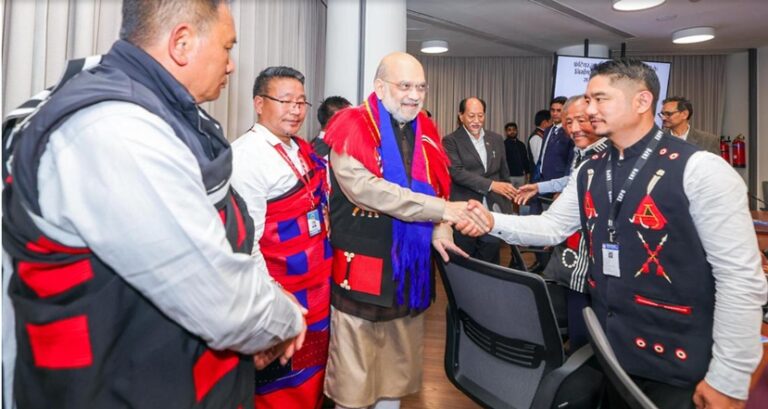
- Recently, the Centre signed a tripartite agreement with the Nagaland Government and the Eastern Nagaland Peoples’ Organisation (ENPO) to establish the Frontier Nagaland Territorial Authority (FNTA).
- The FNTA is designed as a model of “devolutionary autonomy”, granting substantial administrative and financial powers to six relatively underdeveloped eastern districts — Kiphire, Longleng, Mon, Noklak, Shamator, and Tuensang.
- The aim of this devolution is to address long-standing demands for greater self-governance and focused development.
ENPO’s Demand for a Separate Frontier Nagaland
- ENPO has long demanded the creation of a separate State called Frontier Nagaland, carved out of existing Nagaland.
- First formally conveyed to the Centre in 2010, the demand stems from historical neglect dating back to British-era policies that left the eastern hills largely unadministered.
- After Nagaland became a State in 1963, eight Naga tribes in the eastern districts felt politically and economically marginalised compared to western tribes.
- This perceived developmental and administrative imbalance gradually intensified into a sustained movement for greater autonomy and, ultimately, statehood.





Why the Centre Accepted the Eastern Nagaland Autonomy Demand
- The Centre’s move to grant autonomy through the Frontier Nagaland Territorial Authority (FNTA) was shaped by both political pressure and strategic concerns.
- Earlier measures, including a ₹500-crore package and standard operating procedures, failed to address the deeper political aspirations of the ENPO region.
- Tensions peaked in 2024 when ENPO leaders called for a Lok Sabha election boycott, highlighting their significant political leverage.
- Additionally, eastern Nagaland’s location along the sensitive Myanmar border made prolonged unrest a security risk, given the presence of armed groups across the porous frontier.
- The FNTA is thus viewed as a stabilising measure — a way to address regional grievances while safeguarding a strategically vital border region.
Frontier Nagaland Territorial Authority (FNTA): Powers and Provisions
- Semi-Autonomous Governance Structure – The FNTA grants semi-autonomous status to six eastern Nagaland districts. A mini-Secretariat, headed by a senior officer, will function within the region to decentralise administration and reduce reliance on Kohima.
- Financial and Administrative Devolution – Development funds will be allocated proportionately based on population and area, with the Ministry of Home Affairs supporting initial establishment costs. This ensures direct financial empowerment of the region.
- Legislative and Executive Authority – The FNTA will exercise powers over 46 subjects, enabling local decision-making in areas such as land use, agriculture, rural development, and infrastructure, tailored to local needs.
- Safeguarding Constitutional Protections – Importantly, the arrangement does not alter Article 371(A), preserving Nagaland’s special constitutional safeguards related to customary laws and social practices.
Can the FNTA Model Address the Kuki-Zo Demand in Manipur
- The FNTA demonstrates that the Centre can create territorial authorities as a compromise between full statehood and regular district administration.
- Structurally, it resembles Manipur’s Hill Areas Committee under Article 371(C), designed to protect tribal interests.
- The model suggests that constitutional innovation can grant autonomy without redrawing State boundaries.
- This raises the possibility that a similar territorial arrangement could address the Kuki-Zo demand for a separate administrative setup.
- However, conditions differ sharply. In Nagaland, negotiations occurred without violent conflict and had the cooperation of Chief Minister. In Manipur, deep ethnic tensions persist, and the Meitei-dominated state government strongly opposes administrative separation.
- The presence of other groups, including the Tangkhul Naga-influenced NSCN, with overlapping claims in hill districts complicates any clean administrative restructuring, making replication of the FNTA model far more challenging.
Source: TH

 Last updated on March, 2026
→ UPSC Final Result 2025 is now out.
→ UPSC has released UPSC Toppers List 2025 with the Civil Services final result on its official website.
→ Anuj Agnihotri secured AIR 1 in the UPSC Civil Services Examination 2025.
→ UPSC Marksheet 2025 is now out.
→ UPSC Notification 2026 & UPSC IFoS Notification 2026 is now out on the official website at upsconline.nic.in.
→ UPSC Calendar 2026 has been released.
→ Check out the latest UPSC Syllabus 2026 here.
→ UPSC Prelims 2026 will be conducted on 24th May, 2026 & UPSC Mains 2026 will be conducted on 21st August 2026.
→ The UPSC Selection Process is of 3 stages-Prelims, Mains and Interview.
→ Prepare effectively with Vajiram & Ravi’s UPSC Prelims Test Series 2026 featuring full-length mock tests, detailed solutions, and performance analysis.
→ Enroll in Vajiram & Ravi’s UPSC Mains Test Series 2026 for structured answer writing practice, expert evaluation, and exam-oriented feedback.
→ Join Vajiram & Ravi’s Best UPSC Mentorship Program for personalized guidance, strategy planning, and one-to-one support from experienced mentors.
→ Shakti Dubey secures AIR 1 in UPSC CSE Exam 2024.
→ Also check Best UPSC Coaching in India
Eastern Nagaland Autonomy FAQs
Q1. What is Eastern Nagaland Autonomy?+
Q2. Why was Eastern Nagaland Autonomy demanded?+
Q3. Why did the Centre agree to Eastern Nagaland Autonomy?+
Q4. What powers does Eastern Nagaland Autonomy provide?+
Q5. Can Eastern Nagaland Autonomy be replicated in Manipur?+
Tags: Eastern Nagaland Autonomy mains articles upsc current affairs upsc mains current affairs