Ebola Outbreak Latest News
The Ebola outbreak in the Democratic Republic of the Congo (DRC) has spread to a sixth province, Bas-Uele, raising concerns over wider transmission. The outbreak has caused more than 2,000 deaths, making it the fastest-growing Ebola outbreak recorded in the country.
About Ebola
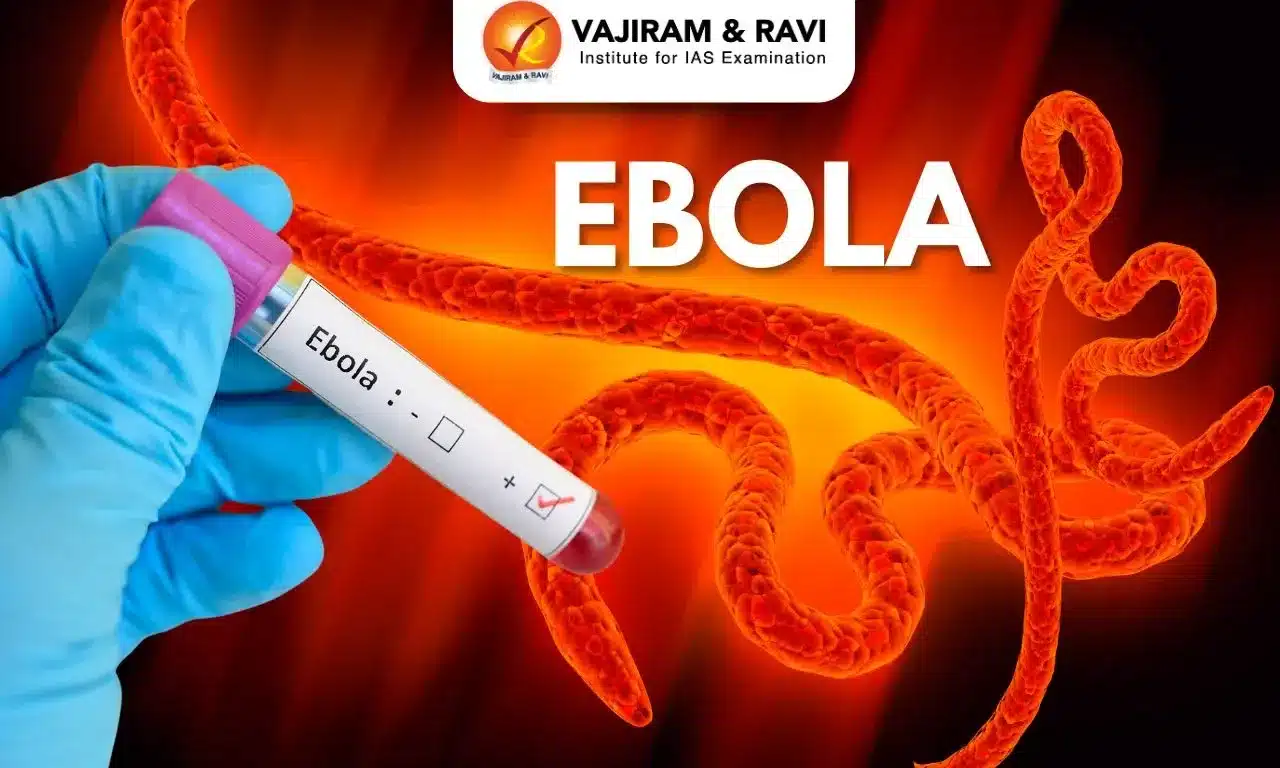
- It is a severe and often deadly viral disease caused by a group of viruses known as orthoebolaviruses (formerly ebolavirus).
- It is a severe contagious disease affecting humans and non-human primates.
- Ebola, first identified in 1976 in southern Sudan and the Democratic Republic of Congo, primarily affects remote villages in Central and West Africa.
- It is known as a hemorrhagic fever virus because it can cause problems with the clotting system of the body and lead to internal bleeding as blood leaks from small blood vessels.


Ebola Transmission
- The virus is transmitted to people from wild animals (such as fruit bats, porcupines, and non-human primates).
- It then spreads in the human population through direct contact with the blood, secretions, organs, or other bodily fluids of infected people and with surfaces and materials contaminated with these fluids.
- Ebola cannot be transmitted by air.
- Infectious period:
- Infected individuals are not contagious during the incubation period and become infectious once they begin to develop symptoms.
- They remain infectious as long as the virus is present in the blood.
Ebola Symptoms
- Incubation period: Typically 5 to 15 days; range is 2 to 21 days.
- Symptoms include fever, diarrhea, vomiting, bleeding, and often, death.
- The average Ebola disease case fatality rate is around 50%. Case fatality rates have varied from 25–90% in past outbreaks.
Ebola Treatment
- There is no known cure for Ebola.
- There are no approved drugs or vaccines available to treat EVD, although experimental vaccines and therapeutics are being tested.
- Recovery seems to depend in part on how much virus a person was initially exposed to, how early treatment is started, and on the patient’s age and immune response.
- Chances of survival can be improved with early supportive care.
- Current therapy consists of maintenance of fluid and electrolyte balance and the administration of blood and plasma to control bleeding.

 Last updated on Oct, 2026
→ UPSC 2027 Notification will be released on 13 January 2027 at upsconline.nic.in.
→ Check Nobel Prize 2026 Winners List here.
→ Download PIB PRiSM Monthly Magazine 2026 here.
→ Check UPSC Monthly Current Affairs Magazine The Recitals here.
→ Check out the latest UPSC Syllabus here.
→ Download UPSC Model Answers for Mains 2026
→ UPSC Mains Question Paper 2026 is out now for Essay & GS Paper 1, 2, 3 & 4.
→ UPSC Calendar 2027 has been released.
→ Enroll in Vajiram & Ravi’s UPSC Mains Test Series 2027 for structured answer writing practice, expert evaluation, and exam-oriented feedback.
→ Join Vajiram & Ravi’s UPSC Mentorship Program 2027 for personalized guidance, strategy planning, and one-to-one support from experienced mentors.
→ Go through the UPSC Mains Previous Year Papers to enhance your preparation.
→ UPSC has released UPSC Toppers List 2025 with the Civil Services final result on its official website.
→ Also check Best UPSC Coaching in India
Ebola FAQs
Q1. What is Ebola?+
Q2. Which organisms are affected by Ebola?+
Q3. Which regions are mainly affected by Ebola outbreaks?+
Q4. How does Ebola spread among humans?+
Q5. Is there a known cure for Ebola?+
Tags: ebola upsc current affairs