Why in News?
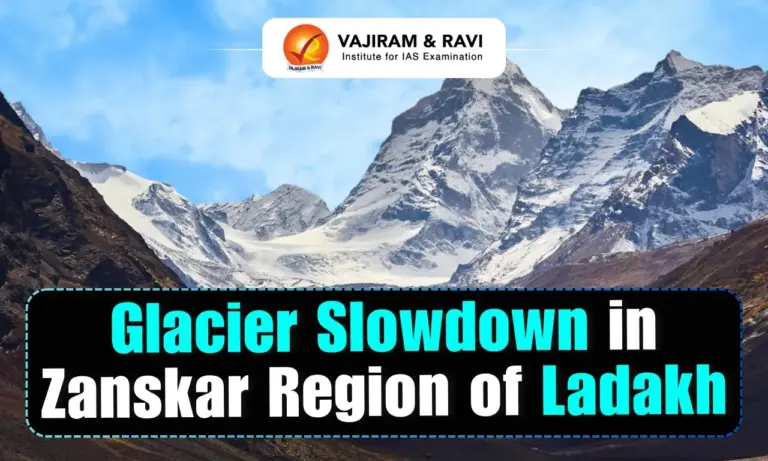
A recent study has found that glaciers in the Zanskar region of Ladakh are slowing down and becoming thinner. Researchers studied 12 glaciers between 1992 and 2023 and found that their average flow speed declined by about 2.43 metres per year per decade.
Key Findings
- The average glacier flow speed fell by around 16% during 1992–2023.
- Glacier surface thinning increased from about 0.22 metres per year in 2000-05 to 0.57 metres per year in 2015-20.
- Warmer temperatures are causing greater ice loss and thinning.
- As glaciers become thinner, the force that moves ice downhill also decreases, leading to slower glacier movement.
Also Read:- Tribes of Ladakh


Why are Zanskar Glaciers Important?
Zanskar is a high-altitude, cold and dry region where rainfall is limited. Snow and glaciers are therefore important sources of water. Glacier melt provides water to rivers, farms, ecosystems and local communities during the warmer months.
Some important glaciers in the region include Drang Drung, Machoi and Parkachik. The meltwater from the Zanskar glacier system contributes to the river network connected with the Indus Basin.
Impact on Water Security
The slowdown and thinning of Zanskar glaciers can affect the long-term availability of meltwater, creating risks for communities, agriculture and ecosystems in the water-scarce Ladakh region.
- Reduced water availability: Less glacier ice may mean lower meltwater supply in the future.
- Agriculture: Irrigation-dependent farming may face water shortages.
- Drinking water: Local communities may experience greater water stress.
- Ecosystems: Changes in river flow can affect mountain biodiversity.
- Downstream regions: Reduced glacier melt may impact water availability in the wider Indus Basin.
Way Forward
There is a need for regular monitoring of Himalayan glaciers through satellite observations and ground-based studies. Better glacier and river-flow data can help predict future water availability and climate-related risks. At the broader level, reducing greenhouse gas emissions and implementing climate adaptation measures are essential to protect the Himalayan cryosphere.

 Last updated on Oct, 2026
→ UPSC 2027 Notification will be released on 13 January 2027 at upsconline.nic.in.
→ Check Nobel Prize 2026 Winners List here.
→ Download PIB PRiSM Monthly Magazine 2026 here.
→ Check UPSC Monthly Current Affairs Magazine The Recitals here.
→ Check out the latest UPSC Syllabus here.
→ Download UPSC Model Answers for Mains 2026
→ UPSC Mains Question Paper 2026 is out now for Essay & GS Paper 1, 2, 3 & 4.
→ UPSC Calendar 2027 has been released.
→ Enroll in Vajiram & Ravi’s UPSC Mains Test Series 2027 for structured answer writing practice, expert evaluation, and exam-oriented feedback.
→ Join Vajiram & Ravi’s UPSC Mentorship Program 2027 for personalized guidance, strategy planning, and one-to-one support from experienced mentors.
→ Go through the UPSC Mains Previous Year Papers to enhance your preparation.
→ UPSC has released UPSC Toppers List 2025 with the Civil Services final result on its official website.
→ Also check Best UPSC Coaching in India
Glacier Slowdown in Zanskar Region of Ladakh FAQs
Q1. What is the glacier slowdown in Zanskar?+
Q2. Why are glaciers in Zanskar slowing down?+
Q3. How much have the Zanskar glaciers thinned?+
Q4. Why are Zanskar glaciers important?+
Q5. What is the impact of glacier slowdown on water security?+
Tags: glacier slowdown in zanskar region of ladakh