About Eco-Sensitive Zones:
- As per the National Wildlife Action Plan (2002-2016), issued by the Union Ministry of Environment, Forest and Climate Change, land within 10 km of the boundaries of national parks and wildlife sanctuaries is to be notified as eco-fragile zones or Eco-Sensitive Zones (ESZ).
- While the 10-km rule is implemented as a general principle, the extent of its application can vary.
- Areas beyond 10-km can also be notified by the Union government as ESZs, if they hold larger ecologically important “sensitive corridors”.
- It acts as buffer zones around Protected Areas — national parks, wildlife sanctuaries, tiger reserves, etc. — so that the wildlife has a transition zone around them.
- Significance of ESZ
- Eco-Sensitive Zones are created as “shock absorbers” for the protected areas, to minimize the negative impact on the “fragile ecosystems” by certain human activities taking place nearby.
- These areas are meant to act as a transition zone from areas requiring higher protection to those requiring lesser protection.
- Permitted activities in ESZ: Ongoing agricultural or horticultural practices, rainwater harvesting, organic farming, among others.
- No commercial mining, stone quarrying, large hydroelectric projects, polluting industries, brick kilns, etc. are allowed in ESZ.
- Commercial establishment of hotels, resorts, small-scale non-polluting industries and the construction of civic amenities are regulated.
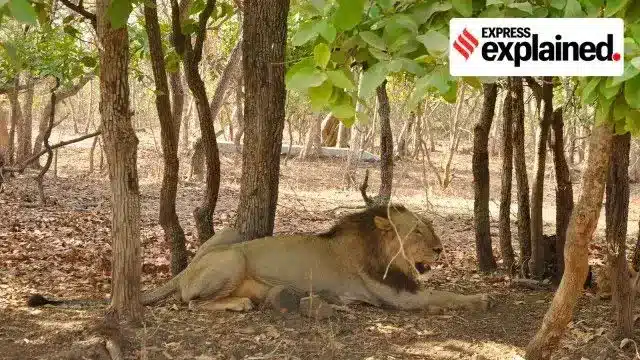
What makes Gir unique?
- Gir PA includes the Gir National Park, the Gir Wildlife Sanctuary, the Paniya Wildlife Sanctuary and the Mitiyala Wildlife Sanctuary, spread across the Junagadh, Amreli and Gir Somnath districts in Gujarat’s Saurashtra region in its south.
Q1: What are protected areas?
These are specifically delineated areas designated and managed to achieve the conservation of nature and the maintenance of associated ecosystem services and cultural values through legal or other effective means.
Source: Why a proposed Eco-Sensitive Zone around Gir forest is facing protests





 Last updated on April, 2026
→ UPSC Final Result 2025 is now out.
→ UPSC has released UPSC Toppers List 2025 with the Civil Services final result on its official website.
→ Anuj Agnihotri secured AIR 1 in the UPSC Civil Services Examination 2025.
→ UPSC Marksheet 2025 is now out.
→ UPSC Notification 2026 & UPSC IFoS Notification 2026 is now out on the official website at upsconline.nic.in.
→ UPSC Calendar 2026 has been released.
→ Check out the latest UPSC Syllabus 2026 here.
→ UPSC Prelims 2026 will be conducted on 24th May, 2026 & UPSC Mains 2026 will be conducted on 21st August 2026.
→ The UPSC Selection Process is of 3 stages-Prelims, Mains and Interview.
→ Prepare effectively with Vajiram & Ravi’s UPSC Prelims Test Series 2026 featuring full-length mock tests, detailed solutions, and performance analysis.
→ Enroll in Vajiram & Ravi’s UPSC Mains Test Series 2026 for structured answer writing practice, expert evaluation, and exam-oriented feedback.
→ Join Vajiram & Ravi’s Best UPSC Mentorship Program for personalized guidance, strategy planning, and one-to-one support from experienced mentors.
→ Shakti Dubey secures AIR 1 in UPSC CSE Exam 2024.
→ Also check Best UPSC Coaching in India