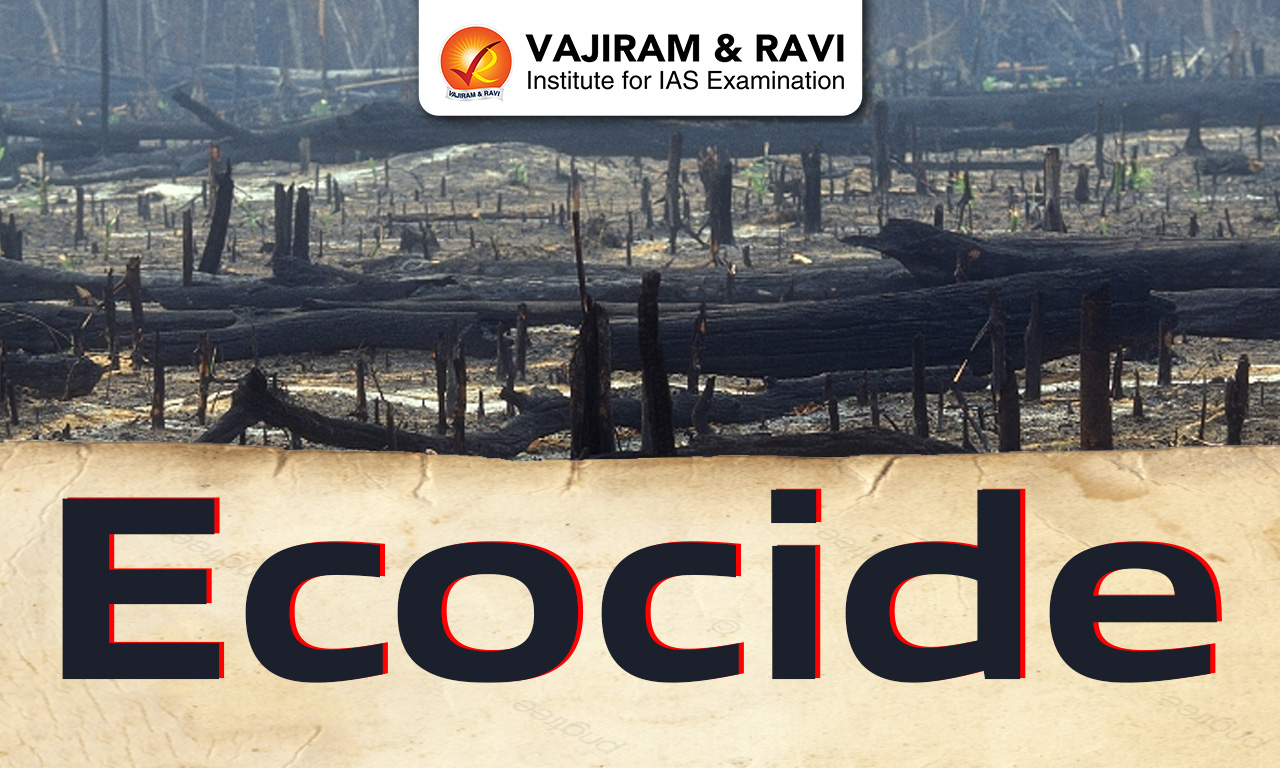
Ecocide refers to large-scale damage or destruction of the natural environment caused by human activities. It includes actions like deforestation, pollution, oil spills, and overuse of natural resources that harm ecosystems and living beings. In simple terms, it means causing serious harm to nature. The idea of ecocide is becoming important today as people and countries are discussing whether such environmental damage should be treated as a serious crime. It highlights the need to protect the Earth and ensure a safe and healthy environment for present and future generations.
About Ecocide
- The term Ecocide comes from Greek and Latin words, meaning “killing our home,” which highlights the idea that harming nature is like harming the Earth we live in.
- It is used to describe situations where nature is damaged to such an extent that ecosystems stop functioning properly.
- At present, there is no universally accepted legal definition of ecocide at the global level.
- In 2021, a group of legal experts supported by the Stop Ecocide Foundation proposed a clear definition to bring ecocide into international law.
- According to their proposal, ecocide includes unlawful or careless actions done with the knowledge that they can cause serious, widespread, or long-term environmental harm.
- It disturbs the natural balance of the environment, making it difficult for life to survive and grow.
- The impact of ecocide is not limited to humans; it affects all living beings, including animals, plants, and future generations.
Historical Background of Ecocide
- The idea of ecocide first gained attention in 1970, when biologist Arthur Galston linked environmental destruction with genocide, a recognised international crime. He raised this issue while speaking about the harmful use of Agent Orange by the U.S. military during the Vietnam War.
- In 1972, Olof Palme spoke at the United Nations and warned that rapid and uncontrolled industrial growth could cause serious and permanent damage to the environment.
- In 2010, British lawyer Polly Higgins strongly pushed for ecocide to be recognised as an international crime by the International Criminal Court. She argued that harming nature on a large scale should be treated as seriously as other global crimes.
- At present, the Rome Statute of the ICC recognises only four major international crimes: genocide, crimes against humanity, war crimes, and the crime of aggression.
- Among these, only the war crimes provision can deal with environmental damage, and even that applies only when such harm is intentionally caused during armed conflict.
- The Stop Ecocide Foundation has played an important role in recent years by proposing a clear legal definition of ecocide, describing it as actions taken with the knowledge that they can cause serious and long-lasting harm to the environment.


India’s Position on Ecocide
- India has not officially recognised ecocide as a crime and has neither signed nor ratified the Rome Statute of the International Criminal Court.
- However, India supports environmental protection by being part of global agreements like the Convention on Biological Diversity, United Nations Framework Convention on Climate Change, and Convention on International Trade in Endangered Species of Wild Fauna and Flora.
- At the national level, India has several laws such as the Environment Protection Act (1986), Wildlife Protection Act (1972), and CAMPA Act (2016) to protect the environment.
- These laws are separate and not unified, and experts believe they should be combined into a single, clear framework for better environmental governance.
- The National Green Tribunal, which handles environmental cases, has limited powers and cannot deal with some important forest and wildlife laws.
- Indian courts have sometimes used the term “ecocide”, but it is not yet a formal legal concept in the country. For example, in the T.N. Godavarman Thirumulpad vs Union of India, the Supreme Court stressed the need to move from a human-centred (anthropocentric) to a nature-centred (ecocentric) approach.
- In another case, Chandra CFS and Terminal Operators Pvt. Ltd. v. Commissioner of Customs, the court noted ongoing environmental damage due to activities like illegal timber removal.
- Recent changes like the Forest Conservation (Amendment) Act, 2023 and Biodiversity (Amendment) Act, 2023 have raised concerns about weakening environmental protections and possible loss of forest cover.
- A major issue in India is fixing responsibility and compensation for environmental damage, as seen in cases like the Bhopal Gas Tragedy, where victims are still seeking justice.
Arguments in Favour of Criminalising Ecocide
- Protecting nature for its own value: Ecosystems like forests, rivers, and oceans have developed over millions of years. Ecocide laws recognise that nature should be protected not just for human use, but for its own existence and balance.
- Filling a legal gap: At present, many environmental harms are not treated as serious crimes. Making ecocide a crime helps give stronger legal protection to the environment and holds people accountable.
- Justice for future generations: Supporters believe that destroying nature today creates a “biodiversity debt” for future generations. Criminalising ecocide ensures that we leave a safe and healthy planet for the future.
- Helping fight climate change: Many harmful activities like deforestation and excessive fossil fuel use contribute to climate change. Ecocide laws can help directly target and reduce such actions.
- Stronger accountability: If ecocide becomes a crime, individuals, companies, and governments can be legally punished for causing large-scale environmental damage, making them more responsible.
- Growing global support: Several countries have already recognised ecocide as a crime, and many others are considering it. This shows a rising global awareness about protecting the environment.
- Voice for vulnerable countries: Smaller and developing nations, which suffer the most from climate change, are pushing for ecocide laws to ensure justice and global responsibility.
- Global legal recognition efforts: Some countries are urging bodies like the International Criminal Court to officially include ecocide as an international crime, similar to genocide or war crimes.
- Encourages responsible development: Recognising ecocide as a crime can push countries and industries to follow sustainable and eco-friendly practices instead of harmful ones.
Arguments Against Criminalising Ecocide
- Development vs environment concern: Critics argue that ecocide laws may slow down essential development projects by labeling them harmful, even when they are meant for public welfare, as seen in debates like the Great Nicobar Project.
- Sovereignty issues: Countries may see ecocide laws as external interference in their domestic policies, limiting their freedom to use natural resources for national growth.
- Legal ambiguity: There is no universally accepted definition of ecocide yet, which can lead to confusion and inconsistent interpretation in courts.
- Enforcement difficulties: Monitoring and proving “large-scale environmental harm” across countries can be complex and costly, making enforcement weak.
- Impact on research and innovation: Strict liability fears may discourage scientific studies, environmental experiments, and industrial innovation.
- Existing laws already present: Many argue that environmental protection can be handled through stronger implementation of existing laws instead of creating a new global crime.
- Risk of misuse: There are concerns that ecocide laws could be misused for political or economic pressure against certain countries or industries.
Countries Recognising Ecocide Laws
- Several countries have already included ecocide-related provisions in their domestic laws, focusing on large-scale environmental destruction such as damage to forests, wildlife, and ecosystems.
- The idea first gained legal recognition in Vietnam (1990), making it the first country to criminalise ecocide-type acts in its national law.
- Later, many post-Soviet countries also adopted similar legal provisions, expanding the idea across Eastern Europe and Central Asia.
- Countries with existing or active ecocide-related laws include Armenia, Belarus, Belgium, Chile, Ecuador, France, Georgia, Kazakhstan, Kyrgyzstan, Moldova, Russia, Tajikistan, Ukraine, Uzbekistan, and Vietnam.
- A major recent development is that Belgium (2024) became the first European country to formally recognise ecocide in its penal code, including liability for major decision-makers responsible for environmental destruction.
- Some countries are now in the process of introducing or discussing ecocide laws, showing growing global interest in the idea.
- Countries such as Scotland, Brazil, Spain, Italy, Mexico, and the Netherlands are actively considering or drafting legislation related to ecocide.

 Last updated on Oct, 2026
→ UPSC 2027 Notification will be released on 13 January 2027 at upsconline.nic.in.
→ Check Nobel Prize 2026 Winners List here.
→ Download PIB PRiSM Monthly Magazine 2026 here.
→ Check UPSC Monthly Current Affairs Magazine The Recitals here.
→ Check out the latest UPSC Syllabus here.
→ Download UPSC Model Answers for Mains 2026
→ UPSC Mains Question Paper 2026 is out now for Essay & GS Paper 1, 2, 3 & 4.
→ UPSC Calendar 2027 has been released.
→ Enroll in Vajiram & Ravi’s UPSC Mains Test Series 2027 for structured answer writing practice, expert evaluation, and exam-oriented feedback.
→ Join Vajiram & Ravi’s UPSC Mentorship Program 2027 for personalized guidance, strategy planning, and one-to-one support from experienced mentors.
→ Go through the UPSC Mains Previous Year Papers to enhance your preparation.
→ UPSC has released UPSC Toppers List 2025 with the Civil Services final result on its official website.
→ Also check Best UPSC Coaching in India
Ecocide FAQs
Q1. What is ecocide?+
Q2. Is there a global legal definition of ecocide?+
Q3. What is the historical background of ecocide?+
Q4. What is India’s position on ecocide?+
Q5. Why should ecocide be criminalised?+
Tags: ecocide environment environment notes