What’s in Today’s Article?
- Einstein Ring Latest News
- NGC 6505
- Einstein Ring
- Need to Study Einstein Rings
- Einstein Ring FAQs
Einstein Ring Latest News
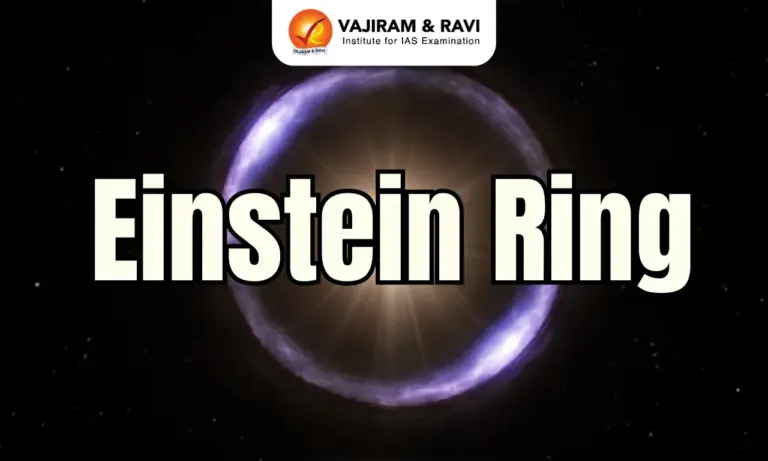
- The European Space Agency’s (ESA) Euclid space telescope has discovered a rare Einstein ring around the galaxy NGC 6505, located 590 million light-years from Earth.
- Captured in September 2023 and released recently, the images show a bright central galaxy encircled by a luminous ring.
- Astronomers have described the find as extraordinary and lucky, highlighting its significance in Euclid’s early data.





NGC 6505
- NGC 6505 is an elliptical galaxy classified as E/S0, located in the Draco constellation in the northern celestial hemisphere.
- Draco is a constellation in the northern sky that looks like a dragon.
- It’s the ninth largest constellation and is visible for most of the year from the Northern Hemisphere.
- It lies about 608 million light-years from the Milky Way and has a diameter of 190,000 light-years.
- Discovered by Lewis A. Swift in 1884, it gained significance in 2025 when the Euclid Space Telescope detected a complete Einstein ring surrounding it.
Einstein Ring
- An Einstein ring is a circular ring of light formed around a galaxy, dark matter, or a cluster of galaxies due to gravitational lensing.
- Gravitational lensing occurs when a massive celestial object, like a galaxy or galaxy cluster, bends and amplifies the light from a more distant object behind it but along the same line of sight.
- The object causing the light to bend is called a gravitational lens.

The Recently Discovered Einstein Ring
- In the case of the Einstein ring found by ESA’s Euclid telescope, the galaxy NGC 6505 acted as the gravitational lens, distorting and magnifying the light from a distant unnamed galaxy located 4.42 billion light-years away.
Rarity and Discovery of Einstein Rings
- Einstein rings were predicted by Albert Einstein’s general theory of relativity.
- The first one was discovered in 1987, and while several more have been found, their total number remains unknown.
- They are extremely rare, with less than 1% of galaxies having an Einstein ring.
- These rings are not visible to the naked eye and can only be observed through space telescopes like Euclid.
Need to Study Einstein Rings
- Understanding Dark Matter – Einstein rings help study dark matter, which makes up 85% of the universe but cannot be directly detected. Gravitational lensing allows scientists to observe its effects.
- Studying Distant Galaxies – These rings magnify galaxies that would otherwise be invisible, providing insights into their structure and composition.
- Exploring Universe Expansion – By analyzing light from both foreground and background galaxies, Einstein rings help scientists understand how the universe is expanding over time.
- Bridging Science with Everyday Life – The principles of gravitational lensing have applications in medical imaging, optical lens design, and telecommunications.
- Computational models used in analyzing cosmic distortions also contribute to AI, machine learning, and big data analytics, influencing diverse fields like finance, climate science, and urban planning.
Einstein Ring FAQs
Q1. What is the Einstein ring?
Ans. An Einstein ring is a circular light pattern formed due to gravitational lensing by a massive celestial object.
Q2. What causes an Einstein ring?
Ans. An Einstein ring occurs when light from a distant galaxy is bent perfectly around a massive foreground object, creating a circular shape.
Q3. What does the Draco constellation represent?
Ans. The Draco constellation represents a dragon and is one of the largest constellations in the northern celestial hemisphere.
Q4. What is gravitational lensing?
Ans. Gravitational lensing is the bending of light by a massive object, magnifying and distorting the appearance of background celestial bodies.
Q5. Do black holes cause gravitational lensing?
Ans. Yes, black holes can act as gravitational lenses, bending and magnifying light from objects behind them due to their immense gravity.

 Last updated on April, 2026
→ UPSC Final Result 2025 is now out.
→ UPSC has released UPSC Toppers List 2025 with the Civil Services final result on its official website.
→ Anuj Agnihotri secured AIR 1 in the UPSC Civil Services Examination 2025.
→ UPSC Marksheet 2025 is now out.
→ UPSC Notification 2026 & UPSC IFoS Notification 2026 is now out on the official website at upsconline.nic.in.
→ UPSC Calendar 2026 has been released.
→ Check out the latest UPSC Syllabus 2026 here.
→ UPSC Prelims 2026 will be conducted on 24th May, 2026 & UPSC Mains 2026 will be conducted on 21st August 2026.
→ The UPSC Selection Process is of 3 stages-Prelims, Mains and Interview.
→ Prepare effectively with Vajiram & Ravi’s UPSC Prelims Test Series 2026 featuring full-length mock tests, detailed solutions, and performance analysis.
→ Enroll in Vajiram & Ravi’s UPSC Mains Test Series 2026 for structured answer writing practice, expert evaluation, and exam-oriented feedback.
→ Join Vajiram & Ravi’s Best UPSC Mentorship Program for personalized guidance, strategy planning, and one-to-one support from experienced mentors.
→ Shakti Dubey secures AIR 1 in UPSC CSE Exam 2024.
→ Also check Best UPSC Coaching in India