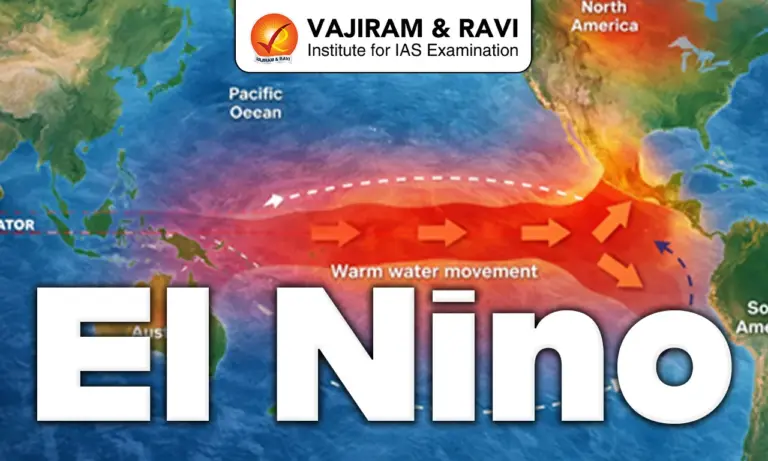
El Nino is a natural climate phenomenon in which the surface water of the central and eastern Pacific Ocean becomes warmer than usual. This warming disrupts normal weather patterns across the world, leading to extreme events such as droughts, floods, and heatwaves.
The term “El Nino” means “The Little Boy” in Spanish, as it was first noticed by fishermen near South America around Christmas time. It is part of a larger climate system called the El Nino-Southern Oscillation (ENSO), which also includes its opposite phase, La Nina.
El Nino Formation
El Nino develops when the normal ocean-atmosphere system of the Pacific Ocean gets disturbed due to changes in wind patterns and heat distribution, leading to large-scale climatic impacts across the globe.
- Weakening of Trade Winds: The easterly trade winds, which normally push warm water toward the western Pacific, lose strength or may even reverse direction.
- Eastward Movement of Warm Water: Warm surface water accumulated near Asia and Australia starts flowing back toward the central and eastern Pacific Ocean.
- Reduction in Upwelling: The usual rise of cold, nutrient-rich water along the western coast of South America decreases significantly, affecting ocean productivity.
- Increase in Sea Surface Temperature (SST): The central and eastern Pacific Ocean experience abnormal warming, which is the core feature of El Nino.
- Shift in Convection Zone: The region of rising warm air and cloud formation moves eastward, changing rainfall patterns across the Pacific.
- Disturbance in Atmospheric Circulation: The Walker Circulation weakens or shifts, disrupting the balance between ocean and atmosphere.
- Change in Pressure Systems: The pressure difference between the eastern and western Pacific reduces, influencing global wind systems.
- Alteration of Jet Streams: The Pacific jet stream shifts its path, affecting weather patterns in different parts of the world.
Also Read: Primary Winds
El Nino and Indian Monsoon
El Nino has a strong and often negative impact on the Indian monsoon, which is crucial for agriculture, water supply, and the overall economy. When El Nino develops, the warming of the Pacific Ocean weakens the monsoon circulation over India, leading to reduced rainfall and increased chances of drought.
- Weak Monsoon Winds: El Nino reduces the strength of southwest monsoon winds, leading to less moisture transport toward India.
- Deficient Rainfall: Many regions experience below-normal rainfall, especially during strong El Nino years.
- Increased Drought Risk: Lower rainfall increases the chances of drought, particularly in central and northwestern India.
- Rise in Temperature: Reduced cloud cover and rainfall lead to higher temperatures and heatwave conditions.
- Agricultural Impact: Crop yields decline due to insufficient water, affecting food production and farmer income.
- Water Scarcity: Reservoir levels, groundwater, and rivers receive less recharge, causing water shortages.
- Regional Variability: While most areas face deficit rainfall, some regions may still receive normal or even excess rain due to local factors.





Global Impact of El Nino
El Nino significantly alters global weather systems by redistributing heat and moisture across the Pacific Ocean. This leads to widespread climatic disturbances such as floods, droughts, and temperature extremes in different parts of the world.
eastern Pacific Ocean.
- Australia and Indonesia: Face severe drought conditions and increased risk of forest fires due to reduced rainfall.
- North America: Southern regions (like California) may receive heavy rainfall, while northern areas experience warmer winters.
- Asia: Countries like India may face weak monsoon and drought-like conditions, while Southeast Asia also sees reduced rainfall.
- Africa: Eastern Africa often receives above-normal rainfall causing floods, while Southern Africa may experience drought.
- Global Temperature Rise: El Nino years are generally warmer, contributing to short-term global warming spikes.
- Marine Ecosystem Impact: Reduced upwelling affects fish populations, especially along the South American coast.
- Coral Bleaching: Warmer ocean temperatures lead to widespread coral bleaching events in tropical oceans.
- Cyclone/Hurricane Patterns: Decreases Atlantic hurricanes but may increase cyclone activity in the Pacific.
- Agriculture Impact: Crop yields decline in drought-affected regions, while floods damage crops elsewhere.
- Water Resources: Causes water scarcity in some regions and excess water in others, disrupting supply systems.
- Economic Losses: Leads to global economic impacts due to damage to agriculture, fisheries, and infrastructure.

 Last updated on April, 2026
→ UPSC Final Result 2025 is now out.
→ UPSC has released UPSC Toppers List 2025 with the Civil Services final result on its official website.
→ Anuj Agnihotri secured AIR 1 in the UPSC Civil Services Examination 2025.
→ UPSC Marksheet 2025 is now out.
→ UPSC Notification 2026 & UPSC IFoS Notification 2026 is now out on the official website at upsconline.nic.in.
→ UPSC Calendar 2026 has been released.
→ Check out the latest UPSC Syllabus 2026 here.
→ UPSC Prelims 2026 will be conducted on 24th May, 2026 & UPSC Mains 2026 will be conducted on 21st August 2026.
→ The UPSC Selection Process is of 3 stages-Prelims, Mains and Interview.
→ Prepare effectively with Vajiram & Ravi’s UPSC Prelims Test Series 2026 featuring full-length mock tests, detailed solutions, and performance analysis.
→ Enroll in Vajiram & Ravi’s UPSC Mains Test Series 2026 for structured answer writing practice, expert evaluation, and exam-oriented feedback.
→ Join Vajiram & Ravi’s Best UPSC Mentorship Program for personalized guidance, strategy planning, and one-to-one support from experienced mentors.
→ Shakti Dubey secures AIR 1 in UPSC CSE Exam 2024.
→ Also check Best UPSC Coaching in India
El Nino FAQs
Q1. What is El Nino?+
Q2. What causes El Nino?+
Q3. How often does El Nino occur?+
Q4. What is the difference between El Nino and La Nina?+
Q5. How does El Nino affect India?+