Nomination Process Latest News
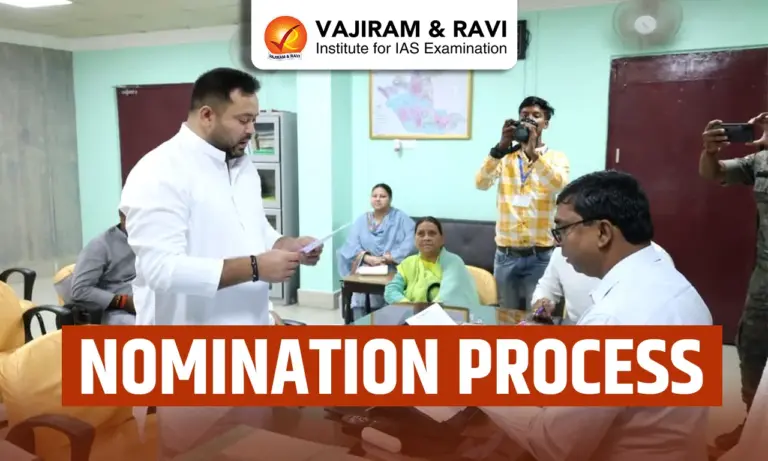
- Frequent disqualifications of candidates on procedural grounds have reignited calls for reforming India’s election nomination process to make it more transparent, fair, and citizen-friendly.
Introduction
- India’s electoral process, the cornerstone of the world’s largest democracy, begins long before votes are cast.
- Yet, one of its most undemocratic aspects lies in the nomination scrutiny stage, where candidates can be disqualified on minor procedural grounds.
- From missing signatures to delayed certificates, technicalities often override democratic principles.
- The Representation of the People Act (RPA), 1951, which governs this process, has accumulated layers of procedural rigidity, granting excessive discretion to Returning Officers (ROs).
- Experts now argue that this system needs urgent reform to uphold the spirit of free and fair elections.





The Legal Framework Governing Nominations
- The Representation of the People Act, 1951, along with the Conduct of Elections Rules, 1961, lays down the framework for candidate nominations.
- Section 33 – Specifies eligibility and procedure for filing nominations.
- Section 34 – Mandates security deposits by candidates.
- Section 36 – Grants the Returning Officer power to scrutinise nominations and reject them for “defects of a substantial character.”
- However, the term “substantial character” is undefined, giving ROs sweeping authority.
- Furthermore, Article 329(b) of the Constitution bars judicial review during the election process, meaning any challenge can only be raised after the polls, when the harm is already done.
- This combination of discretionary power and delayed remedy has made the nomination stage a potential chokepoint for political exclusion, often weaponised against opposition candidates.
Procedural Technicalities and Arbitrary Rejections
- Examples across India reveal how technicalities are misused to eliminate candidates even before campaigning begins:
- In Bihar, an RJD candidate was disqualified for leaving a few fields blank in the nomination form.
- In Surat (2024), opposition candidates were rejected after proposers allegedly denied their signatures, leading to an unopposed win for the ruling party.
- In Varanasi (2019), ex-BSF jawan Tej Bahadur Yadav’s nomination was rejected for failing to obtain a certificate within a day.
- In Birbhum, a former IPS officer’s form was invalidated due to a delayed “no-dues” certificate.
- Such rejections are legally valid under the current framework but morally corrosive to democracy. They expose how bureaucratic discretion can effectively curtail voter choice.
The Growing Burden of Compliance
- The Supreme Court’s ruling in Resurgence India v. Election Commission (2013), which mandated detailed affidavits on assets and criminal records, increased procedural complexity.
- Ironically, this created a paradox: false declarations don’t invalidate nominations, but incomplete ones do.
- Thus, a candidate who omits a minor detail in good faith can be rejected, while one who lies outright can remain on the ballot.
- Common procedural traps include:
- The Oath Trap: Candidates must take the oath after filing but before scrutiny, too early or too late renders it invalid.
- The Treasury Trap: Deposits must be made via treasury challans, often disqualifying candidates who pay via incorrect modes or outside the 3 PM filing window.
- The Notarisation Trap: Missing notarization of affidavits leads to automatic rejection.
- The Certificate Trap: Delay in “no-dues” or clearance certificates from government offices can eliminate a candidacy entirely.
- These conditions reward bureaucratic precision over democratic participation, turning the process into a test of procedural compliance rather than popular legitimacy.
Learning from Global Best Practices
- In contrast, other democracies treat election officials as facilitators, not gatekeepers.
- United Kingdom: ROs help candidates correct minor errors before deadlines.
- Canada: Provides a 48-hour window for corrections post-scrutiny.
- Germany: Mandates written notice of deficiencies and opportunities for remedy.
- Australia: Encourages early submission to allow corrections and appeals.
- These systems recognise that elections should promote participation, not exclusion.
Way Forward
- Experts suggest several structural reforms to make the nomination process more democratic and accountable:
- Codify Clear Classification of Defects:
- Technical Errors (missing signatures, blank columns, typos) should not justify rejection.
- Authenticity Issues (disputed signatures, false documents) should require verification.
- Statutory Disqualifications (age, dual citizenship, corruption convictions) should lead to outright disqualification.
- Guarantee a Correction Window:
- ROs should issue a written notice detailing the defect, citing the legal provision violated, and allow 48 hours for rectification.
- Mandate Reasoned Orders:
- Every rejection must include the specific grounds, evidence considered, and justification for why the defect is “substantial.”
- Digital-by-Default System:
- The Election Commission of India (ECI) could develop a unified digital portal integrating voter rolls, affidavit submissions, proposer verification, and deposits.
- A public dashboard could display the nomination status, ensuring transparency and minimising human discretion.
Source: TH

 Last updated on March, 2026
→ UPSC Final Result 2025 is now out.
→ UPSC has released UPSC Toppers List 2025 with the Civil Services final result on its official website.
→ Anuj Agnihotri secured AIR 1 in the UPSC Civil Services Examination 2025.
→ UPSC Marksheet 2025 is now out.
→ UPSC Notification 2026 & UPSC IFoS Notification 2026 is now out on the official website at upsconline.nic.in.
→ UPSC Calendar 2026 has been released.
→ Check out the latest UPSC Syllabus 2026 here.
→ UPSC Prelims 2026 will be conducted on 24th May, 2026 & UPSC Mains 2026 will be conducted on 21st August 2026.
→ The UPSC Selection Process is of 3 stages-Prelims, Mains and Interview.
→ Prepare effectively with Vajiram & Ravi’s UPSC Prelims Test Series 2026 featuring full-length mock tests, detailed solutions, and performance analysis.
→ Enroll in Vajiram & Ravi’s UPSC Mains Test Series 2026 for structured answer writing practice, expert evaluation, and exam-oriented feedback.
→ Join Vajiram & Ravi’s Best UPSC Mentorship Program for personalized guidance, strategy planning, and one-to-one support from experienced mentors.
→ Shakti Dubey secures AIR 1 in UPSC CSE Exam 2024.
→ Also check Best UPSC Coaching in India
Nomination Process FAQs
Q1. What governs India’s election nomination process?+
Q2. Why are nominations often rejected?+
Q3. What reforms are being proposed?+
Q4. How do other countries handle nomination scrutiny?+
Q5. What role should the Election Commission play?+
Tags: mains articles nomination process upsc current affairs upsc mains current affairs