Electoral Roll Revision in India Latest News
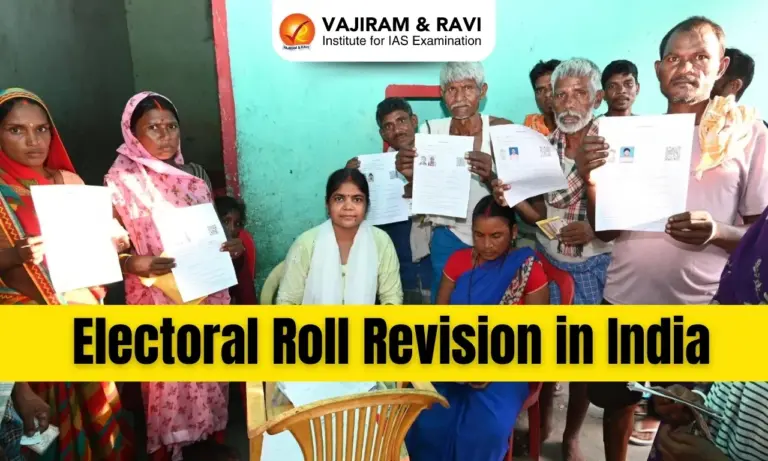
- The Supreme Court allowed Bihar’s Special Intensive Revision (SIR) of electoral rolls to continue but advised accepting Aadhaar, voter ID, and ration cards as valid documents.
- Political opposition has grown over the ECI’s rule requiring even existing voters (enrolled after 2003) to provide birth-related documents to prove citizenship, raising fears of large-scale voter disenfranchisement.
- In earlier electoral roll revisions across India, similar concerns had arisen. Over time, legal safeguards evolved:
- Courts ruled that voters cannot be excluded without full inquiry and due process.
- Past voter lists must be respected as valid proof.
- Citizenship verification cannot rely on vague suspicions or unverified claims.
Types of Electoral Roll Revisions in India
- An intensive revision involves preparing fresh electoral rolls through house-to-house visits, recording eligible voters as of a set date.
- This is done when existing rolls are outdated or inaccurate, usually before major elections or after constituency changes.
- In contrast, a summary revision is a regular annual update where draft rolls are published, and citizens can request additions, deletions, or corrections without home visits.
- A special revision occurs in exceptional situations like missed areas, major errors, or legal or political needs.
- It may follow either summary or intensive methods, depending on what is required to maintain accurate and inclusive voter lists.





Bihar’s Exercise: A Special Intensive Revision
- The ongoing Special Intensive Revision (SIR) in Bihar combines elements of both intensive and summary revisions under the ECI’s powers in Section 21(3) of the 1950 law.
- It involves door-to-door verification along with using existing voter lists.
- What makes it different is a new requirement: electors must provide documentary proof of birth or place of birth during enumeration — a step not seen in earlier revisions.
- The term “special” highlights this flexible, hybrid method tailored to specific needs.
Why the Special Intensive Revision Began Now, Starting with Bihar
- The Special Intensive Revision (SIR) is a nationwide exercise announced by the Election Commission of India (ECI)— the first such drive in over 20 years.
- It began with Bihar, where Assembly elections are due before November.
- The ECI cited major changes in voter lists caused by urbanisation, migration, and voters shifting addresses without deleting previous entries, leading to duplication.
- Repeated political complaints, including allegations of electoral roll manipulation, have also prompted this verification drive to clean up and standardise rolls across the country.
History and Purpose of Intensive Electoral Roll Revisions in India
-
- Since Independence, the Election Commission of India (ECI) has conducted intensive revisions of electoral rolls multiple times — in 1952–56, 1957, 1961, 1965, 1966, 1983–84, 1987–89, 1992, 1993, 1995, 2002, 2003, and 2004.
- Early Focus – The first revisions aimed to correct serious flaws in the rolls used for the 1951–52 Lok Sabha election, caused by public inexperience, administrative gaps, and the absence of a formal electoral law.
- A notable issue was the mass exclusion of women, many of whom did not share their names with officials.
- Phased Approach – To improve accuracy, the ECI adopted a phased revision strategy — covering sections of each state yearly before major elections.
- Changing Priorities Over Time – By the 1980s, focus shifted toward preventing ineligible entries, especially foreign nationals.
- Border states often reported such concerns, prompting the ECI to issue guidelines stressing that no name could be removed without due process, placing the burden of proof on the objector.
- Role of EPIC – In 1993 and 1995, intensive revisions helped introduce Elector’s Photo Identity Cards (EPIC), although that wasn’t their main purpose.
- Shift to Summary Revisions – As voter lists improved and costs grew, the ECI made summary revisions the norm.
- But when serious concerns arose due to demographic changes, political complaints, or administrative needs, the ECI returned to intensive methods tailored to that moment’s challenges.
Source: IE

 Last updated on March, 2026
→ UPSC Final Result 2025 is now out.
→ UPSC has released UPSC Toppers List 2025 with the Civil Services final result on its official website.
→ Anuj Agnihotri secured AIR 1 in the UPSC Civil Services Examination 2025.
→ UPSC Marksheet 2025 is now out.
→ UPSC Notification 2026 & UPSC IFoS Notification 2026 is now out on the official website at upsconline.nic.in.
→ UPSC Calendar 2026 has been released.
→ Check out the latest UPSC Syllabus 2026 here.
→ UPSC Prelims 2026 will be conducted on 24th May, 2026 & UPSC Mains 2026 will be conducted on 21st August 2026.
→ The UPSC Selection Process is of 3 stages-Prelims, Mains and Interview.
→ Prepare effectively with Vajiram & Ravi’s UPSC Prelims Test Series 2026 featuring full-length mock tests, detailed solutions, and performance analysis.
→ Enroll in Vajiram & Ravi’s UPSC Mains Test Series 2026 for structured answer writing practice, expert evaluation, and exam-oriented feedback.
→ Join Vajiram & Ravi’s Best UPSC Mentorship Program for personalized guidance, strategy planning, and one-to-one support from experienced mentors.
→ Shakti Dubey secures AIR 1 in UPSC CSE Exam 2024.
→ Also check Best UPSC Coaching in India
Electoral Roll Revision in India FAQs
Q1. What is an intensive revision of electoral rolls? +
Q2. Why is Bihar undergoing a special intensive revision? +
Q3. How is special intensive revision different? +
Q4. How has India historically revised electoral rolls? +
Q5. What safeguards exist against wrongful voter exclusion? +
Tags: electoral roll revision in india mains articles upsc current affairs upsc mains current affairs