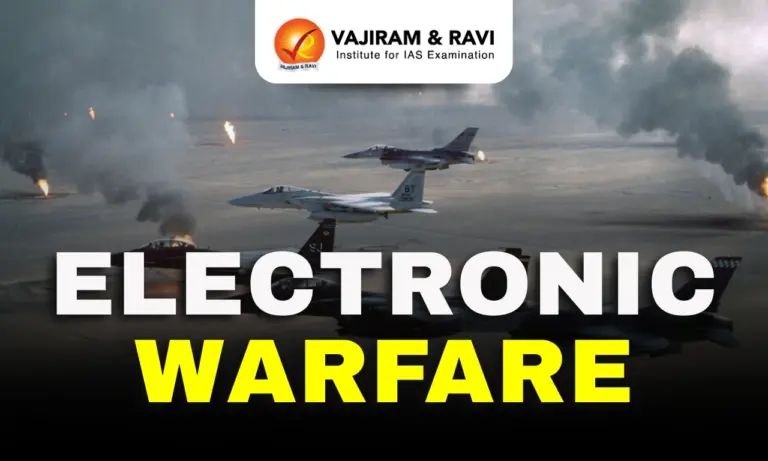
Electronic Warfare (EW) refers to a military action that uses electromagnetic energy to control, exploit, disrupt, or deny the enemy’s use of the electromagnetic spectrum. This spectrum includes radio waves, infrared signals, radar systems, and other communication channels used in modern warfare. In simple terms, EW is the science of “fighting without bullets,” where victory depends on controlling invisible electronic signals rather than physical weapons.
Electronic Warfare
Electronic Warfare is defined as a military strategy that involves the use of electromagnetic energy to:
- Detect enemy signals
- Disrupt or jam communication systems
- Protect friendly forces from electronic attacks
- Gather intelligence from enemy transmissions
Three Major Areas of Electronic Warfare
Electronic Warfare (EW) is broadly divided into three major areas that help military forces detect, disrupt, and protect electromagnetic communications and radar systems during combat operations.
1. Electronic Support Measures (ESM) – Passive EW
Electronic Support Measures (ESM) involve intercepting, detecting, locating, and analyzing enemy electromagnetic emissions such as radar and communication signals. Its primary purpose is threat identification, intelligence collection, and situational awareness without transmitting any signals.
- Detects enemy radar and communication transmissions.
- Provides early warning of potential threats.
- Supports intelligence gathering and surveillance.
- Helps in mission planning and target identification.
2. Electronic Counter-Measures (ECM) – Active EW
Electronic Counter-Measures (ECM) involve the active use of electromagnetic energy to disrupt, deceive, or deny the enemy’s use of the electromagnetic spectrum.
- Jams enemy communication networks.
- Disrupts radar tracking and missile guidance systems.
- Uses deceptive signals to mislead enemy sensors.
- Protects friendly forces from detection and attack.
3. Electronic Counter-Countermeasures (ECCM)
Electronic Counter-Countermeasures (ECCM) are defensive measures used to protect friendly electronic systems from enemy jamming and electronic attacks, ensuring reliable operation in contested environments.
- Prevents or minimizes the effects of enemy jamming.
- Uses frequency hopping and signal encryption.
- Maintains communication and radar effectiveness.
- Enhances the survivability of military electronic systems.


Need for Electronic Warfare in India
As modern warfare increasingly relies on radar, communication networks, satellites, drones, and electronic sensors, Electronic Warfare (EW) has become essential for India’s national security and military preparedness. EW enables the armed forces to gain control over the electromagnetic spectrum and counter technologically advanced adversaries.
- Countering Advanced Military Threats: India faces evolving security challenges from neighbouring countries equipped with sophisticated electronic warfare capabilities, making EW crucial for maintaining a strategic advantage.
- Protecting Military Communications: EW safeguards critical communication networks from enemy interception, jamming, and cyber-electronic attacks, ensuring uninterrupted command and control during operations.
- Enhancing Border Security: Advanced EW systems help monitor and detect hostile activities along India’s borders by intercepting enemy radar and communication signals.
- Defending Against Drones and Missiles: Modern EW systems can disrupt the navigation, communication, and guidance systems of hostile drones, aircraft, and precision-guided missiles.
- Supporting Network-Centric Warfare: Today’s military operations depend on real-time data sharing among land, air, naval, and space assets. EW ensures secure and reliable information exchange.
- Countering China’s Electronic Warfare Capabilities: The deployment of advanced platforms such as China’s Y-9LG electronic warfare aircraft highlights the need for India to strengthen its indigenous EW capabilities.
- Improving Intelligence and Surveillance: EW systems provide valuable electronic intelligence by detecting and analyzing enemy transmissions, helping military commanders make informed decisions.
- Strengthening Indigenous Defence Capabilities: Developing domestic EW systems reduces dependence on foreign technologies and supports India’s goal of self-reliance in defence manufacturing.
Electronic Warfare Systems in India
India has developed a range of Electronic Warfare (EW) systems to strengthen its defence capabilities across land, sea, and air domains. These systems are designed to intercept, monitor, jam, and neutralize enemy electronic communications, radar networks, and weapon guidance systems.
Shakti Electronic Warfare System
- An advanced naval EW system developed for the Indian Navy.
- Provides an electronic layer of defence against modern radars and anti-ship missiles.
- Capable of intercepting, analyzing, and jamming enemy electromagnetic signals.
- Enhances the survivability of warships in hostile environments.
Programme Sangraha
- A joint initiative of DRDO and the Indian Navy.
- Focuses on the design and development of indigenous EW systems for naval platforms.
- Includes multiple variants for surveillance, signal interception, and electronic attack.
- Reduces dependence on imported electronic warfare technologies.
Integrated Electronic Warfare System (IEWS)
- Developed primarily for the Indian Army.
- Designed to operate in plains, deserts, semi-desert regions, and mountainous terrain.
- Provides electronic intelligence, communication interception, and jamming capabilities.
- Supports battlefield surveillance and command operations.
Himshakti
- A specialized version of the Integrated Electronic Warfare System.
- Developed for deployment in high-altitude and mountainous regions.
- Enhances electronic surveillance and communication monitoring along sensitive border areas.
- Improves operational effectiveness in challenging terrain.
Samyukta Electronic Warfare System
- A mobile tactical EW system developed for the Indian Army.
- Designed to perform multiple functions including signal interception, monitoring, direction finding, and jamming.
- Capable of supporting large-scale military operations across diverse battlefields.
- Provides real-time electronic intelligence and electronic attack capabilities.
Divya Drishti
- An indigenous electronic intelligence system.
- Used for monitoring and intercepting enemy communications.
- Supports intelligence gathering and strategic surveillance missions.
- Strengthens situational awareness for military commanders.
Airborne Electronic Warfare Systems
- Integrated into various Indian Air Force aircraft and helicopters.
- Provide radar warning, signal interception, electronic support, and self-protection capabilities.
- Enhance aircraft survivability against enemy air defence systems.
- Support electronic attack and suppression of enemy air defences.
Importance of Electronic Warfare
Electronic Warfare (EW) has become a critical component of modern military operations as contemporary warfare increasingly depends on communication systems, radars, satellites, drones, and electronic sensors. Control over the electromagnetic spectrum can significantly influence the outcome of military conflicts.
- Ensures Dominance in the Electromagnetic Spectrum: EW enables armed forces to detect, control, and deny the enemy’s use of electromagnetic signals, providing a decisive battlefield advantage.
- Protects Military Communication Networks: It safeguards critical communication channels from interception, jamming, and electronic attacks, ensuring uninterrupted command and control.
- Enhances Intelligence Gathering: EW systems intercept and analyze enemy radar and communication signals, providing valuable intelligence for strategic and tactical decision-making.
- Counters Enemy Radar and Surveillance Systems: Electronic warfare can disrupt or deceive enemy radars, reducing their ability to detect and track friendly forces.
- Defends Against Missiles and Drones: Advanced EW systems can jam navigation and guidance signals of hostile drones, aircraft, and precision-guided missiles.
- Supports Network-Centric Warfare: Modern military operations rely on real-time information sharing. EW ensures secure and reliable data transmission across different military platforms.
- Improves Force Protection: By reducing the effectiveness of enemy electronic systems, EW enhances the survivability of troops, aircraft, naval vessels, and military infrastructure.
- Acts as a Force Multiplier: Electronic warfare increases the effectiveness of conventional military assets without necessarily increasing troop strength or firepower.

 Last updated on Oct, 2026
→ UPSC 2027 Notification will be released on 13 January 2027 at upsconline.nic.in.
→ Check Nobel Prize 2026 Winners List here.
→ Download PIB PRiSM Monthly Magazine 2026 here.
→ Check UPSC Monthly Current Affairs Magazine The Recitals here.
→ Check out the latest UPSC Syllabus here.
→ Download UPSC Model Answers for Mains 2026
→ UPSC Mains Question Paper 2026 is out now for Essay & GS Paper 1, 2, 3 & 4.
→ UPSC Calendar 2027 has been released.
→ Enroll in Vajiram & Ravi’s UPSC Mains Test Series 2027 for structured answer writing practice, expert evaluation, and exam-oriented feedback.
→ Join Vajiram & Ravi’s UPSC Mentorship Program 2027 for personalized guidance, strategy planning, and one-to-one support from experienced mentors.
→ Go through the UPSC Mains Previous Year Papers to enhance your preparation.
→ UPSC has released UPSC Toppers List 2025 with the Civil Services final result on its official website.
→ Also check Best UPSC Coaching in India
Electronic Warfare FAQs
Q1. What is Electronic Warfare (EW)?+
Q2. Why is Electronic Warfare important in modern warfare?+
Q3. What is the role of Electronic Support Measures (ESM)?+
Q4. What are Electronic Counter-Measures (ECM)?+
Q5. What is Electronic Counter-Countermeasures (ECCM)?+
Tags: electronic warfare electronics engineering military science