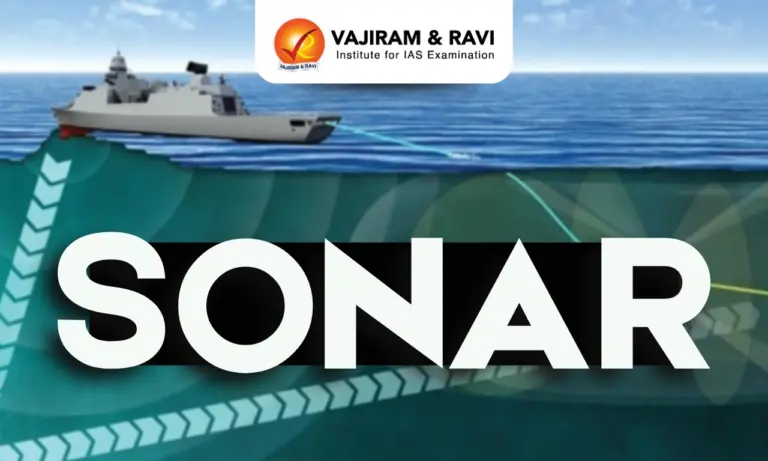
SONAR, which stands for Sound Navigation and Ranging, is a powerful underwater detection system that uses sound waves to detect, locate, and identify objects beneath the water surface. It is widely used in naval defense, submarine navigation, underwater exploration, fishing, and oceanographic research.
SONAR works on the principle of sound wave propagation in water, where sound travels much faster and farther than light, making it highly effective for underwater communication and detection.
What is SONAR?
SONAR is a system that uses sound waves (usually ultrasonic waves) to detect objects under water and measure their distance, direction, and speed. It is mainly used where electromagnetic waves like radar cannot function effectively, especially in deep sea environments.
Working Principle of SONAR
SONAR operates on a simple but powerful principle called echo or reflection of sound waves.
- A SONAR system emits high-frequency sound pulses into the water.
- These sound waves travel through water until they hit an object (like a submarine, rock, or fish).
- The waves then bounce back as echoes.
- The system receives the reflected sound waves.
- By calculating the time taken for the echo to return, SONAR determines:
- Distance of the object
- Direction of the object
- Speed (if the object is moving)
Formula used: Distance = (Speed of sound in water × Time taken) / 2


Components of SONAR System
A typical SONAR system consists of:
- Transmitter – Generates sound waves
- Transducer – Converts electrical energy into sound waves
- Receiver – Detects reflected sound waves
- Processor – Analyzes signals and calculates distance and direction
- Display Unit – Shows results in graphical form
Applications of SONAR Technology
SONAR technology is widely used across military, marine exploration, fishing, navigation, and scientific research sectors, where it helps in detecting underwater objects, mapping the ocean floor, locating submarines, identifying fish schools, and supporting safe and efficient underwater operations.
- Detects and tracks submarines and underwater threats for naval defense and maritime security operations.
- Helps in mine detection and clearance in deep-sea and coastal regions to ensure safe naval movement.
- Used in ocean floor mapping to study underwater terrain, trenches, mountains, and geological formations.
- Assists in locating shipwrecks and submerged structures for archaeological and historical research.
- Enables fish finding systems in the fishing industry to identify schools of fish and improve catch efficiency.
- Supports safe navigation of submarines and ships by detecting underwater obstacles and hazards.
- Used in underwater surveillance and border security to monitor unauthorized marine activities.
- Plays a key role in marine biology research by studying movement and behavior of marine organisms.
- Helps in offshore oil and gas exploration by mapping seabed structures and identifying potential drilling zones.
- Assists in environmental monitoring by studying underwater ecosystems and detecting changes in seabed conditions.
SONAR in Modern Warfare
- SONAR is used for submarine detection and tracking, helping navies locate hidden enemy submarines underwater.
- Plays a key role in anti-submarine warfare (ASW) by detecting and countering underwater threats.
- Helps in underwater mine detection and clearance, ensuring safe movement of naval ships and fleets.
- Used for maritime border security and surveillance to protect coastal areas from infiltration and attacks.
- Integrated into warships and submarines for real-time underwater monitoring and strategic defense operations.

 Last updated on Oct, 2026
→ UPSC 2027 Notification will be released on 13 January 2027 at upsconline.nic.in.
→ Check Nobel Prize 2026 Winners List here.
→ Download PIB PRiSM Monthly Magazine 2026 here.
→ Check UPSC Monthly Current Affairs Magazine The Recitals here.
→ Check out the latest UPSC Syllabus here.
→ Download UPSC Model Answers for Mains 2026
→ UPSC Mains Question Paper 2026 is out now for Essay & GS Paper 1, 2, 3 & 4.
→ UPSC Calendar 2027 has been released.
→ Enroll in Vajiram & Ravi’s UPSC Mains Test Series 2027 for structured answer writing practice, expert evaluation, and exam-oriented feedback.
→ Join Vajiram & Ravi’s UPSC Mentorship Program 2027 for personalized guidance, strategy planning, and one-to-one support from experienced mentors.
→ Go through the UPSC Mains Previous Year Papers to enhance your preparation.
→ UPSC has released UPSC Toppers List 2025 with the Civil Services final result on its official website.
→ Also check Best UPSC Coaching in India
SONAR FAQs
Q1. What is SONAR?+
Q2. What is the full form of SONAR?+
Q3. How does SONAR work?+
Q4. Where is SONAR used?+
Q5. What are the types of SONAR?+