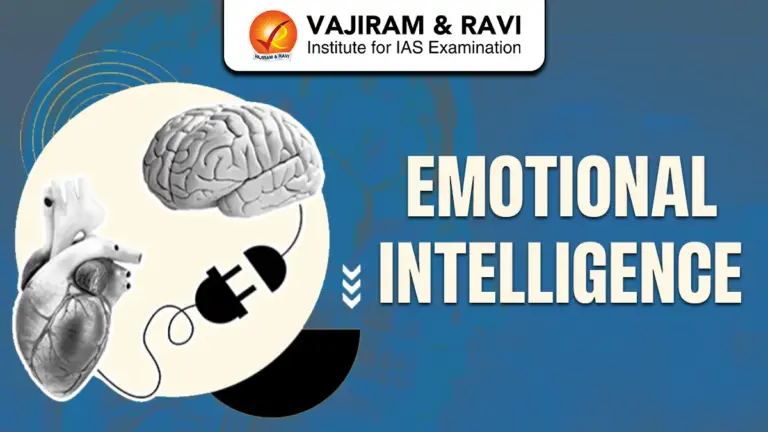
Emotional Intelligence (EI) refers to the sophisticated ability to identify, understand and manage one’s own emotions while simultaneously recognizing and influencing the emotions of others. While traditional intelligence focuses on cognitive and logical reasoning, EI centers on the capacity to harness emotions and apply them to various tasks and social interactions. In essence, it is the bridge between thought and feeling that allows individuals to regulate their behavior and achieve specific goals. The measure of this intelligence is known as the Emotional Quotient (EQ), which serves as a metric for an individual’s awareness of emotions in relation to self and society.
Emotional Intelligence Definitions
The foundation of Emotional Intelligence is built upon several definitions that highlight its multifaceted nature as given below:
“The ability to motivate oneself and persist in the face of frustrations, to control impulse and delay gratification, to regulate one’s moods and keep distress from swamping the ability to think, to empathize, and to hope.”– Daniel Goleman
“The ability to monitor one’s own and others’ feelings and emotions, to discriminate among them and use this information to guide one’s thinking and actions.”– Peter Salovey and John Mayer
“The capacity to be aware of, control and express one’s emotions and to handle interpersonal relationships judiciously and empathetically.”– Oxford Dictionary
Emotional Intelligence Components
According to the influential model popularized by Daniel Goleman, Emotional Intelligence consists of five core elements that dictate how we manage ourselves and our relationships.
- Self-Awareness: The fundamental skill of recognizing and understanding one’s own emotions, strengths and weaknesses as they evolve in real-time.
- Self-Regulation: The ability to reign in emotions and think before responding, ensuring that reactions are managed rather than impulsive.
- Internal Motivation: A personal drive to achieve goals fueled by optimism and resilience rather than just external rewards or status.
- Empathy: The awareness of the needs and feelings of others, allowing one to see the world from different perspectives and group dynamics.
- Social Skills: The mastery of building rapport, resolving conflicts and balancing the requirements of others through effective communication.





Emotional Intelligence Significance
Emotional Intelligence is often considered a greater predictor of lifelong success and character than IQ alone, particularly in high-pressure environments like civil services or leadership roles.
- Decision-Making: It helps individuals recognize emotions that are unrelated to a specific problem, preventing irrelevant feelings from biasing the final result.
- Stress Management: EI enables the regulation of anxiety in provocative situations, maintaining both physical and mental well-being under pressure.
- Effective Leadership: By comprehending the emotions of others, an emotionally intelligent leader can motivate subordinates and navigate disagreements calmly.
- Targeting Public Policy: For administrators, EI is crucial for understanding the moods and drives of the public, leading to more empathetic and innovative solutions to societal problems.
- Relationship Building: It fosters healthy connections by balancing personal wants with the requirements of others, leading to better social communication and trust.

 Last updated on April, 2026
→ UPSC Final Result 2025 is now out.
→ UPSC has released UPSC Toppers List 2025 with the Civil Services final result on its official website.
→ Anuj Agnihotri secured AIR 1 in the UPSC Civil Services Examination 2025.
→ UPSC Marksheet 2025 is now out.
→ UPSC Notification 2026 & UPSC IFoS Notification 2026 is now out on the official website at upsconline.nic.in.
→ UPSC Calendar 2026 has been released.
→ Check out the latest UPSC Syllabus 2026 here.
→ UPSC Prelims 2026 will be conducted on 24th May, 2026 & UPSC Mains 2026 will be conducted on 21st August 2026.
→ The UPSC Selection Process is of 3 stages-Prelims, Mains and Interview.
→ Prepare effectively with Vajiram & Ravi’s UPSC Prelims Test Series 2026 featuring full-length mock tests, detailed solutions, and performance analysis.
→ Enroll in Vajiram & Ravi’s UPSC Mains Test Series 2026 for structured answer writing practice, expert evaluation, and exam-oriented feedback.
→ Join Vajiram & Ravi’s Best UPSC Mentorship Program for personalized guidance, strategy planning, and one-to-one support from experienced mentors.
→ Shakti Dubey secures AIR 1 in UPSC CSE Exam 2024.
→ Also check Best UPSC Coaching in India
Emotional Intelligence FAQs
Q1. What is the difference between IQ and EQ? +
Q2. Who coined the term "Emotional Intelligence"? +
Q3. Can Emotional Intelligence be improved? +
Q4. What is Aristotle’s view on Emotional Intelligence? +
Q5. How does Emotional Intelligence help in a professional environment? +
Tags: emotional intelligence