New START Treaty Latest News
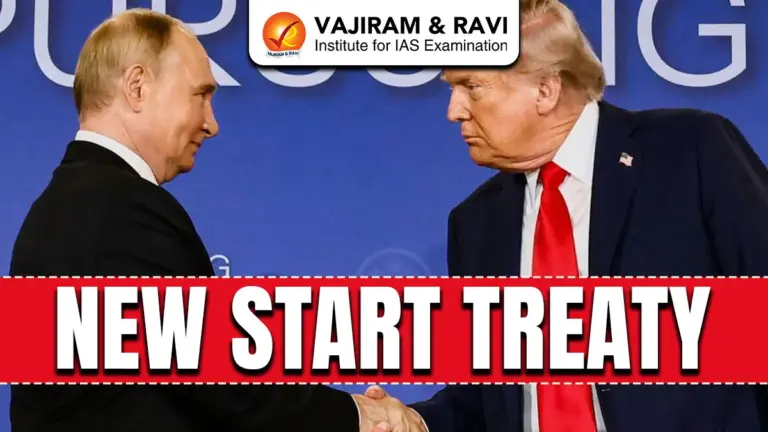
- The expiry of the New START Treaty marks the end of five decades of binding nuclear limits between the US and Russia, raising global concerns about strategic stability and the risk of a renewed nuclear arms race.
Cold War Arms Control Efforts
- In the late 1960s, at the peak of the Cold War, the Soviet Union began expanding its intercontinental ballistic missile (ICBM) arsenal to match the United States.
- In January 1967, US President Lyndon B. Johnson warned that Moscow was developing an anti-ballistic missile (ABM) system around its capital, raising fears of a destabilising first-strike capability.
SALT Talks and Early Treaties
- To curb the escalating arms race, Washington and Moscow launched the Strategic Arms Limitation Talks (SALT) in November 1969.
- These negotiations produced two key agreements:
- The Anti-Ballistic Missile (ABM) Treaty, which capped missile defence systems at 200 (later reduced to 100) per side.
- An interim SALT accord under which both sides agreed not to expand their ICBM capabilities.
SALT II and Its Collapse
- Negotiations for a follow-up pact, SALT II, began in 1972 and culminated in a 1979 agreement limiting nuclear delivery vehicles—such as ICBMs, submarine-launched missiles, and strategic bombers—to 2,250 each.
- However, after the Soviet invasion of Afghanistan in December 1979, US President Jimmy Carter withdrew the treaty from Senate consideration, and it was never ratified.
Unravelling of Controls
- Years later, the US unilaterally exited the ABM Treaty in 2002, arguing it constrained defences against terrorist and rogue-state missile threats.
- This marked an early step in the gradual erosion of Cold War-era arms control frameworks.





Post–Cold War Nuclear Arms Reduction
- After the Cold War, the US and Russia signed the Strategic Arms Reduction Treaty (START I) in 1991.
- It required both sides to cap deployed strategic delivery systems at 1,600 and reduce nuclear warheads to 6,000.
- Crucially, START I mandated the destruction of excess missiles and bombers, backed by an intrusive verification regime that included on-site inspections, data exchanges, and satellite monitoring.
- Because of the Soviet Union’s collapse and efforts to denuclearise former Soviet states, implementation took longer than expected.
- The reductions were completed only in December 2001, and the treaty expired in 2009.
START II: An Unfulfilled Follow-on
- A second agreement, START II, was signed in January 1993. It aimed to cut strategic warheads further, to 3,000–3,500 by 2003.
- However, the treaty never entered into force due to delays in ratification in both countries.
- After the US withdrew from the Anti-Ballistic Missile Treaty in 2002, Russia formally withdrew from START II, and plans for a START III agreement collapsed.
SORT: A Temporary Bridge
- In May 2002, the two countries adopted the Strategic Offensive Reductions Treaty (SORT), committing to reduce operationally deployed warheads to 1,700–2,200.
- SORT came into force in 2003 after legislative approval in both countries.
- It was conceived as an interim arrangement and was later superseded by the New START treaty in 2011.
A New Phase in US–Russia Arms Control
- In 2010, US President Barack Obama and Russian President Dmitry Medvedev signed the New Strategic Arms Reduction Treaty (New START).
- The agreement came into force on February 5, 2011, marking a renewed commitment to nuclear arms control after earlier treaties expired.
- Key Limits and Reductions
- Under New START, both countries agreed to cap their strategic nuclear warheads at 1,550 and limit strategic delivery vehicles to 800, including both deployed and non-deployed systems.
- These cuts were substantial, requiring about a 30% reduction in warheads and a 50% reduction in delivery vehicles compared to the earlier SORT agreement.
- Verification and Inspections
- To ensure compliance, the treaty established a strong verification mechanism.
- Each side was permitted to conduct up to 18 on-site inspections per year of the other’s strategic nuclear facilities, along with regular data exchanges.
- Extension and Expiry
- The treaty allowed for a one-time extension. In 2021, after President Joe Biden took office, the US and Russia mutually agreed to extend New START by five years, setting its expiry date at February 5, 2026.
After New START: What Lies Ahead
- End of Legal Limits on Nuclear Arsenals – With the treaty’s expiry, binding caps on US and Russian nuclear warheads cease to exist. As of 2025, the US holds about 5,277 warheads and Russia around 5,449, raising concerns over unchecked expansion.
- Rising Risks and Loss of Transparency – Experts warn that the absence of arms control increases the danger of accidental or unintended escalation, especially amid regional conflicts involving Russia or China. Ending limits also reduces transparency over nuclear forces.
- Erosion of Nuclear Deterrence – Analysts argue that traditional nuclear deterrence is weakening as a stabilising force. The breakdown of arms control norms signals a shift toward open-ended strategic competition among major powers.
- Global Implications and Non-Proliferation Concerns – The lapse could undermine restraint worldwide, just ahead of the 2026 Nuclear Non-Proliferation Treaty review. While rethinking arms control is possible, experts caution that even limited mutual restraint is safer than unconstrained nuclear rivalry.

 Last updated on April, 2026
→ UPSC Final Result 2025 is now out.
→ UPSC has released UPSC Toppers List 2025 with the Civil Services final result on its official website.
→ Anuj Agnihotri secured AIR 1 in the UPSC Civil Services Examination 2025.
→ UPSC Marksheet 2025 is now out.
→ UPSC Notification 2026 & UPSC IFoS Notification 2026 is now out on the official website at upsconline.nic.in.
→ UPSC Calendar 2026 has been released.
→ Check out the latest UPSC Syllabus 2026 here.
→ UPSC Prelims 2026 will be conducted on 24th May, 2026 & UPSC Mains 2026 will be conducted on 21st August 2026.
→ The UPSC Selection Process is of 3 stages-Prelims, Mains and Interview.
→ Prepare effectively with Vajiram & Ravi’s UPSC Prelims Test Series 2026 featuring full-length mock tests, detailed solutions, and performance analysis.
→ Enroll in Vajiram & Ravi’s UPSC Mains Test Series 2026 for structured answer writing practice, expert evaluation, and exam-oriented feedback.
→ Join Vajiram & Ravi’s Best UPSC Mentorship Program for personalized guidance, strategy planning, and one-to-one support from experienced mentors.
→ Shakti Dubey secures AIR 1 in UPSC CSE Exam 2024.
→ Also check Best UPSC Coaching in India
New START Treaty FAQs
Q1. What is the New START Treaty and why is it important?+
Q2. What happens after the New START Treaty expires? +
Q3. How many nuclear warheads do the US and Russia have after New START?+
Q4. Does the end of the New START Treaty increase arms race risks?+
Q5. Why does the New START Treaty expiry matter globally?+
Tags: mains articles new start treaty upsc current affairs upsc mains current affairs