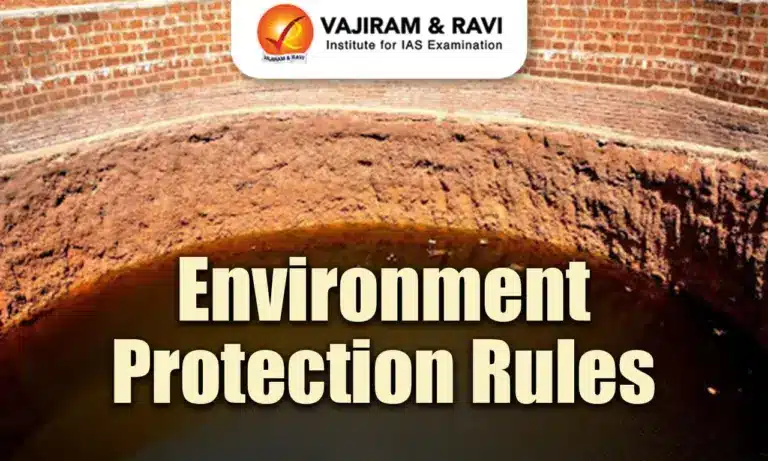
Environment Protection Rules Latest News
- The Environment Ministry has notified the Environment Protection (Management of Contaminated Sites) Rules, 2025.
Introduction
- India has taken a major step toward formalising its response to chemically contaminated sites.
- On July 25, 2025, the Ministry of Environment, Forest and Climate Change notified the Environment Protection (Management of Contaminated Sites) Rules, 2025 under the Environment Protection Act.
- For the first time, India has codified the procedures to identify, assess, and remediate sites where historical dumping of hazardous chemicals has polluted soil, groundwater, or surface water, posing long-term risks to public health and ecosystems.





Understanding Contaminated Sites
- According to the Central Pollution Control Board (CPCB), contaminated sites are locations where hazardous and other wastes have been historically dumped, often prior to the enforcement of proper regulatory mechanisms. Such sites typically include:
- Defunct industrial landfills
- Waste storage and chemical spill sites
- Abandoned chemical handling facilities
- India has identified 103 such sites, but remedial operations have been initiated in only seven. Many polluters have ceased operations or lack the resources for clean-up, leaving local communities and environments exposed to toxic hazards.
Key Features of the Environment Protection Rules
- The Environment Protection (Management of Contaminated Sites) Rules, 2025 provide a legally binding, time-bound framework for the entire remediation process:
- Step 1: Identification and Reporting
- District administrations must prepare half-yearly reports listing “suspected contaminated sites.”
- These reports are sent to the State Pollution Control Board or a designated reference organisation.
- Step 2: Preliminary Assessment
- The Board or organisation must carry out a preliminary assessment within 90 days to ascertain the likelihood of contamination.
- Step 3: Detailed Site Survey
- If contamination is likely, a detailed survey must be completed within the next 90 days, checking for any of the 189 hazardous chemicals listed under the Hazardous and Other Wastes (Management and Transboundary Movement) Rules, 2016.
- Sites found to be contaminated will be publicly notified and access restricted.
- Step 4: Remediation Planning
- A reference organisation comprising scientific experts will propose a remediation plan.
- The State Board must also identify the person(s) responsible for the contamination within 90 days.
- Step 5: Cost Recovery and Liability
- Those responsible must bear the cost of remediation.
- If the polluter is unavailable or unable to pay, the Centre and State will split the cost under a prescribed arrangement.
- Criminal liability, if proven to involve loss of life or severe damage, will be addressed under the Bharatiya Nyaya Sanhita (2023).
Scope and Exemptions
- While comprehensive, the rules exclude certain categories already covered by other legislation:
- Radioactive waste (under the Atomic Energy Act)
- Mining-related contamination (governed separately)
- Marine oil pollution
- Municipal solid waste dump sites
- This ensures that regulatory overlap is avoided, and specialised agencies continue to govern complex waste streams.
Significance of the Rules
- The notification marks a paradigm shift from fragmented enforcement to structured environmental remediation.
- Previously, there was no legally codified framework for addressing contaminated sites, leading to regulatory inaction and long delays in clean-up. By defining:
- Responsibilities of district officials and pollution boards
- Timelines for assessment and response
- Polluter-pays mechanism for cost recovery
Challenges in Implementation
- While the rules provide a legal foundation, successful implementation will hinge on:
- Scientific capacity for hazardous chemical assessment
- Institutional coordination between the State Boards, CPCB, and district administrations
- Funding support, especially where no liable party is available
- Public awareness and community participation in reporting pollution
- Capacity-building at the district and state levels will be critical to make the framework actionable.
Source : TH

 Last updated on March, 2026
→ UPSC Final Result 2025 is now out.
→ UPSC has released UPSC Toppers List 2025 with the Civil Services final result on its official website.
→ Anuj Agnihotri secured AIR 1 in the UPSC Civil Services Examination 2025.
→ UPSC Marksheet 2025 is now out.
→ UPSC Notification 2026 & UPSC IFoS Notification 2026 is now out on the official website at upsconline.nic.in.
→ UPSC Calendar 2026 has been released.
→ Check out the latest UPSC Syllabus 2026 here.
→ UPSC Prelims 2026 will be conducted on 24th May, 2026 & UPSC Mains 2026 will be conducted on 21st August 2026.
→ The UPSC Selection Process is of 3 stages-Prelims, Mains and Interview.
→ Prepare effectively with Vajiram & Ravi’s UPSC Prelims Test Series 2026 featuring full-length mock tests, detailed solutions, and performance analysis.
→ Enroll in Vajiram & Ravi’s UPSC Mains Test Series 2026 for structured answer writing practice, expert evaluation, and exam-oriented feedback.
→ Join Vajiram & Ravi’s Best UPSC Mentorship Program for personalized guidance, strategy planning, and one-to-one support from experienced mentors.
→ Shakti Dubey secures AIR 1 in UPSC CSE Exam 2024.
→ Also check Best UPSC Coaching in India
Environment Protection Rules FAQs
Q1. What are chemically contaminated sites?+
Q2. What new legal rules govern contaminated sites in India?+
Q3. Who is responsible for remediation under the new rules?+
Q4. How are contaminated sites identified and assessed?+
Q5. Are there penalties for polluters under these rules?+
Tags: environment protection rules mains articles upsc current affairs upsc mains current affairs