EU–Mercosur Trade Deal Latest News
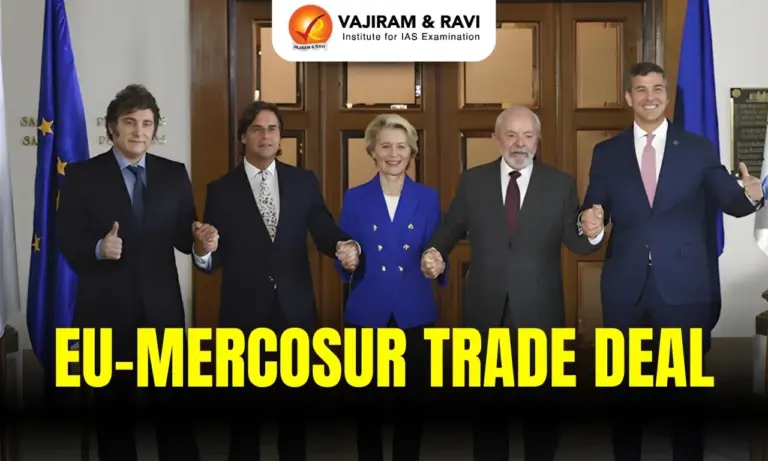
- The European Union and Mercosur are set to sign a long-pending free trade agreement in Asuncion, concluding negotiations dating back to 1999.
- Although the agreement was formally concluded in December 2024 by Ursula von der Leyen, EU member state ambassadors approved it only recently. The signing is scheduled for January 17 in Paraguay.
- The deal, however, remains contentious within Europe. France has led opposition, warning that reduced trade barriers with Mercosur countries could hurt domestic agriculture.
Mercosur: An Overview
- Mercosur, or the Southern Common Market, is a major South American trade bloc created to promote economic integration through the free movement of goods, services, capital, and people among member states.
- The official working languages of Mercosur are Spanish and Portuguese.
Founding and Membership
- Established in 1991 by the Treaty of Asunción, Mercosur’s founding members are Argentina, Brazil, Paraguay, and Uruguay.
- Bolivia later joined, while Venezuela is a full member whose membership is currently suspended.
- Several other South American countries participate as associate members.
Core Objectives
- Mercosur aims to:
- Create a common market
- Eliminate internal trade barriers
- Harmonise economic policies
- Enable free movement of goods, services, capital, and people
- Promote regional trade and cooperation





What the EU–Mercosur Trade Deal Includes
- According to the European Commission, this is the EU’s largest free trade agreement by tariff cuts, eliminating over €4 billion in duties on EU exports.
- Mercosur currently imposes high tariffs on cars, dairy, and wine.
- Current Trade Profile
- Annual goods trade between the EU and Mercosur is about €111 billion.
- EU exports: machinery, chemicals, transport equipment
- EU imports: agricultural products, paper, minerals
- Market Access Commitments
- Mercosur will remove duties on 91% of EU exports over 15 years (from ~35% now).
- EU will remove duties on 92% of Mercosur exports within 10 years.
- Sensitive Products and Quotas
- EU quotas maintained on poultry, pork, sugar, ethanol, rice, honey, maize, sweet corn.
- Mercosur quotas on milk powders and infant formula.
- Expanded quotas:
- EU beef imports up to 99,000 tonnes
- Duty-free 30,000-tonne cheese quota for EU exports
- Geographical Indications (GIs)
- About 350 EU food and drink products receive GI protection, safeguarding them from imitation in Mercosur markets.
- Safeguards and Enforcement
- The EU can suspend preferential access for sensitive farm imports if conditions are breached, alongside tighter controls on pesticide residues.
- Support Measures
- To address domestic concerns, the EU has set up a crisis fund, cut duties on fertiliser imports, fast-tracked €45 billion in farmer support, and strengthened import checks.
Why Some EU Countries Oppose the EU–Mercosur Trade Deal
- Countries Leading the Opposition – France, Poland, Austria, Hungary and Ireland voted against the agreement, while Belgium abstained. Italy dropped its earlier veto, allowing the deal to move forward despite dissent.
- Concerns Over Agricultural Competition – Opposing countries fear that cheaper farm imports from Mercosur will undercut European farmers. Irish farmers, in particular, worry about the 99,000 tonnes of additional beef entering the EU market.
- Environmental and Climate Safeguards – Critics argue that agricultural imports may not meet the European Union’s strict environmental and animal welfare standards.
- They have demanded binding and enforceable safeguards on climate protection and biodiversity.
- Deforestation and Sustainability Fears – Environmental groups and some governments say the deal lacks strong enforcement mechanisms to prevent deforestation, especially in sensitive regions such as the Amazon. They warn it could accelerate resource extraction and forest loss in South America.
- Standards and Fair Competition – Farmers’ groups stress that without equal environmental and production standards, EU producers face unfair competition from lower-cost imports that operate under looser regulations.
Why the EU–Mercosur Deal Matters Now
- Strategic Trade Diversification – The agreement reflects the European Union’s push to diversify trade ties beyond traditional partners at a time of global economic uncertainty and rising protectionism.
- Countering China’s Growing Influence – Supporters argue the deal will deepen Europe’s engagement with the Global South and act as a counterweight to expanding Chinese economic influence in Latin America.
- Boosting Mercosur’s Global Standing – For Mercosur, the pact strengthens its credibility as a serious trading partner despite internal political and economic divisions within the bloc.
- Economic Gains for Both Sides – According to Bloomberg Economics, the agreement could raise Mercosur’s GDP by 0.7% and Europe’s by 0.1%, offering modest but meaningful growth.
- Shield Against Trade Disruptions – In the wake of renewed tariff shocks following Donald Trump’s return to the White House, EU members see the deal as a way to offset trade losses caused by US protectionist policies.
- Reducing Dependence on China for Critical Minerals – The pact could help Europe diversify supply chains away from China. Brazil holds major reserves of graphite, nickel, manganese, rare earths and niobium, while Argentina is a leading global producer of lithium—both vital for clean energy and advanced manufacturing.

 Last updated on April, 2026
→ UPSC Final Result 2025 is now out.
→ UPSC has released UPSC Toppers List 2025 with the Civil Services final result on its official website.
→ Anuj Agnihotri secured AIR 1 in the UPSC Civil Services Examination 2025.
→ UPSC Marksheet 2025 is now out.
→ UPSC Notification 2026 & UPSC IFoS Notification 2026 is now out on the official website at upsconline.nic.in.
→ UPSC Calendar 2026 has been released.
→ Check out the latest UPSC Syllabus 2026 here.
→ UPSC Prelims 2026 will be conducted on 24th May, 2026 & UPSC Mains 2026 will be conducted on 21st August 2026.
→ The UPSC Selection Process is of 3 stages-Prelims, Mains and Interview.
→ Prepare effectively with Vajiram & Ravi’s UPSC Prelims Test Series 2026 featuring full-length mock tests, detailed solutions, and performance analysis.
→ Enroll in Vajiram & Ravi’s UPSC Mains Test Series 2026 for structured answer writing practice, expert evaluation, and exam-oriented feedback.
→ Join Vajiram & Ravi’s Best UPSC Mentorship Program for personalized guidance, strategy planning, and one-to-one support from experienced mentors.
→ Shakti Dubey secures AIR 1 in UPSC CSE Exam 2024.
→ Also check Best UPSC Coaching in India
EU–Mercosur Trade Deal FAQs
Q1. What is the EU–Mercosur trade deal?+
Q2. Why is the EU–Mercosur trade deal considered historic?+
Q3. Why do some EU countries oppose the EU–Mercosur trade deal?+
Q4. What sectors benefit most from the EU–Mercosur trade deal?+
Q5. Why does the EU–Mercosur trade deal matter now?+
Tags: EU–Mercosur trade deal mains articles upsc current affairs upsc mains current affairs