Euclid Space Telescope Latest News
Galaxies in Different Shapes Captured by Euclid
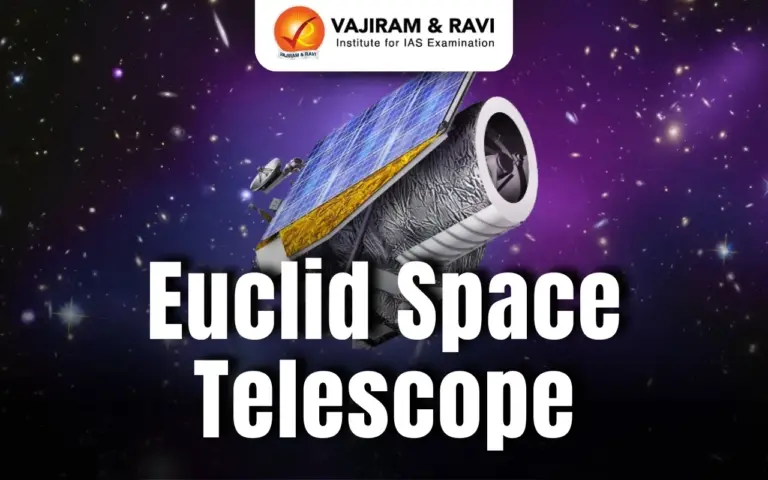
About the Euclid Space Telescope
- Named After: Euclid of Alexandria, an ancient Greek mathematician known for his contributions to geometry.
- Part of: ESA’s Cosmic Vision Programme, which aims to explore the origin, components, and fundamental laws governing the universe.
- Launch Vehicle: SpaceX Falcon 9 rocket.
- Operational Lifespan: Minimum 6 years.
- Orbit: 1.5 million km above Earth, at the Lagrange Point 2 (L2), a stable gravitational point in space.
- Size: 4.7 meters tall and 3.7 meters in diameter.
- Image Quality: Four times sharper than ground-based telescopes.





Scientific Objectives
- Investigate why the universe is expanding at an accelerating rate (a phenomenon attributed to dark energy).
- Study the distribution of dark matter by observing how galaxies and cosmic structures have evolved over billions of years.
- Map the large-scale structure of the universe in 3D to understand the effects of gravity and cosmic expansion.
Scientific Instruments
- Visible-Wavelength Camera (VISible Instrument – VIS): It captures high-resolution images of galaxies.
- Helps detect tiny distortions in galaxy shapes caused by gravitational lensing—a method used to study dark matter.
- Near-Infrared Spectrometer and Photometer (NISP): It measures how fast galaxies are moving apart, providing insight into the influence of dark energy over time.
- Developed with NASA’s contribution, including sensor-chip electronics and detectors.
Key Observations and Data Release
- The Deep Field South region, observed for one week, contains 26 million galaxies, some over 10.5 billion light-years away.
- The telescope aims to survey 1.5 billion galaxies over its six-year mission, covering a third of the sky.
- The first cosmology data release is scheduled for October 2026.
Comparison with Other Missions
|
Mission |
Agency |
Objective |
Expected Launch |
|
Euclid |
ESA (with NASA) |
Study dark energy & dark matter, and cosmic structure |
Launched July 2023 |
|
Nancy Grace Roman Telescope |
NASA |
Study dark energy, exoplanets, and infrared astrophysics |
By 2027 |
|
James Webb Space Telescope (JWST) |
NASA/ESA/CSA |
Study early galaxies, star formation, and exoplanets |
Launched 2021 |
Euclid Space Telescope FAQs
Q1. What is the Euclid Space Telescope?
Ans. The Euclid Space Telescope is a European Space Agency (ESA) mission designed to study dark matter and dark energy by mapping the universe’s large-scale structure.
Q2. When was Euclid launched?
Ans. Euclid was launched on July 1, 2023, aboard a SpaceX Falcon 9 rocket from Cape Canaveral, Florida.
Q3. What is Euclid’s primary method of observation?
Ans. Euclid observes galaxies across 10 billion years of cosmic history using visible and near-infrared imaging along with spectroscopic techniques.
Q4. Where is Euclid located in space?
Ans. Euclid operates from the Lagrange Point 2 (L2), approximately 1.5 million km from Earth, providing a stable environment for deep-space observations.
Source: WP

 Last updated on March, 2026
→ UPSC Final Result 2025 is now out.
→ UPSC has released UPSC Toppers List 2025 with the Civil Services final result on its official website.
→ Anuj Agnihotri secured AIR 1 in the UPSC Civil Services Examination 2025.
→ UPSC Marksheet 2025 is now out.
→ UPSC Notification 2026 & UPSC IFoS Notification 2026 is now out on the official website at upsconline.nic.in.
→ UPSC Calendar 2026 has been released.
→ Check out the latest UPSC Syllabus 2026 here.
→ UPSC Prelims 2026 will be conducted on 24th May, 2026 & UPSC Mains 2026 will be conducted on 21st August 2026.
→ The UPSC Selection Process is of 3 stages-Prelims, Mains and Interview.
→ Prepare effectively with Vajiram & Ravi’s UPSC Prelims Test Series 2026 featuring full-length mock tests, detailed solutions, and performance analysis.
→ Enroll in Vajiram & Ravi’s UPSC Mains Test Series 2026 for structured answer writing practice, expert evaluation, and exam-oriented feedback.
→ Join Vajiram & Ravi’s Best UPSC Mentorship Program for personalized guidance, strategy planning, and one-to-one support from experienced mentors.
→ Shakti Dubey secures AIR 1 in UPSC CSE Exam 2024.
→ Also check Best UPSC Coaching in India