About Ex-Parte Decree
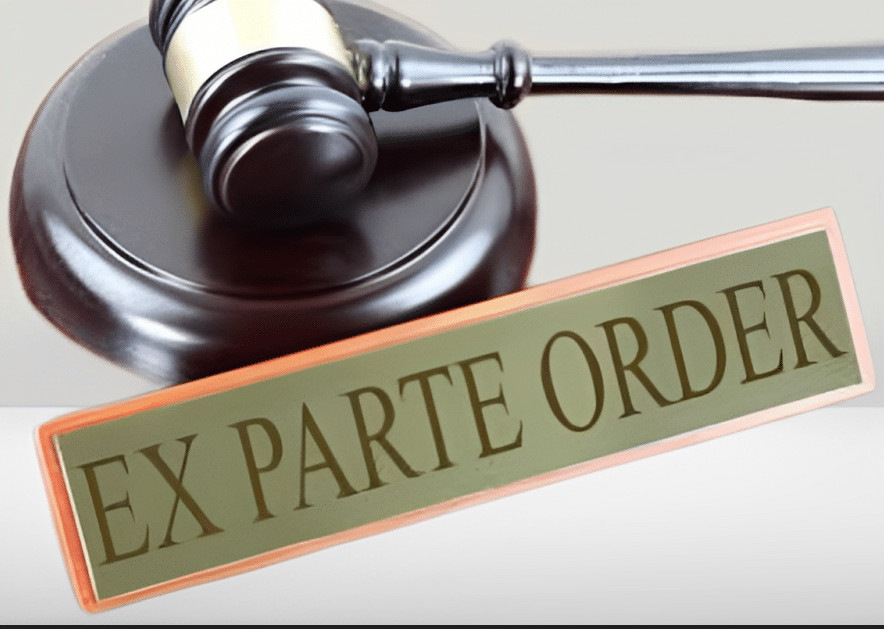
- An ‘Ex parte decree’ is a decree passed against a defendant in absentia.
- Despite service of summons, where on the date of hearing only the plaintiff does and a defendant does not appear, the court may hear the suit ex parte and pass a decree against the defendant.
- The legal validity, enforceability, and operation of such a decree are similar to those of any bipartite decree.
- Can an Ex-Parte Decree be set aside?
- Courts generally aim to ensure fairness and due process, and if a genuine reason for the party’s absence is established, the ex-parte order can be set aside, allowing for a reevaluation of the case with both parties present.
- The defendant against whom an ex-parte decree is passed can file an application to the court that passed such a decree to set it aside on two grounds:
- Summons was not duly served upon him.
- He was prevented by sufficient cause from appearing before court.
- As per the CPC, there is no specific time limit mentioned to file an application to set aside the ex-parte order, but it is advisable to file the application as soon as possible after becoming aware of the ex-parte order.
- Supporting Evidence: The applicant should provide supporting evidence to substantiate their claim. For example, if the ground for setting aside the order is improper service of summons, the applicant may need to provide proof that the summons was not served correctly.
- Hearing: The court will schedule a hearing to consider the application. The court will assess the validity of the grounds presented by the applicant and may inquire into the circumstances that led to the ex-parte order.
- Discretion of the Court:
- The court has the discretion to decide whether the grounds presented are sufficient and whether the ex-parte order should be set aside.
- The court may also impose conditions and terms, including costs and other factors, when setting aside the order.
Q1) What is the Code of Civil Procedure, 1908 (CPC)?
The Code of Civil Procedure, 1908 is a procedural law related to the administration of civil proceedings in India. The Code is divided into two parts: the first part contains 158 sections and the second part contains the First Schedule, which has 51 Orders and Rules.


 Last updated on Oct, 2026
→ UPSC 2027 Notification will be released on 13 January 2027 at upsconline.nic.in.
→ Check Nobel Prize 2026 Winners List here.
→ Download PIB PRiSM Monthly Magazine 2026 here.
→ Check UPSC Monthly Current Affairs Magazine The Recitals here.
→ Check out the latest UPSC Syllabus here.
→ Download UPSC Model Answers for Mains 2026
→ UPSC Mains Question Paper 2026 is out now for Essay & GS Paper 1, 2, 3 & 4.
→ UPSC Calendar 2027 has been released.
→ Enroll in Vajiram & Ravi’s UPSC Mains Test Series 2027 for structured answer writing practice, expert evaluation, and exam-oriented feedback.
→ Join Vajiram & Ravi’s UPSC Mentorship Program 2027 for personalized guidance, strategy planning, and one-to-one support from experienced mentors.
→ Go through the UPSC Mains Previous Year Papers to enhance your preparation.
→ UPSC has released UPSC Toppers List 2025 with the Civil Services final result on its official website.
→ Also check Best UPSC Coaching in India