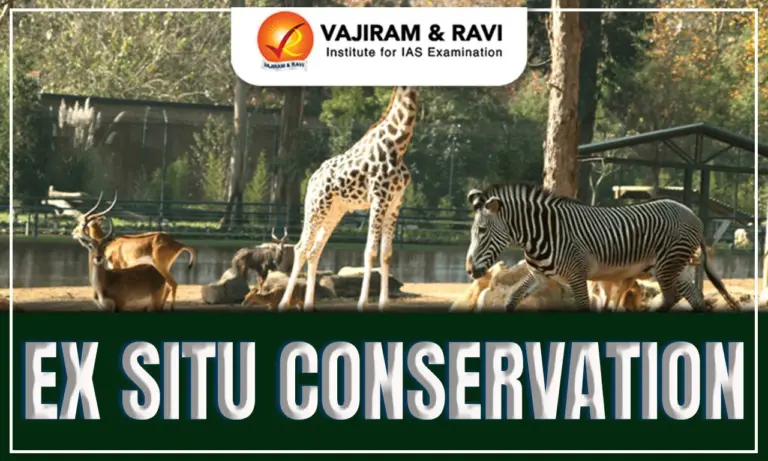
Ex-situ Conservation is important for biodiversity management. While Ex-situ conservation provides a safety net by preserving species outside their natural environment, In-situ conservation protects species within their natural habitat. The process is a complementary approach, making sure that species face extinction in the wild, their genetic material and populations can be safeguarded and potentially restored. In this article, we are going to cover Ex-situ conservation, its examples and applications in biodiversity preservation.
Ex-situ Conservation
- Ex-situ Conservation means the preservation of species, genetic material and ecosystems outside their natural habitats. This includes using specialised facilities, scientific techniques and controlled environments to ensure long term survival and potential reintroduction of endangered species.
- The process includes conservation of genetic resources, cultivated species and wild species through methods such as seed banks, zoological parks, botanical gardens and cryopreservation. Madhya Pradesh, Uttar Pradesh and Rajasthan are examples of introduction of Gangetic gharial in the river that were extinct before. Ex-situ conservation doesn’t only safeguard genetic diversity and also provide opportunity for research, education and restoration of ecosystems.
Ex-situ Biodiversity Conservation Methods
Ex-situ conservation provides many methods that are both scientific and institutional in nature. These activities include:
1. Botanical Gardens
- Botanical gardens keep a living collection of plants that are maintained and documented for research, conservation and education.
- These gardens support seeds, cuttings, tissue culture and genetically representative collections.
- These facilities help conserve rare plant species but also serve as a centre of education, public awareness and reintroduction programmes.
2. Zoological Parks
- Zoological parks are places where animals are kept in controlled enclosures, protected from threats in the wild.
- Beyond public display, the parks act as breeding centres for endangered species through cooperative global programmes.
- Studbooks and coordinated breeding strategies ensure that genetic diversity is maintained for possible future reintroduction.
- For example, projects involving the Asiatic lion, Bengal tiger, and Red Panda have greatly benefited from such initiatives.
3. Gene Banks
- Gene banks store genetic material such as DNA, embryos, and sperms for future use in research and breeding.
- They act as a safeguard against extinction by ensuring that valuable genetic diversity is available for conservation and crop improvement programmes.
- For endangered species, gene banks are particularly useful in assisted breeding and genetic restoration.
4. Seed Banks
- Seed banks preserve plant seeds under controlled conditions to maintain genetic diversity.
- They are highly cost-effective, easy to maintain, and capable of storing large quantities for long durations.
- Seeds stored in these banks are important for:
- Developing crops with better yield, drought resistance, and disease tolerance.
- Conserving rare and endangered species that may otherwise disappear from natural ecosystems.
- Examples include the Svalbard Global Seed Vault in Norway and the National Bureau of Plant Genetic Resources (NBPGR) in India.
5. Cryopreservation
- Cryopreservation is the technique of preserving biological material at extremely low temperatures (–80°C using solid CO₂ or –196°C using liquid nitrogen).
- At such low temperatures, biological activities cease, preventing deterioration.
- It is particularly effective for:
- Plant germplasm conservation (e.g., banana, coffee, coconut).
- Vegetatively propagated species such as fruit trees and tuber crops.
- Preservation of genetically transformed tissues and plant pathogens for research.
- For livestock, it is widely used to preserve sperm and embryos for future breeding.





Ex-Situ Conservation Uses and Importance
Ex-situ conservation has the following uses and importance:
- Gives a back-up system for species threatened in the wild.
- Allows research and genetic studies on rare and endangered organisms.
- Ensures food security through crop gene conservation.
- Enables captive breeding and reintroduction programmes.
- Facilitates public awareness and education through botanical and zoological parks.

 Last updated on March, 2026
→ UPSC Final Result 2025 is now out.
→ UPSC has released UPSC Toppers List 2025 with the Civil Services final result on its official website.
→ Anuj Agnihotri secured AIR 1 in the UPSC Civil Services Examination 2025.
→ UPSC Marksheet 2025 is now out.
→ UPSC Notification 2026 & UPSC IFoS Notification 2026 is now out on the official website at upsconline.nic.in.
→ UPSC Calendar 2026 has been released.
→ Check out the latest UPSC Syllabus 2026 here.
→ UPSC Prelims 2026 will be conducted on 24th May, 2026 & UPSC Mains 2026 will be conducted on 21st August 2026.
→ The UPSC Selection Process is of 3 stages-Prelims, Mains and Interview.
→ Prepare effectively with Vajiram & Ravi’s UPSC Prelims Test Series 2026 featuring full-length mock tests, detailed solutions, and performance analysis.
→ Enroll in Vajiram & Ravi’s UPSC Mains Test Series 2026 for structured answer writing practice, expert evaluation, and exam-oriented feedback.
→ Join Vajiram & Ravi’s Best UPSC Mentorship Program for personalized guidance, strategy planning, and one-to-one support from experienced mentors.
→ Shakti Dubey secures AIR 1 in UPSC CSE Exam 2024.
→ Also check Best UPSC Coaching in India
Ex Situ Conservation FAQs
Q1. What is ex-situ conservation?+
Q2. What is the importance of ex-situ conservation?+
Q3. What is ex-situ and in-situ conservation?+
Q4. What are seed banks?+
Q5. What are zoological parks?+
Tags: ex situ conservation