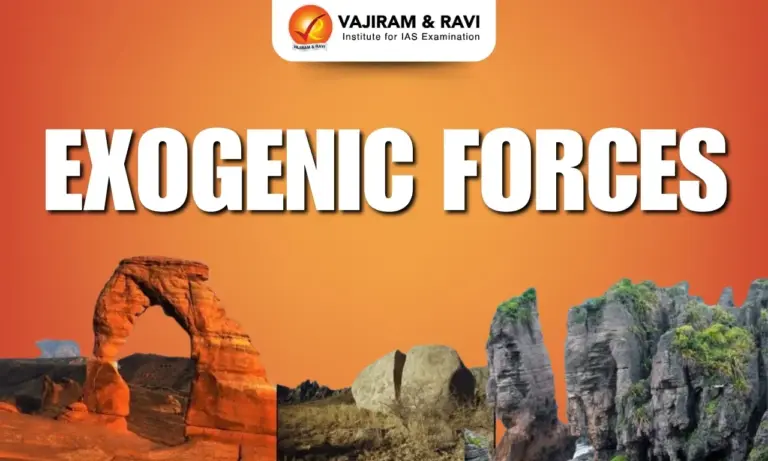
Exogenic Forces are external geomorphic forces that operate on the Earth’s surface and shape landforms by breaking down rocks and redistributing materials. These forces originate outside the Earth’s crust and derive their energy primarily from the Sun. Through continuous interaction with atmosphere, hydrosphere, and biosphere, Exogenic Forces slowly but persistently modify relief features over geological time. Although their effects appear gradual, long-term action causes extensive transformation of mountains, plateaus, plains, and coastal regions across the planet.
Exogenic Forces Definition
Exogenic Forces refer to geomorphic processes driven by external agents such as wind, water, ice, waves, and biological activity that act on Earth’s surface. These processes include weathering, erosion, transportation, and deposition, collectively responsible for denudation. Unlike internal tectonic forces that build landforms, Exogenic Forces predominantly reduce elevation by wearing down rocks through mechanical stress, chemical reactions, and gravitational movement, reshaping landscapes continuously under the influence of solar energy.
Exogenic Forces Process
Exogenic Forces operate through a sequence of interlinked geomorphic processes driven by solar energy, gravity, and atmospheric circulation patterns.
- Weathering: In-situ breakdown of rocks without material movement due to physical, chemical, and biological actions.
- Erosion: Removal of weathered material by running water, wind, glaciers, or waves.
- Transportation: Movement of eroded sediments through fluvial, aeolian, glacial, or marine agents.
- Deposition: Accumulation of transported material when carrying capacity of agents decreases.
- Denudation: Combined effect of weathering, erosion, transportation, and deposition lowering land surface.
- Gravitational Movement: Downslope transfer of materials under Earth’s gravity without external transporting medium.
- Stress Induction: Temperature changes create molecular stresses within rocks causing structural fatigue.
- Chemical Bond Weakening: Chemical reactions loosen mineral bonds accelerating rock disintegration.
- Surface Energy Control: Solar radiation regulates rainfall, winds, freeze-thaw cycles, and evaporation.
- Long-Term Landscape Evolution: Small-scale processes cumulatively reshape continents over millions of years.





Exogenic Forces Types
Exogenic Forces are classified based on the dominant process and agent responsible for landform modification.
- Weathering Forces: Processes breaking rocks at their original location without displacement.
- Erosional Forces: Agents removing loosened materials from Earth’s surface.
- Depositional Forces: Processes laying down sediments forming new landforms.
- Mass Wasting Forces: Gravity-driven movement of soil and rock downslope.
- Fluvial Forces: Running water shaping valleys, floodplains, and deltas.
- Aeolian Forces: Wind-driven erosion and deposition in arid and semi-arid regions.
- Glacial Forces: Ice movement sculpting high-latitude and high-altitude terrains.
- Marine Forces: Waves and currents reshaping coastlines.
- Biological Forces: Living organisms contributing to mechanical and chemical weathering.
- Anthropogenic Forces: Human-induced acceleration of natural exogenic processes.
Also Read: Endogenic Vs Exogenic Forces
Exogenic Forces Features
Exogenic Forces display distinct characteristics that differentiate them from endogenic processes.
- Solar Energy Driven: Sun’s heat controls winds, rainfall, evaporation, and weathering intensity.
- Surface-Oriented: Processes operate mainly on Earth’s crustal surface.
- Gradual Action: Changes occur slowly but continuously over long periods.
- Denudational Nature: Primarily reduce elevation rather than create relief.
- Climate Sensitive: Intensity varies with temperature, precipitation, and humidity.
- Material Redistribution: Transport sediments from highlands to lowlands.
- Repetitive Cycles: Weathering-erosion-deposition operate in continuous loops.
- Universally Active: Affect all climatic and geomorphic regions.
- Scale Dependent: Range from microscopic mineral changes to continental reshaping.
- Landscape Smoothing: Tend to flatten irregular topography over time.
Denudation Exogenic Forces
Denudation represents the cumulative effect of all Exogenic Forces stripping Earth’s surface.
- Meaning of Denudation: Derived from Latin “denudare” meaning to strip or expose.
- Process Coverage: Includes weathering, erosion, mass wasting, and transportation.
- Structural Control: Influenced by joints, bedding planes, faults, and folds.
- Lithological Control: Rock hardness and mineral composition determine denudation rate.
- Permeability Effect: Porous rocks weather faster due to water infiltration.
- Chemical Susceptibility: Minerals prone to corrosion denude rapidly.
- Climatic Influence: Humid tropics experience intense chemical denudation.
- Slope Dependency: Steeper slopes enhance erosional denudation.
- Time Scale: Operates over thousands to millions of years.
- Landscape Outcome: Produces peneplains, pediplains, and erosion surfaces.
Weathering Exogenic Forces
Weathering is the foundational Exogenic Force initiating landscape modification.
- In-Situ Process: Rock disintegration occurs without transportation.
- Physical Agents: Temperature, pressure, frost, and salt cause mechanical breakdown.
- Chemical Agents: Water, oxygen, carbon dioxide alter mineral composition.
- Biological Agents: Plants, animals, and microbes accelerate decay.
- Precursor Role: Supplies material for erosion and soil formation.
- Climate Dependence: Hot-wet climates favour chemical weathering.
- Rock Type Control: Igneous, sedimentary, and metamorphic rocks weather differently.
- Surface Exposure: Greater exposure increases weathering rate.
- Time Accumulation: Effects intensify with prolonged exposure.
- Soil Genesis: Weathering initiates soil development.
Exogenic Forces Physical Weathering
Physical weathering disintegrates rocks through mechanical stress without chemical alteration.
- Pressure Release Exfoliation: Removal of overburden causes sheet-like rock peeling.
- Sheeting: Expansion fractures parallel to surface in intrusive igneous rocks.
- Thermal Stress Weathering: Expansion and contraction due to temperature variation.
- Desert Effectiveness: Strong diurnal temperature range enhances exfoliation.
- Granular Disintegration: Differential heating separates mineral grains.
- Colour Absorption: Dark minerals expand more than light minerals.
- Freeze-Thaw Weathering: Water expansion on freezing widens rock cracks.
- Frost Wedging: Repeated freeze-thaw cycles force cracks apart.
- Shattering: Severe frost produces angular rock fragments.
- Block Disintegration: Joint-controlled splitting into angular blocks.
Exogenic Forces Salt Weathering
Salt crystallization is a powerful physical weathering mechanism in arid regions.
- Saline Infiltration: Salt solutions enter rock pores and fractures.
- Evaporation Effect: Water loss leaves salt crystals behind.
- Crystallization Pressure: Growing crystals exert outward force.
- Thermal Expansion: Heat enhances crystal expansion.
- Grain Splitting: Individual mineral grains detach.
- Granular Foliation: Surface layers peel off gradually.
- Arid Climate Dominance: Strong evaporation intensifies salt weathering.
- Coastal Occurrence: Sea spray supplies salts.
- Structural Weakening: Progressive loss of cohesion.
- Surface Flaking: Leads to rock surface decay
Also Read: Geomorphology
Exogenic Forces Mass Wasting
Mass wasting involves downslope movement driven solely by gravity.
- Gravity Dominance: No transporting agent required.
- Material Involved: Soil, regolith, debris, and rock fragments.
- Slope Threshold: Occurs when driving force exceeds resisting force.
- Rapid Events: Landslides and debris flows occur within seconds.
- Slow Movements: Soil creep operates over centuries.
- Trigger Factors: Rainfall, earthquakes, deforestation increase risk.
- Alluvial Fans: Depositional features at slope bases.
- Mountain Regions: High relief increases mass wasting frequency.
- Human Impact: Construction destabilises slopes.
- Landscape Reshaping: Gradually reduces slope angles.
Exogenic Forces Chemical Weathering
Chemical weathering alters rock composition through chemical reactions.
- Dissolution: Soluble minerals dissolve directly in water.
- Solution Weathering: Acidic solutions enhance mineral dissolution.
- Carbonation: Carbon dioxide forms carbonic acid dissolving limestone.
- Karst Formation: Caves develop in carbonate rock regions.
- Temperature Control: Colder water retains more carbon dioxide.
- Anthropogenic Acid Rain: Sulphur dioxide lowers rainwater pH below 4.
- Hydration: Mineral water absorption increases volume.
- Hydrolysis: Water reacts with silicate minerals causing decomposition.
- Oxidation: Iron reacts with oxygen forming rust.
- Reduction: Oxygen-poor environments reverse oxidation effects.
Exogenic Forces Biological Weathering
Living organisms significantly contribute to both mechanical and chemical weathering.
- Lichen Colonisation: Creates acidic microenvironment on bare rocks.
- Root Pressure: Growing roots widen cracks physically.
- Burrowing Activity: Animals expose fresh rock surfaces.
- Microbial Acids: Organic acids dissolve minerals.
- Humic Acid Formation: Decaying matter enhances chemical decay.
- Algae Action: Concentrates iron and manganese oxides.
- Soil Formation Role: Organic matter enriches weathered material.
- Moisture Retention: Vegetation increases rock-water interaction.
- Nutrient Cycling: Releases mineral nutrients into ecosystems.
- Long-Term Impact: Gradual but persistent landscape alteration.
Exogenic Forces Significance
Exogenic Forces play a fundamental role in Earth system functioning.
- Soil Formation: Convert bedrock into fertile soil.
- Resource Availability: Enrich ores by leaching unwanted minerals.
- Landscape Evolution: Shape valleys, plains, and coastal features.
- Ecosystem Support: Provide nutrients for vegetation growth.
- Hydrological Balance: Influence drainage patterns.
- Human Settlement: Create habitable landforms.
- Sediment Supply: Support riverine and marine ecosystems.
- Climate Interaction: Regulate carbon dioxide through weathering.
- Economic Importance: Enable agriculture and mining.
- Earth Surface Renewal: Maintain dynamic equilibrium of landscapes.

 Last updated on April, 2026
→ UPSC Final Result 2025 is now out.
→ UPSC has released UPSC Toppers List 2025 with the Civil Services final result on its official website.
→ Anuj Agnihotri secured AIR 1 in the UPSC Civil Services Examination 2025.
→ UPSC Marksheet 2025 is now out.
→ UPSC Notification 2026 & UPSC IFoS Notification 2026 is now out on the official website at upsconline.nic.in.
→ UPSC Calendar 2026 has been released.
→ Check out the latest UPSC Syllabus 2026 here.
→ UPSC Prelims 2026 will be conducted on 24th May, 2026 & UPSC Mains 2026 will be conducted on 21st August 2026.
→ The UPSC Selection Process is of 3 stages-Prelims, Mains and Interview.
→ Prepare effectively with Vajiram & Ravi’s UPSC Prelims Test Series 2026 featuring full-length mock tests, detailed solutions, and performance analysis.
→ Enroll in Vajiram & Ravi’s UPSC Mains Test Series 2026 for structured answer writing practice, expert evaluation, and exam-oriented feedback.
→ Join Vajiram & Ravi’s Best UPSC Mentorship Program for personalized guidance, strategy planning, and one-to-one support from experienced mentors.
→ Shakti Dubey secures AIR 1 in UPSC CSE Exam 2024.
→ Also check Best UPSC Coaching in India
Exogenic Forces FAQs
Q1. What are Exogenic Forces?+
Q2. What is the main energy source of Exogenic Forces?+
Q3. Which processes are included under Exogenic Forces?+
Q4. How are Exogenic Forces different from Endogenic Forces?+
Q5. Why are Exogenic Forces important?+
Tags: exogenic forces