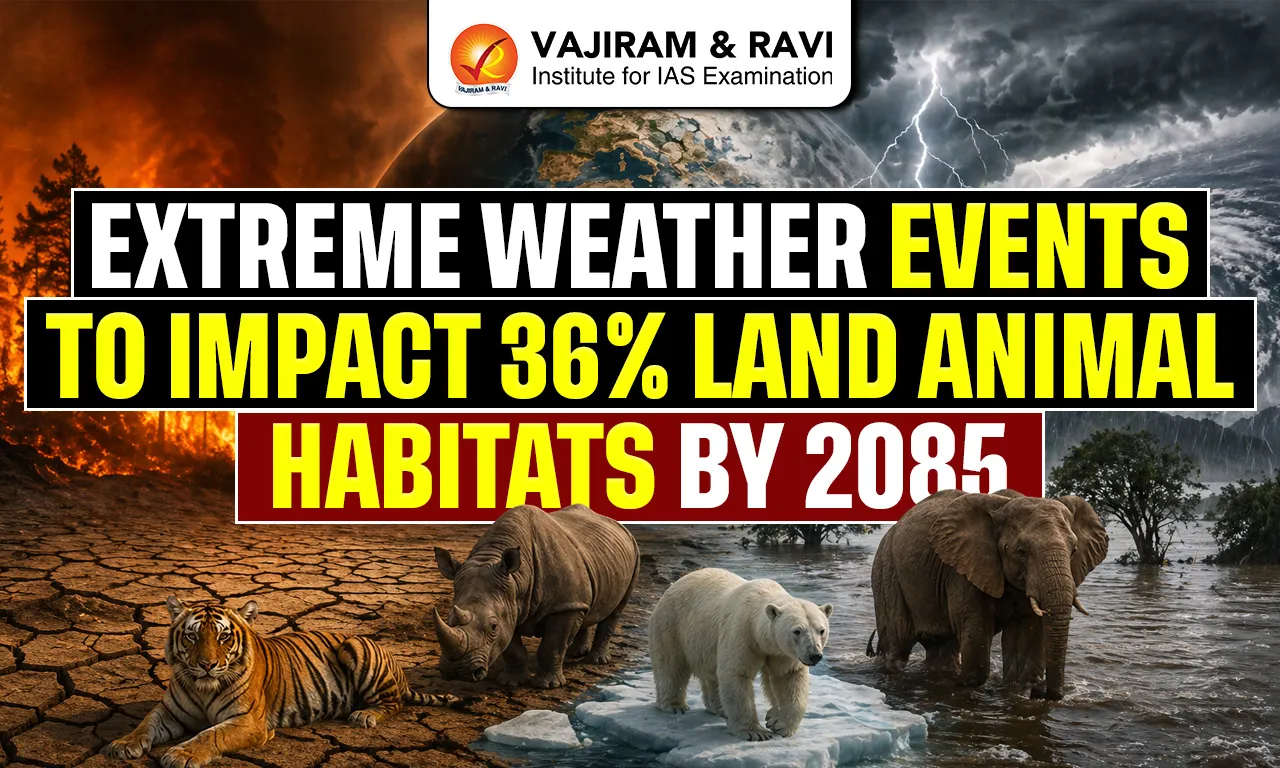
A recent study published in the journal Nature Ecology & Evolution warns that extreme weather events could severely disrupt global biodiversity, with nearly 36% of terrestrial animal habitats at risk by 2085, if current emission trends continue.
Key Findings of the Study
The study, conducted by researchers from the Potsdam Institute for Climate Impact Research, provides a comprehensive assessment of climate risks to biodiversity. It analysed 33,936 terrestrial vertebrate species across 794 ecoregions using climate projections and impact simulations.
- By 2085, around 36% of terrestrial habitats could experience compounded extreme events such as heatwaves, wildfires, droughts, and floods.
- By 2050, 74% of animal habitats on land will be exposed to heatwaves, 16% to wildfire, 8% to droughts, and 3% to floods if warming continues into the latter half of the century.
- Biodiversity hotspots such as the Amazon, tropical Africa, and Southeast Asia are expected to witness the highest increase in extreme events.
What are Compounded Climate Events?
The study introduces the concept of compounded climate risks, which significantly amplifies ecological damage.
- These refer to multiple extreme weather events occurring simultaneously or in quick succession.
- Their combined impact is greater than the sum of individual events, leading to cascading ecological failures.
- For example, drought followed by wildfire weakens ecosystems, resulting in higher species mortality.
- Evidence from the 2019-20 Australian bushfires shows 27-40% greater species decline in drought-affected areas.
Also Read: Climate of India


Impact on Biodiversity
Extreme weather events are already causing widespread damage to ecosystems and species survival.
- The 2019-20 Australian heatwave killed over 72,000 flying foxes.
- Wildfires in the Pantanal region (South America) resulted in the death of nearly 17 million vertebrates.
- Native species tend to be more vulnerable than non-native species due to lower adaptability.
- Loss of vegetation affects food availability, shelter, and breeding patterns, disrupting entire ecosystems.
- The study finds that while some species may temporarily benefit from extreme events, for example the ornate chorus frog faces less predation during droughts, overall, the increasing intensity and frequency of such events due to climate change are exceeding the ability of most species to adapt.
Concerns with Current Conservation Planning
The findings reveal significant gaps in existing biodiversity conservation strategies.
- Most conservation frameworks focus on gradual temperature rise rather than extreme events.
- Extreme events are still underestimated in conservation planning.
- Lack of integration of compound risks and climate shocks makes current strategies inadequate.
- This calls for a shift towards dynamic, risk-based, and resilience-focused conservation models.
Also Read: Climatic Regions
Can the Situation be Reversed?
Despite the alarming projections, the study makes it clear that the outcome is not inevitable and can still be altered through timely action.
- Achieving net-zero emissions can dramatically reduce the share of habitats exposed to multiple extreme events from about 36% to nearly 9%, highlighting the power of mitigation.
- Rapid and sustained cuts in greenhouse gas emissions can limit the intensity and frequency of extreme events, thereby protecting biodiversity and ecosystem stability.
- The findings emphasise that immediate and coordinated global action is crucial to avoid long-term and irreversible ecological damage, making the present decade decisive for conservation efforts.

 Last updated on Oct, 2026
→ UPSC 2027 Notification will be released on 13 January 2027 at upsconline.nic.in.
→ Check Nobel Prize 2026 Winners List here.
→ Download PIB PRiSM Monthly Magazine 2026 here.
→ Check UPSC Monthly Current Affairs Magazine The Recitals here.
→ Check out the latest UPSC Syllabus here.
→ Download UPSC Model Answers for Mains 2026
→ UPSC Mains Question Paper 2026 is out now for Essay & GS Paper 1, 2, 3 & 4.
→ UPSC Calendar 2027 has been released.
→ Enroll in Vajiram & Ravi’s UPSC Mains Test Series 2027 for structured answer writing practice, expert evaluation, and exam-oriented feedback.
→ Join Vajiram & Ravi’s UPSC Mentorship Program 2027 for personalized guidance, strategy planning, and one-to-one support from experienced mentors.
→ Go through the UPSC Mains Previous Year Papers to enhance your preparation.
→ UPSC has released UPSC Toppers List 2025 with the Civil Services final result on its official website.
→ Also check Best UPSC Coaching in India
Extreme weather events to impact 36% land animal habitats by 2085 FAQs
Q1. What does the study in Nature Ecology & Evolution say about the impact of extreme weather on animal habitats?+
Q2. What are compounded climate events?+
Q3. Which regions are most vulnerable to these impacts?+
Q4. How do extreme weather events affect biodiversity?+
Q5. Can these impacts be reduced or prevented?+
Tags: environmental science extreme weather events to impact 36% land animal habitats by 2085