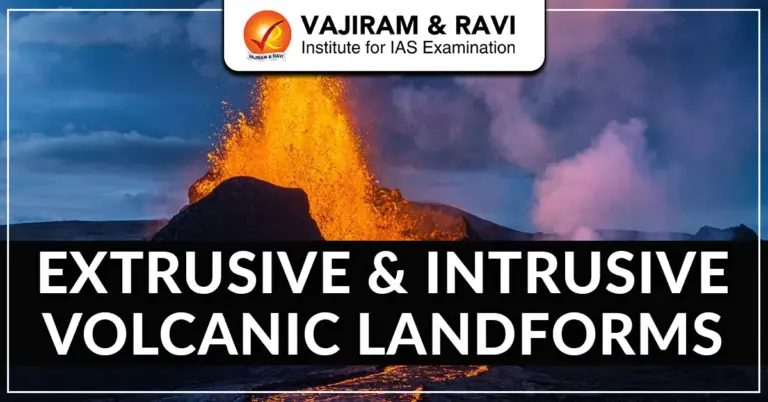
Volcanic landforms are geological features created by the movement, eruption, cooling, and solidification of magma and lava originating from the Earth’s interior. These landforms are broadly classified into extrusive and intrusive types depending on whether the molten material solidifies above the Earth’s surface or within the crust. Volcanic processes shape continents, ocean floors, plate boundaries, and mineral rich regions, playing a critical role in Earth’s geomorphological evolution. Globally, volcanic landforms cover nearly 8% of the Earth’s surface and dominate tectonically active zones.
Extrusive Volcanic Landforms
Extrusive volcanic landforms are surface features formed when molten magma reaches the Earth’s exterior as lava, ash, gases, or fragmented materials and rapidly cools. These landforms develop directly above the crust and include lava flows, volcanic cones, plateaus, craters, and calderas. The rocks formed through this process are igneous in nature, often basaltic due to low silica content, and they strongly influence surface topography, soil fertility, and atmospheric composition.
Also Read: Landforms of the Earth
Extrusive Volcanic Landforms Features
Extrusive volcanic landforms display rapid cooling textures, wide spatial spread, and direct interaction with atmospheric and hydrological processes, producing diverse surface expressions.
- Surface Formation: Extrusive landforms form above the crust when lava, ash, and gases solidify rapidly after eruption, producing fine grained igneous rocks.
- Material Composition: These landforms consist of lava flows, ash, volcanic bombs, pyroclasts, and gases such as sulphur compounds, nitrogen compounds, hydrogen, and argon.
- Cooling Rate: Rapid cooling at the surface prevents crystal growth, leading to glassy or fine textured rocks like basalt and obsidian.
- Topographic Impact: Extrusive features create cones, plateaus, ridges, and depressions that strongly modify surface relief and drainage systems.
- Global Distribution: Extrusive landforms dominate mid ocean ridges, rift valleys, volcanic arcs, and hotspot regions such as Hawaii and Iceland.





Extrusive Volcanic Landform Formation
Extrusive landforms form through distinct eruptive processes depending on magma viscosity, gas content, and tectonic setting.
- Effusive Eruption: Low viscosity basaltic magma flows smoothly through fissures, spreading over vast areas to form lava plains and plateaus.
- Explosive Eruption: High viscosity magma traps gases, leading to violent explosions that eject ash, bombs, and pyroclastic material.
- Fissure Eruption: Lava escapes through long linear cracks, forming extensive basalt sheets without central cone development.
- Central Vent Eruption: Magma rises through cylindrical vents, building steep cones composed of layered lava and pyroclastic deposits.
- Submarine Eruption: Lava erupts beneath oceans at mid ocean ridges, forming pillow lavas and contributing to seafloor spreading.
Extrusive Volcanic Landform Classification
Extrusive landforms are classified based on eruption style, material dominance, and surface morphology.
- Conical Vent Volcanoes: Narrow cylindrical vents eject magma violently, forming steep cones commonly associated with andesitic composite volcanoes.
- Fissure Vent Volcanoes: Linear vents several kilometres long allow basaltic lava to spread laterally, forming extensive lava fields.
- Composite Volcanoes: Alternating layers of lava and pyroclastic debris build tall stratovolcanoes with steep slopes and explosive behavior.
- Shield Volcanoes: Broad, gently sloping structures formed by repeated basaltic lava flows, producing the largest volcanoes by volume.
- Flood Basalt Plateaus: Successive fissure eruptions create flat, layered lava plateaus covering thousands of square kilometres.
- Crater Landforms: Bowl shaped depressions formed at volcanic summits due to eruptive excavation or collapse of vent material.
- Caldera Landforms: Large cauldron like depressions created by the collapse of emptied magma chambers after massive eruptions.
- Cinder Cones: Steep sided cones formed from loose pyroclastic fragments accumulated around a single eruptive vent.
- Lava Domes: Mound shaped protrusions formed by slow extrusion of highly viscous magma accumulating near the vent.
- Pseudo Volcanic Features: Non volcanic landforms resembling volcanoes, including meteorite craters, salt domes, and mud volcanoes.
Also Read: Glacial Landforms
Extrusive Volcanic Landform Examples
Extrusive volcanic landforms are best understood through globally significant physical examples.
- Mid Ocean Ridges: Over 70,000 kilometres long, these submarine volcanic chains continuously produce basaltic lava and expand ocean basins.
- Mauna Loa: The world’s largest active shield volcano in Hawaii, built entirely from low viscosity basaltic lava flows.
- Deccan Traps: One of the largest flood basalt provinces, covering nearly 500,000 square kilometres of western and central India.
- Mount Fuji: A classic composite volcano in Japan formed through repeated explosive and effusive eruptions.
- Lake Toba: The largest volcanic caldera lake, formed after a supereruption approximately 75,000 years ago in Indonesia.
- Crater Lake: Formed by the collapse of Mount Mazama, this caldera lake is among the deepest in the United States.
- Lonar Lake: A meteorite impact crater lake in Maharashtra, demonstrating pseudo volcanic surface resemblance.
Intrusive Volcanic Landforms
Intrusive volcanic landforms are features formed when magma cools and solidifies beneath the Earth’s surface within the crust. These landforms never erupt directly but crystallize slowly, forming coarse grained plutonic rocks. Over time, erosion and denudation expose these features at the surface. Intrusive landforms provide critical insights into magma chamber dynamics and deep crustal processes.
Intrusive Volcanic Landforms Features
Intrusive landforms exhibit slow cooling, large crystal development, and subsurface emplacement.
- Subsurface Formation: Intrusive landforms develop below the crust where magma solidifies without surface eruption.
- Rock Texture: Slow cooling allows large crystals to form, producing coarse grained plutonic rocks like granite.
- Structural Control: These landforms intrude along planes of weakness such as joints, bedding planes, and folds.
- Erosional Exposure: Intrusive bodies appear at the surface only after prolonged erosion removes overlying materials.
- Tectonic Significance: Intrusive landforms often mark ancient magma chambers and plate boundary activity.
Intrusive Volcanic Landform Formation
Intrusive landforms form through magma emplacement and crystallization within the crust.
- Vertical Intrusion: Magma forces its way upward through fractures, solidifying as wall like structures.
- Horizontal Intrusion: Magma spreads laterally along weak bedding planes, forming sheet like bodies.
- Dome Intrusion: Viscous magma accumulates and uplifts overlying strata into dome shaped intrusions.
- Saucer Shaped Intrusion: Magma settles in concave forms due to pressure and gravitational equilibrium.
- Fold Controlled Intrusion: Magma occupies structural lows and highs in folded strata.
Also Read: Fluvial Landforms
Intrusive Volcanic Landform Classification
Intrusive landforms are classified based on size, shape, and orientation.
- Batholiths: Massive granitic bodies formed deep within the crust, often forming the core of major mountain ranges.
- Laccoliths: Dome shaped intrusions with flat bases, connected to magma chambers through vertical conduits.
- Lapoliths: Saucer shaped intrusions concave upward, formed when magma spreads horizontally along weak planes.
- Phacoliths: Wavy intrusions found at anticline crests or syncline troughs within folded rock systems.
- Sills: Thick horizontal intrusions emplaced parallel to bedding planes within sedimentary sequences.
- Sheets: Thin, tabular horizontal intrusions formed by limited magma supply.
- Dykes: Vertical or steeply inclined wall like intrusions that cut across existing rock layers.
Intrusive Volcanic Landform Examples
Intrusive volcanic landforms are well represented by exposed geological structures worldwide.
- Sierra Nevada Batholith: A massive granitic batholith forming the backbone of California’s mountain system.
- Karnataka Plateau: Characterized by granite domes representing exposed laccoliths and batholiths.
- Western Maharashtra Dykes: Dense dyke networks that acted as feeders for Deccan Trap flood basalts.
- Bushveld Complex: One of the world’s largest layered intrusive complexes, rich in platinum group metals.
- Deccan Trap Feeders: Vertical dykes supplying repeated basaltic eruptions during Late Cretaceous volcanism.

 Last updated on March, 2026
→ UPSC Final Result 2025 is now out.
→ UPSC has released UPSC Toppers List 2025 with the Civil Services final result on its official website.
→ Anuj Agnihotri secured AIR 1 in the UPSC Civil Services Examination 2025.
→ UPSC Marksheet 2025 is now out.
→ UPSC Notification 2026 & UPSC IFoS Notification 2026 is now out on the official website at upsconline.nic.in.
→ UPSC Calendar 2026 has been released.
→ Check out the latest UPSC Syllabus 2026 here.
→ UPSC Prelims 2026 will be conducted on 24th May, 2026 & UPSC Mains 2026 will be conducted on 21st August 2026.
→ The UPSC Selection Process is of 3 stages-Prelims, Mains and Interview.
→ Prepare effectively with Vajiram & Ravi’s UPSC Prelims Test Series 2026 featuring full-length mock tests, detailed solutions, and performance analysis.
→ Enroll in Vajiram & Ravi’s UPSC Mains Test Series 2026 for structured answer writing practice, expert evaluation, and exam-oriented feedback.
→ Join Vajiram & Ravi’s Best UPSC Mentorship Program for personalized guidance, strategy planning, and one-to-one support from experienced mentors.
→ Shakti Dubey secures AIR 1 in UPSC CSE Exam 2024.
→ Also check Best UPSC Coaching in India
Extrusive and Intrusive Volcanic Landforms FAQs
Q1. What are Extrusive Volcanic Landforms?+
Q2. What are Intrusive Volcanic Landforms?+
Q3. Which rocks are formed by Extrusive and Intrusive processes?+
Q4. Why do Intrusive Volcanic Landforms have large crystals?+
Q5. What is the major example for Extrusive and Intrusive Volcanic Landforms?+
Tags: extrusive and intrusive volcanic landforms