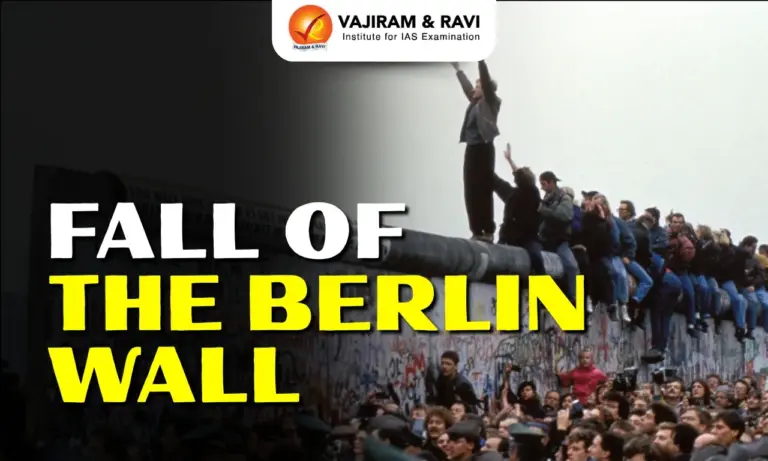
The Berlin Wall, built in 1961, divided East and West Germany for 28 years, symbolizing the Cold War divide. The Fall of the Berlin Wall in 1989 was triggered by mass protests, economic stagnation, and political reforms in the Soviet Union. The event marked the end of the Cold War, leading to German reunification and democratic reforms across Eastern Europe. It also had lasting political, economic, social, and global impacts, inspiring freedom movements worldwide.
Fall of the Berlin Wall 1989
The Berlin Wall, built in 1961, physically and ideologically divided East and West Germany for nearly three decades. The Fall of the Berlin Wall in 1989 was due to mass protests, political reforms in the Soviet Union, and economic difficulties in East Germany. Its collapse marked the end of the Cold War and paved the way for German reunification. The event also inspired democracy movements across Eastern Europe and became a global symbol of freedom.
Fall of the Berlin Wall Causes
Several factors contributed to the Fall of the Berlin Wall, making it inevitable by late 1989:
- Political Reforms in the Soviet Union: Under Mikhail Gorbachev, policies like Perestroika (economic restructuring) and Glasnost (political openness) encouraged reform and weakened Soviet control over Eastern Europe.
- Mass Pro-Democracy Protests: Cities like Leipzig and East Berlin saw continuous demonstrations demanding freedom of movement, political reforms, and better living conditions.
- Economic Stagnation in East Germany: East Germany’s planned economy faced shortages of goods, low productivity, and limited opportunities, creating widespread public dissatisfaction.
- Emigration Pressure: Many East Germans fled through neighboring countries such as Hungary and Czechoslovakia, highlighting the regime’s inability to control migration.
- Diplomatic Shifts: The Soviet Union adopted a non-interventionist stance, signaling that it would not use force to maintain East Germany’s communist regime, emboldening citizens and reformers.





Fall of the Berlin Wall Significance
The Fall of the Berlin Wall had profound historical, political, and social significance:
- End of Cold War Division: It marked the decline of Soviet influence in Eastern Europe and the beginning of a new era in global politics.
- German Reunification: Germany officially reunited on 3 October 1990, symbolizing national unity and European integration.
- Democratic Movements: The event inspired pro-democracy movements across Eastern Europe, including in Czechoslovakia and Romania.
- Symbol of Freedom: The Wall became a global icon of liberation from oppression, representing the triumph of liberty over authoritarianism.
Fall of the Berlin Wall Impact
- The Fall of the Berlin Wall marked the end of the Cold War and the collapse of communist regimes in Eastern Europe.
- It led to German reunification on 3 October 1990, restoring a single democratic Germany.
- East Germany integrated into a market-oriented economy, leading to modernization, infrastructure development, and increased investment.
- Citizens regained freedom of movement, expression, and travel, reuniting families and communities separated for decades.
- The event inspired pro-democracy movements across Eastern Europe, including in Czechoslovakia and Romania.
- It became a global symbol of liberty and human resilience, showing the power of popular movements over authoritarian control.
- The fall reshaped geopolitics in Europe, contributing to the expansion of NATO and the European Union and redefining international relations.

 Last updated on March, 2026
→ UPSC Final Result 2025 is now out.
→ UPSC has released UPSC Toppers List 2025 with the Civil Services final result on its official website.
→ Anuj Agnihotri secured AIR 1 in the UPSC Civil Services Examination 2025.
→ UPSC Marksheet 2025 is now out.
→ UPSC Notification 2026 & UPSC IFoS Notification 2026 is now out on the official website at upsconline.nic.in.
→ UPSC Calendar 2026 has been released.
→ Check out the latest UPSC Syllabus 2026 here.
→ UPSC Prelims 2026 will be conducted on 24th May, 2026 & UPSC Mains 2026 will be conducted on 21st August 2026.
→ The UPSC Selection Process is of 3 stages-Prelims, Mains and Interview.
→ Prepare effectively with Vajiram & Ravi’s UPSC Prelims Test Series 2026 featuring full-length mock tests, detailed solutions, and performance analysis.
→ Enroll in Vajiram & Ravi’s UPSC Mains Test Series 2026 for structured answer writing practice, expert evaluation, and exam-oriented feedback.
→ Join Vajiram & Ravi’s Best UPSC Mentorship Program for personalized guidance, strategy planning, and one-to-one support from experienced mentors.
→ Shakti Dubey secures AIR 1 in UPSC CSE Exam 2024.
→ Also check Best UPSC Coaching in India
Fall of the Berlin Wall 1989 FAQs
Q1. When did the Berlin Wall fall?+
Q2. Why was the Berlin Wall built?+
Q3. How did the Berlin Wall impact Germany?+
Q4. How long did the Berlin Wall stand?+
Q5. What lessons does the fall of the Berlin Wall teach?+
Tags: fall of the berlin wall