What’s in Today’s Article?
- Why in News?
- What is the Financial Action Task Force (FATF)?
- About PFI
- Highlights of the FATF Report – ‘Crowdfunding for Terrorism Financing‘
- Other Reports of FATF Highlighting Different Modes of Money Laundering
- What Makes Crowdfunding an Attractive Method of Fundraising for Terrorist Financing?
- Way Ahead to Curb Terrorist Financing
Why in News?
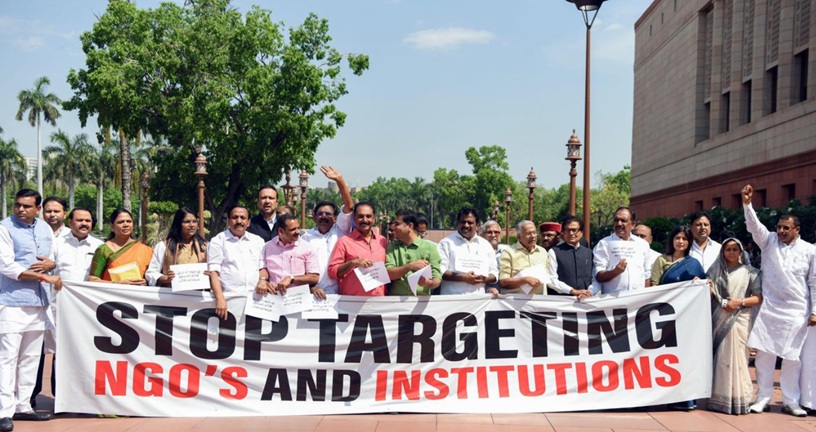
- According to the ‘Crowdfunding for Terrorism Financing’ report, recently published by the FATF, a violent extremist organisation under investigation in India collected funds through well-structured networks.
- Without naming the organisation, the Financial Action Task Force (FATF) report makes a reference to the Popular Front of India (PFI).





What is the Financial Action Task Force (FATF)?
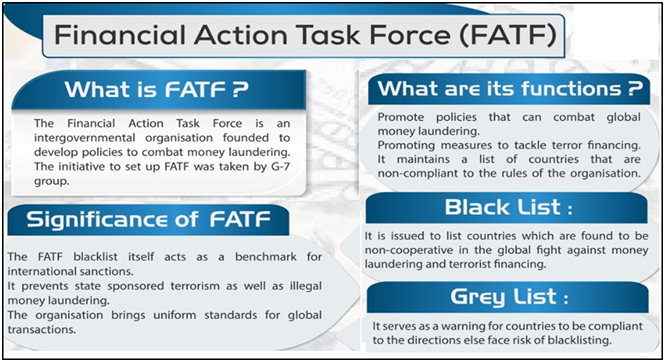
- It is an intergovernmental organisation founded in 1989 to develop policies to combat money laundering and its mandate was expanded to include terror financing in 2001.
- It operates from Organisation for Economic Cooperation and Development (OECD) headquarters in Paris and its plenary/ decision-making body meets three times per year.
- It has 39 members including India (became observer in 2006 and a full time member in 2010) and two regional organisations – the EU and GCC (Gulf cooperation council).
- FATF’s mandate –
- Recognises the need to continue to lead decisive, coordinated and effective global action to counter the threats of the abuse of the financial system by criminals and terrorists, and
- Strengthens its capacity to respond to these threats that all countries face.
- The FATF conducts peer reviews of each member on an ongoing basis to assess levels of implementation of the FATF Recommendations.
- It provides an in-depth description and analysis of each country’s system for preventing criminal abuse of the financial system.
- India is currently under the FATF review. It last underwent a similar review in 2013 where it was found that India had reached a satisfactory level of compliance.
About PFI
- The PFI was created in 2007 through the merger of 3 Muslim organisations in southern India, the National Democratic Front in Kerala, the Karnataka Forum for Dignity, and the Manitha Neethi Pasarai in Tamil Nadu.
- The PFI, which emerged in the aftermath of the ban on the Students Islamic Movement of India (SIMI), has projected itself as an organisation that fights for the rights of minorities, Dalits, and marginalised communities.
- In 2022, the Ministry of Home Affairs had declared the PFI along with its associates or affiliates or fronts as an “unlawful association”.
Highlights of the FATF Report – ‘Crowdfunding for Terrorism Financing‘
- The FATF report said the accounts of PFI involved both domestic and foreign transactions, making this case extremely difficult to investigate.
- Funds were ultimately used to procure arms and ammunition and for training the cadres of the violent extremist organisation, among other purposes.
- A portion of the funds raised through crowdfunding was also invested and parked in businesses and real estate projects to generate regular income for terrorism activities.
- The group’s fundraising tactics included offline and online mechanisms, such as circulating QR codes and account details through which donors were asked to send money.
Other Reports of FATF Highlighting Different Modes of Money Laundering
- Earlier, the FATF had included a case study in a report titled ‘Money Laundering and Terrorist Financing In The Arts And Antiques Market’ that resembled the ED’s case against former Yes Bank CMD Rana Kapoor.
- While FATF mentioned no name, it had made a reference to money laundering through paintings, including one bought from a close relative of a member of the ruling political party at that time for USD 264,000.
- The FATF report notes different ways in which crowdfunding platforms can be abused for terrorist financing purposes –
- Abuse of humanitarian, charitable or non-profit causes;
- Use of dedicated crowdfunding platforms or websites;
- Use of social media platforms and messaging apps; and
- Interaction of crowdfunding with virtual assets.
What Makes Crowdfunding an Attractive Method of Fundraising for Terrorist Financing?
- The possibility of quickly and easily reaching a global audience makes crowdfunding an attractive method of fundraising for terrorist financing.
- Some estimates have valued the global crowdfunding market at $17.2 billion in 2020 and note that it is expected to reach $34.6 billion by 2026.
- There were over 6 million crowdfunding campaigns around the world.
- Although the majority of crowdfunding activity is legitimate, terrorist groups (like ISIL) and ethnically or racially motivated terrorist (EoRMT) have exploited it to raise money for terrorist financing purposes.
- A terrorist may establish a fundraising campaign on a dedicated crowdfunding platform, share the campaign on social media, and request payment in virtual assets.
- While certain jurisdictions and industries proactively implement measures to mitigate these risks, anti-money laundering and counter-terrorist financing (AML/CFT) regulation is not consistent across the globe.
Way Ahead to Curb Terrorist Financing
- Countries should assess the nature, size and risks associated with all types and methods of crowdfunding in their particular jurisdiction, including companies, individuals or any other type of organisation.
- Countries should also take note of the risk analysis of the sector more globally given the cross-border nature of crowdfunding campaigns and associated financial transfers.
- Countries should recognise that even if their jurisdiction does not have significant terrorism activity domestically, their jurisdiction can still be used as a pass-through for financial flows.
Q1) What is the Organisation for Economic Cooperation and Development (OECD)?
The OECD is a unique forum where the governments of 37 democracies with market-based economies collaborate to develop policy standards to promote sustainable economic growth.
Q2) What do you mean by money laundering?
Money laundering is the process of hiding the source of money obtained from illegal sources and converting it to a clean source, thereby avoiding prosecution, conviction, and confiscation of the criminal funds. It is an illegal exercise that converts black money into white money.

 Last updated on March, 2026
→ UPSC Final Result 2025 is now out.
→ UPSC has released UPSC Toppers List 2025 with the Civil Services final result on its official website.
→ Anuj Agnihotri secured AIR 1 in the UPSC Civil Services Examination 2025.
→ UPSC Marksheet 2025 is now out.
→ UPSC Notification 2026 & UPSC IFoS Notification 2026 is now out on the official website at upsconline.nic.in.
→ UPSC Calendar 2026 has been released.
→ Check out the latest UPSC Syllabus 2026 here.
→ UPSC Prelims 2026 will be conducted on 24th May, 2026 & UPSC Mains 2026 will be conducted on 21st August 2026.
→ The UPSC Selection Process is of 3 stages-Prelims, Mains and Interview.
→ Prepare effectively with Vajiram & Ravi’s UPSC Prelims Test Series 2026 featuring full-length mock tests, detailed solutions, and performance analysis.
→ Enroll in Vajiram & Ravi’s UPSC Mains Test Series 2026 for structured answer writing practice, expert evaluation, and exam-oriented feedback.
→ Join Vajiram & Ravi’s Best UPSC Mentorship Program for personalized guidance, strategy planning, and one-to-one support from experienced mentors.
→ Shakti Dubey secures AIR 1 in UPSC CSE Exam 2024.
→ Also check Best UPSC Coaching in India