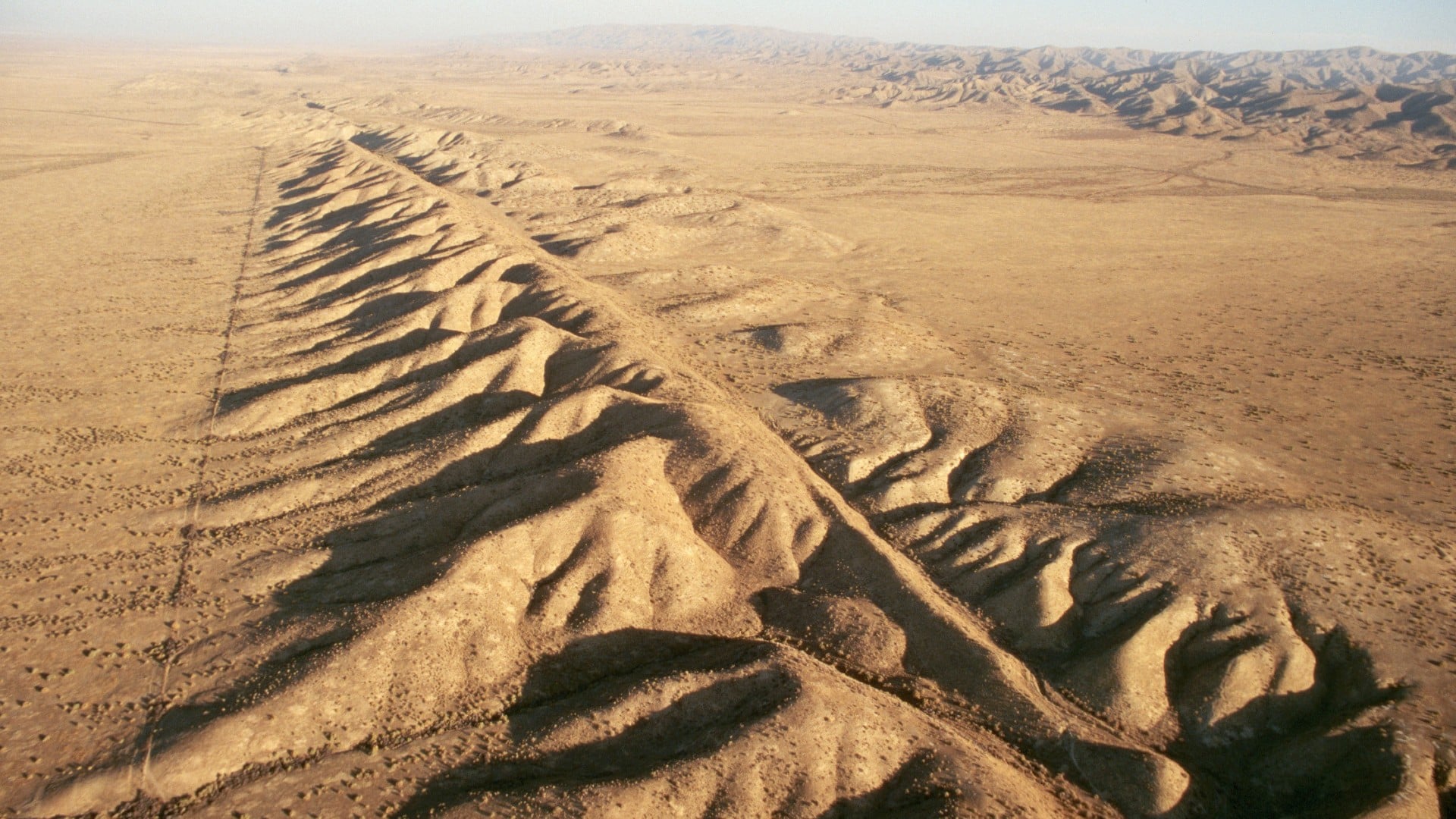
About Fault Line
- It is a line determined by the intersection of a geological fault and the earth’s surface.
- A fault is a fracture or zone of fractures between two blocks of rock.
- This is caused by the stresses created as sections of a plate (or two plates) are moving in different directions.
- All faults are related to the movement of Earth’s tectonic plates. The biggest faults mark the boundary between two plates.
- Faults allow the blocks to move relative to each other.
- This movement may occur rapidly, in the form of an earthquake, or it may occur slowly, in the form of creep.
- Faults may range in length from a few millimeters to thousands of kilometers, such as the San Andreas Fault in California and the Anatolian Fault in Turkey, both of which are visible from space.
- Most faults produce repeated displacements over geologic time.
- The fault surface can be horizontal, vertical or some arbitrary angle in between.
- Earth scientists use the angle of the fault with respect to the surface (known as the dip) and the direction of slip along the fault to classify faults.
- There are a number of different types of faults, but most can be divided into three categories: strike-slip faults, normal faults, and thrust faults.
- Strike-slip fault:
- It occurs in an area where two plates are sliding past horizontally with little to no vertical movement.
- Strike-slip faults are found in California, the San Andreas Fault being the most famous, which has caused many powerful earthquakes.
- Normal fault:
- Normal faults cracks where one mass of rock slides downward and pulls away from another mass of rock.
- Normal faults create space. Two blocks of crust pull apart, stretching the crust into a valley.
- The Basin and Range Province in North America and the East African Rift Zone are two well-known regions where normal faults are spreading apart Earth’s crust.
- Reverse faults:
- Reverse faults also called thrust faults, slide one block of crust on top of another.
- This involves upward movement as the two plates collide and buckle upwards.
- These faults are commonly found in collisions zones, where tectonic plates push up mountain ranges such as the Himalayas and the Rocky Mountains.
Q1) What is a tectonic plate?
A tectonic plate (also called lithospheric plate) is a massive, irregularly shaped slab of solid rock, generally composed of both continental and oceanic lithosphere. Due to the convection of the asthenosphere and lithosphere, the plates move relative to each other. Plate size can vary greatly, from a few hundred to thousands of kilometers across; the Pacific and Antarctic Plates are among the largest. Plate thickness also varies greatly, ranging from less than 15 km for young oceanic lithosphere to about 200 km or more for ancient continental lithosphere (for example, the interior parts of North and South America).
Source: Discovery of 72-kilometer fault line on Canada’s Vancouver Island


 Last updated on Oct, 2026
→ UPSC 2027 Notification will be released on 13 January 2027 at upsconline.nic.in.
→ Check Nobel Prize 2026 Winners List here.
→ Download PIB PRiSM Monthly Magazine 2026 here.
→ Check UPSC Monthly Current Affairs Magazine The Recitals here.
→ Check out the latest UPSC Syllabus here.
→ Download UPSC Model Answers for Mains 2026
→ UPSC Mains Question Paper 2026 is out now for Essay & GS Paper 1, 2, 3 & 4.
→ UPSC Calendar 2027 has been released.
→ Enroll in Vajiram & Ravi’s UPSC Mains Test Series 2027 for structured answer writing practice, expert evaluation, and exam-oriented feedback.
→ Join Vajiram & Ravi’s UPSC Mentorship Program 2027 for personalized guidance, strategy planning, and one-to-one support from experienced mentors.
→ Go through the UPSC Mains Previous Year Papers to enhance your preparation.
→ UPSC has released UPSC Toppers List 2025 with the Civil Services final result on its official website.
→ Also check Best UPSC Coaching in India