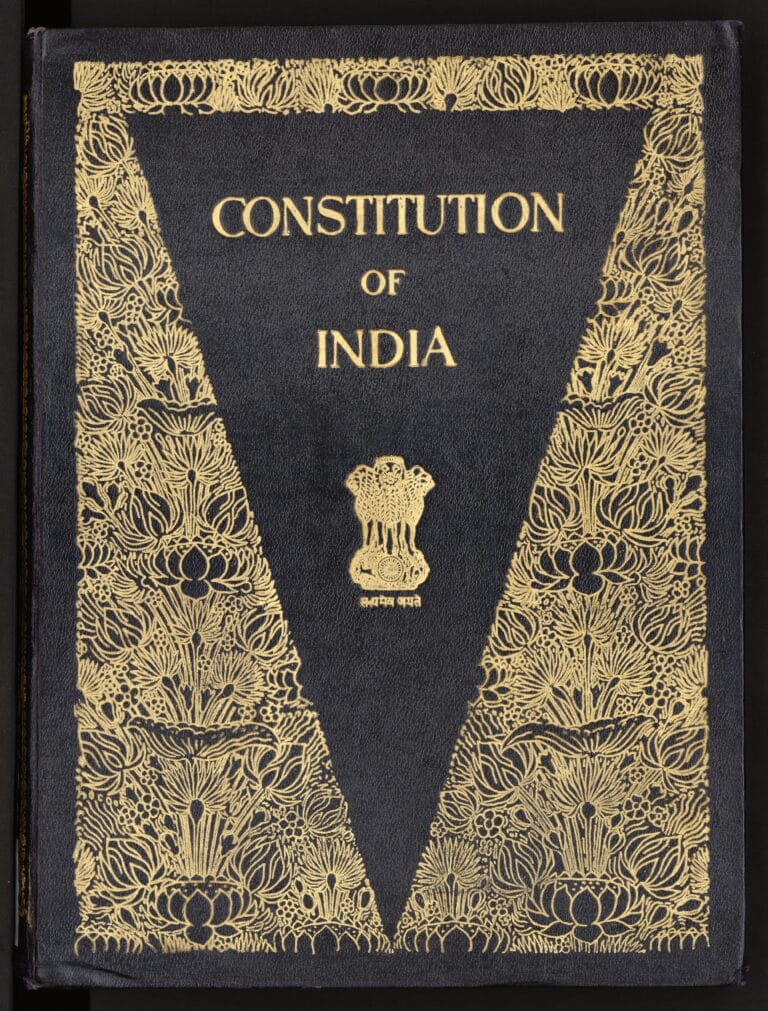
About Fifth Schedule of the Indian Constitution
- It deals with provisions related to the administration and control of Scheduled Areas and Scheduled Tribes in any State, other than the States of Assam, Meghalaya, Tripura, and Mizoram.
- These areas are treated differently from the other areas in the countrybecause they are inhabited by the aboriginals, who are socially and economically rather backward, and special efforts need to be made to improve their condition.
Declaration of Scheduled Areas:
- Article 244(1): The President of India is empowered to declare an area a Scheduled Area.
- He can direct that the whole or any specified part of a Scheduled Area shall cease to be a Scheduled Area.
- The President can increase or decrease the area of any Scheduled Area in a State after consultation with the Governor of that State and also alter its boundary lines, but only by way of rectification of boundaries.
The criteria followed for declaring an area as a Scheduled Area are
- preponderance of the tribal population;
- compactness and reasonable size of the area;
- under-developed nature of the area; and
- marked disparity in economic standard of the people.
- These criteria are not spelt out in the Constitution of India but have become well established.
- Special Provisions:
- The executive power of a State extends to the Scheduled Ares therein.
- The Central Government can give directions to the State regarding the administration of such Areas.
- The Governor annually, or whenever required by the President, makes a report to the President regarding the administration of the Scheduled Areas.
Tribal Advisory Council (TAC):
- A TAC has to be established in each State, having Scheduled Areas to deal with the welfare and advancement of Scheduled tribes in states.
- A similar council can be established in any State having Scheduled Tribes but not Scheduled Areas if the President directs.
- It consists of not more than twenty members of whom, three-fourthsshall be the representatives of the Scheduled Tribes in the Legislative Assembly of the State.
- The TAC shall advise on such matters pertaining to the welfare and the advancement of the STs in the State as may be referred to them by the Governor.
- The Governor may make rules prescribing or regulating the number of members of the Council, the mode of their appointment and the appointment of the Chairman of the Council and of the officers and servants thereof, theconduct of its meetings, and its procedure in general.
Applicablity of Laws in Scheduled Areas:
- The Governormay, by public notification, direct that any particular Act of Parliament or of the Legislature of the State shall or shall not apply to a Scheduled Area or any part thereof in the State, subject to such exceptions and modifications as specified.
- The Governor may make regulations for the peace and good government of any area in the State, which is for the time being a SA.
- Such regulations may prohibit or restrict the transfer of landby or among members of the Scheduled tribes in such area;
- regulate the allotment of land to members of the STs in such area;
- regulate the carrying on of business as money-lender by persons who lend money to members of the STs in such area.
- In making such regulations, the Governor may repeal or amend any Act of Parliament or of Legislature of the State or any existing law after obtaining assent of the President.
Q1: What are Particularly Vulnerable Tribal Groups (PVTGs)?
They are considered the most disadvantaged and marginalized among the tribal communities. On the recommendation of the Dhebar Commission (1973), in 1975 Government of India created a sub-category called Primitive Tribal Groups (PTGs), later renamed as Particularly Vulnerable Tribal Groups (PVTGs). Now there are total of 75 PVTGs spread over 17 states and one Union Territory (UT).






 Last updated on April, 2026
→ UPSC Final Result 2025 is now out.
→ UPSC has released UPSC Toppers List 2025 with the Civil Services final result on its official website.
→ Anuj Agnihotri secured AIR 1 in the UPSC Civil Services Examination 2025.
→ UPSC Marksheet 2025 is now out.
→ UPSC Notification 2026 & UPSC IFoS Notification 2026 is now out on the official website at upsconline.nic.in.
→ UPSC Calendar 2026 has been released.
→ Check out the latest UPSC Syllabus 2026 here.
→ UPSC Prelims 2026 will be conducted on 24th May, 2026 & UPSC Mains 2026 will be conducted on 21st August 2026.
→ The UPSC Selection Process is of 3 stages-Prelims, Mains and Interview.
→ Prepare effectively with Vajiram & Ravi’s UPSC Prelims Test Series 2026 featuring full-length mock tests, detailed solutions, and performance analysis.
→ Enroll in Vajiram & Ravi’s UPSC Mains Test Series 2026 for structured answer writing practice, expert evaluation, and exam-oriented feedback.
→ Join Vajiram & Ravi’s Best UPSC Mentorship Program for personalized guidance, strategy planning, and one-to-one support from experienced mentors.
→ Shakti Dubey secures AIR 1 in UPSC CSE Exam 2024.
→ Also check Best UPSC Coaching in India