Fiscal Devolution to Cities Latest News
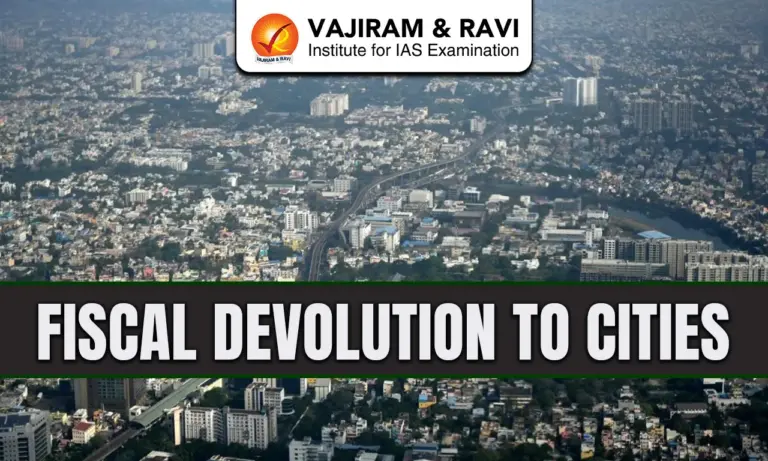
- Urban centres in India are the primary engines of economic growth, generating nearly 67% of GDP and around 90% of government revenues.
- Despite their economic importance and rapid population growth, the 16th Finance Commission (FC) continues the pattern of limited fiscal transfers to Urban Local Bodies (ULBs).
- The Commission instead emphasises enhancing Own Source Revenue (OSR) through local taxation, raising questions about the adequacy of fiscal support and the implications for urban governance and federalism.
Urban Economy vs Fiscal Support
- Cities as engines of growth:
- Urban centres contribute around two-thirds of India’s GDP and a significant share of government revenues.
- India’s urban population is projected to reach 41% by 2031, increasing pressure on infrastructure, housing, sanitation, and mobility.
- Urban grants under Finance Commissions:
- 15th Finance Commission (2021–26): Urban local bodies received ₹1.2–1.3 lakh crore over five years. This amounted to roughly 0.12–0.13% of GDP.
- 16th Finance Commission (2026–31): Proposed allocation of ₹3.56 lakh crore over five years (₹75,000 crore annually). With India’s projected GDP around ₹400 lakh crore, the ratio remains around 0.13% of GDP.
- Key insight: Despite higher nominal allocations, the share of GDP transferred to cities remains stagnant, indicating limited improvement in fiscal support.





Per Capita Transfers – The Hidden Reality
- India’s urban population exceeded 470 million around 2020. It is expected to reach 600 million or more during the 2026–30 FC cycle.
- When grants are distributed across this growing population, per capita transfers remain stagnant or decline in real terms.
- The fiscal capacity of cities does not grow proportionately with the rising urban population and infrastructure demands.
Utilisation Challenges
- Even the limited funds allocated have not always been effectively utilised.
- For example,
- Under the 15th FC, total local body grants were about ₹4.36 lakh crore.
- Around ₹90,000–95,000 crore remained unspent or pending utilisation.
- Approximately ₹30,000–35,000 crore of these unspent funds were meant for urban local bodies.
- Reasons include: Administrative bottlenecks, weak institutional capacity in ULBs, delays in project approvals and fund releases.
Tied Grants and Fiscal Autonomy
- What are tied grants? Tied grants are earmarked funds that must be used for specific sectors such as water supply, sanitation, wastewater management, etc.
- Implications: They limit the fiscal autonomy of cities. ULBs cannot allocate funds according to local priorities.
- 16th FC: It introduces even stricter conditions through performance-based grants.
Performance-Based Conditions
- A portion of urban grants is linked to certain governance reforms, such as regular elections for local bodies, improved fiscal discipline, publication of provisional and audited accounts, and constitution of State Finance Commissions.
- Additionally, 20% of funds are conditional on meeting specific benchmarks. Cities must increase OSR (~₹1,200 per household annually), especially through property taxes and user charges.
- Concern: Many cities may struggle to meet these benchmarks, risking the loss of funds.
Federalism Concerns
- Incentives for peri-urban mergers: The Commission has proposed ₹10,000 crore as a one-time incentive for merging peri-urban villages (population >1 lakh) with urban areas.
- Issues involved:
- Constitutional concerns: Urban development is a State subject under the Constitution. Central incentives may interfere with State autonomy.
- Administrative complications: In States with strong rural governance structures (e.g., Kerala), such mergers could create institutional and service delivery challenges.
Neglect of Climate Finance
- The 16th FC recommendations pay limited attention to climate change, despite cities being highly vulnerable to floods, heatwaves, urban pollution, and infrastructure stress.
- At the same time, the Centre collects cess revenues worth around 2.2% of GDP (≈ ₹8.8 lakh crore).
- These funds remain outside the divisible pool, even though much of the revenue originates from urban economic activity.
- Implication: Cities receive limited fiscal returns despite generating substantial revenue.
Way Forward
- Increase: Fiscal transfers to cities, raise urban grants as a larger share of GDP.
- Enhance: Fiscal autonomy, reduce reliance on tied grants and allow flexible funding.
- Strengthen: Own source revenues, reform property tax systems, improve municipal financial management.
- Empower: Urban Local Bodies, implement 74th Constitutional Amendment provisions fully, strengthen State Finance Commissions.
- Allocate: Dedicated funds for climate-resilient infrastructure.
- Revisit: Cess revenue sharing, consider including a portion of cess collections in the divisible pool.
Conclusion
- India’s cities are the primary drivers of economic growth, yet their fiscal empowerment remains limited.
- While the 16th FC emphasises fiscal discipline and revenue generation, it does not substantially increase the share of funds flowing to urban local bodies.
- A sustainable urban future requires greater fiscal devolution, enhanced autonomy, and stronger institutional capacity, enabling cities to plan and finance their own development while the Centre plays the role of an enabler rather than a controller.
Source: TH

 Last updated on March, 2026
→ UPSC Final Result 2025 is now out.
→ UPSC has released UPSC Toppers List 2025 with the Civil Services final result on its official website.
→ Anuj Agnihotri secured AIR 1 in the UPSC Civil Services Examination 2025.
→ UPSC Marksheet 2025 is now out.
→ UPSC Notification 2026 & UPSC IFoS Notification 2026 is now out on the official website at upsconline.nic.in.
→ UPSC Calendar 2026 has been released.
→ Check out the latest UPSC Syllabus 2026 here.
→ UPSC Prelims 2026 will be conducted on 24th May, 2026 & UPSC Mains 2026 will be conducted on 21st August 2026.
→ The UPSC Selection Process is of 3 stages-Prelims, Mains and Interview.
→ Prepare effectively with Vajiram & Ravi’s UPSC Prelims Test Series 2026 featuring full-length mock tests, detailed solutions, and performance analysis.
→ Enroll in Vajiram & Ravi’s UPSC Mains Test Series 2026 for structured answer writing practice, expert evaluation, and exam-oriented feedback.
→ Join Vajiram & Ravi’s Best UPSC Mentorship Program for personalized guidance, strategy planning, and one-to-one support from experienced mentors.
→ Shakti Dubey secures AIR 1 in UPSC CSE Exam 2024.
→ Also check Best UPSC Coaching in India
Fiscal Devolution to Cities FAQs
Q1. Why are Indian cities considered the primary engines of economic growth?+
Q2. What are ‘tied grants’ in the context of Finance Commission transfers to ULBs?+
Q3. How does the 16th FC promote fiscal discipline among ULBs?+
Q4. Why does the proposal to merge peri-urban villages with cities raise federal concerns?+
Q5. What is the major concern regarding cess revenues in the context of urban fiscal governance? +
Tags: fiscal devolution to cities mains articles upsc current affairs upsc mains current affairs