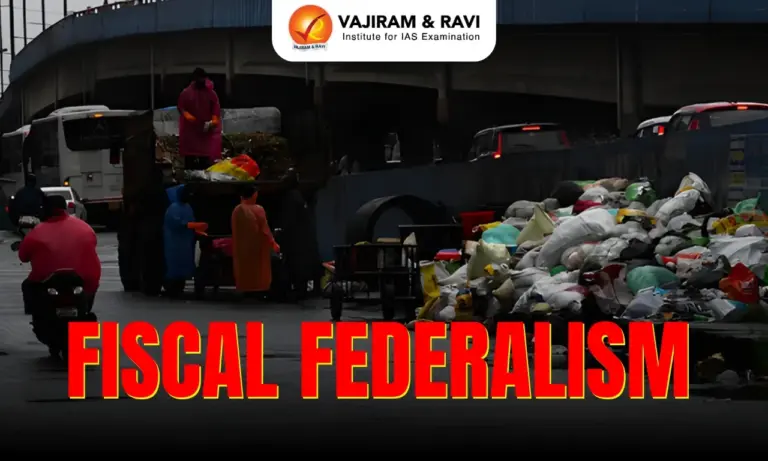
Fiscal Federalism Latest News
- Urban India contributes nearly two-thirds of the national GDP, yet its municipalities control less than 1% of the country’s tax revenue.
- This mismatch highlights a fundamental flaw in India’s fiscal architecture, where centralisation of taxation powers has weakened municipal autonomy.
- Understanding this issue is crucial, as it touches upon governance, decentralisation, urbanisation, and fiscal federalism.
The Fiscal Paradox of Urban India
- Urban contribution vs fiscal control:
- Indian cities are economic powerhouses but remain fiscally handicapped.
- Municipalities depend heavily on State and Central transfers, loans, and schemes.
- This has created an inversion of democracy — power is centralised while responsibilities are decentralised.
- Post-GST revenue loss:
- Introduction of GST (2017) led to the subsuming of octroi, entry tax, and local surcharges, resulting in an average 19% loss of municipal revenues.
- Compensation mechanisms have not reached the municipal level effectively.
- The result is the fiscal uncertainty and dependence on higher governments.





Municipal Bonds – Promise and Pitfalls
- Policy push:
- NITI Aayog and recent urban reforms promote municipal bonds as the next frontier of city finance.
- However, credibility and uptake remain low due to systemic flaws.
- Challenges in creditworthiness:
- Credit rating agencies assess cities narrowly on their “own revenue,” ignoring grants and transfers which form a legitimate and recurring income stream.
- This misjudgment reflects an ideological bias, treating cities as dependent entities rather than equal tiers of governance envisaged under the 74th Constitutional Amendment.
- The property tax trap:
- Property tax reforms, though vital, contribute only 20–25% of total revenue potential.
- Over-reliance on the “user-pays” model shifts the burden of urban finance onto citizens, especially the urban poor, turning public goods into private commodities.
- Services like water, sanitation, public lighting, and mobility are collective entitlements, not market goods.
The Constitutional and Ideological Dimensions
- 74th Amendment and fiscal equality:
- The 74th Constitutional Amendment (1992) envisioned urban local bodies (ULBs) as institutions of self-government.
- However, the absence of fiscal devolution has reduced them to dependent implementers of centrally designed schemes.
- Need for fiscal justice:
- Recognising grants and shared taxes as rights, not favours, align with the spirit of cooperative federalism.
- Urban fiscal empowerment is not a technical reform but a moral and political imperative.
The Way Forward
- Democratise the fiscal contract:
- Adopt a Scandinavian model where cities have the right to levy and collect local taxes, including income taxes in some cases.
- This promotes accountability, transparency, and a direct link between citizens and governance.
- Reimagine fiscal federalism: Ensure predictable, adequate, and untied transfers to cities. Recognise municipal grants as part of a shared fiscal ecosystem, not as discretionary handouts.
- Reform the municipal bond framework:
- Recognise grants and shared taxes as part of city income.
- Include governance indicators (transparency, audit compliance, citizen participation) in city credit ratings.
- Allow cities to use GST compensation or State tax shares as collateral for borrowing.
- Strengthen local revenue mechanisms: Improve property tax coverage, digitise assessment systems. Diversify revenue sources — land value capture, service charges, and urban transport levies.
- Restructure urban fiscal framework: Tackling urban challenges — from waste management and housing to climate resilience and infrastructure, and grounded in cooperative federalism, predictability, and autonomy.
Conclusion
- India’s urban future depends on fiscal justice. Municipal finance is not merely a bookkeeping exercise, but a reflection of democratic and moral values.
- Cities should not be viewed as cost centres but as engines of national prosperity.
- For India to achieve sustainable urbanisation and inclusive growth, the fiscal relationship between the Centre, States, and cities must be rebalanced — restoring trust, autonomy, and resources to the grassroots.
Source: TH

 Last updated on March, 2026
→ UPSC Final Result 2025 is now out.
→ UPSC has released UPSC Toppers List 2025 with the Civil Services final result on its official website.
→ Anuj Agnihotri secured AIR 1 in the UPSC Civil Services Examination 2025.
→ UPSC Marksheet 2025 is now out.
→ UPSC Notification 2026 & UPSC IFoS Notification 2026 is now out on the official website at upsconline.nic.in.
→ UPSC Calendar 2026 has been released.
→ Check out the latest UPSC Syllabus 2026 here.
→ UPSC Prelims 2026 will be conducted on 24th May, 2026 & UPSC Mains 2026 will be conducted on 21st August 2026.
→ The UPSC Selection Process is of 3 stages-Prelims, Mains and Interview.
→ Prepare effectively with Vajiram & Ravi’s UPSC Prelims Test Series 2026 featuring full-length mock tests, detailed solutions, and performance analysis.
→ Enroll in Vajiram & Ravi’s UPSC Mains Test Series 2026 for structured answer writing practice, expert evaluation, and exam-oriented feedback.
→ Join Vajiram & Ravi’s Best UPSC Mentorship Program for personalized guidance, strategy planning, and one-to-one support from experienced mentors.
→ Shakti Dubey secures AIR 1 in UPSC CSE Exam 2024.
→ Also check Best UPSC Coaching in India
Fiscal Federalism FAQs
Q1. Why are Indian municipalities facing a fiscal crisis?+
Q2. How did the introduction of the GST impact municipal finances in India?+
Q3. What are the major limitations of the current municipal bond framework in India?+
Q4. How can India democratise its fiscal contract to strengthen municipal governance?+
Q5. Why is municipal finance in India described as a moral and political issue?+
Tags: mains articles upsc current affairs upsc mains current affairs