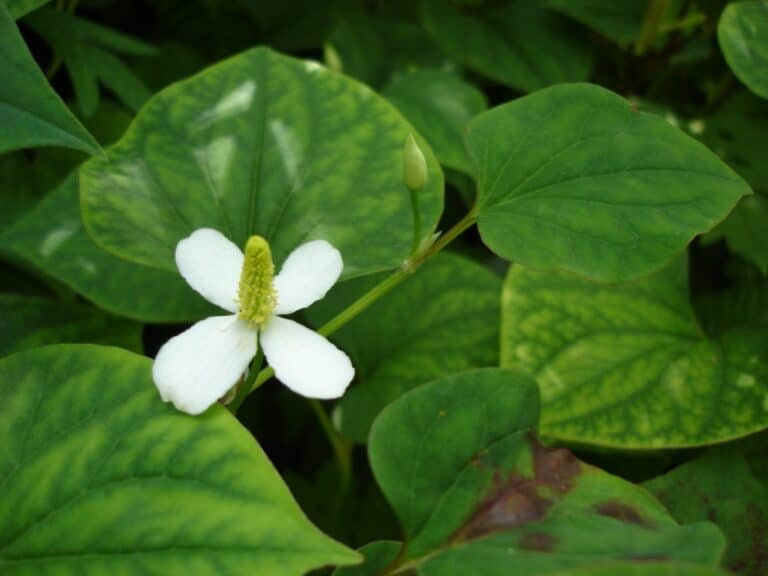
About Fish Mint
- It is an herbal plant full of medicinal properties and grown on the ground with wide leaves.
- Scientific Name: Houttuynia cordata
- Other Names: It has many names, such as Bishop’s Weed, Chinese Lizard Tail, Fish Wort, Fish Leaf, Rainbow Plant and Chameleon Plant.
- Despite being called “fish mint”, it’s not a member of the mint family. It does, however, spread aggressively like mint.
- Distribution: Its native range extends from the Himalayan foothills through Southeast Asia, China, Korea and Japan.
- Habitat: It thrives in wet locations and can even grow partially submerged in water.
- Features:
- It is an herb with beautiful white flowers and broad, heart-shaped leaves.
- Unlike its appearance, it has a fish-like taste and smell. Hence, the name, fish mint.
- The plants grow to 2 to 3 feet in height with a spread of 3 feet.
- The stems of this plant are climbing tender vines. The color of its stem is medium to light green, and its leaves are of dark to medium green color.
- It is considered an invasive plant because of its ability to regrow from underground rhizomes, which are fragile and break off easily, forming new plants when disturbed.
- Medicinal Properties: It is used to treat digestive issues, insect bites, fevers, coughs, influenza, kidney ailments and a host of other ailments.
- The leaf is used in many Asian cuisines as a vegetable or fresh herb, and fish mint root can also be eaten.
Q1) What are Rhizomes?
Rhizomes are specialized underground plant structures that serve various functions, including storage of nutrients, water, and carbohydrates, as well as vegetative reproduction. They are stem-like structures that grow horizontally beneath the soil surface, giving rise to new shoots and roots. Rhizomes are found in many different plant species and play a crucial role in the growth and survival of these plants.
Source: This herb tastes and smells like fish; it has recognised health benefits






 Last updated on March, 2026
→ UPSC Final Result 2025 is now out.
→ UPSC has released UPSC Toppers List 2025 with the Civil Services final result on its official website.
→ Anuj Agnihotri secured AIR 1 in the UPSC Civil Services Examination 2025.
→ UPSC Marksheet 2025 is now out.
→ UPSC Notification 2026 & UPSC IFoS Notification 2026 is now out on the official website at upsconline.nic.in.
→ UPSC Calendar 2026 has been released.
→ Check out the latest UPSC Syllabus 2026 here.
→ UPSC Prelims 2026 will be conducted on 24th May, 2026 & UPSC Mains 2026 will be conducted on 21st August 2026.
→ The UPSC Selection Process is of 3 stages-Prelims, Mains and Interview.
→ Prepare effectively with Vajiram & Ravi’s UPSC Prelims Test Series 2026 featuring full-length mock tests, detailed solutions, and performance analysis.
→ Enroll in Vajiram & Ravi’s UPSC Mains Test Series 2026 for structured answer writing practice, expert evaluation, and exam-oriented feedback.
→ Join Vajiram & Ravi’s Best UPSC Mentorship Program for personalized guidance, strategy planning, and one-to-one support from experienced mentors.
→ Shakti Dubey secures AIR 1 in UPSC CSE Exam 2024.
→ Also check Best UPSC Coaching in India