Flash Floods in India Latest News
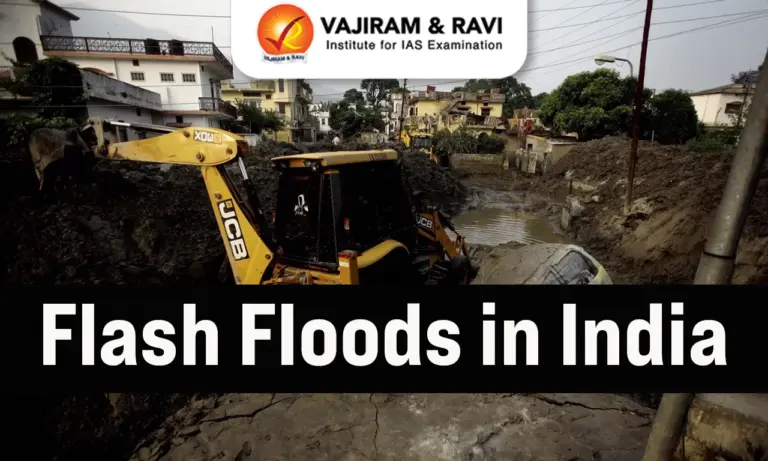
- Flash floods have emerged as a deadly and recurring hazard across India, claiming thousands of lives and damaging infrastructure annually.
- Tragedies in Himachal Pradesh (July 2025), Kerala’s Wayanad (July 2024), Ladakh (June 2024), and Sikkim (October 2023) underline the severity of the crisis.
- These sudden and intense floods, primarily triggered by extreme rainfall, have become more frequent with rising global temperatures — increasing from 132 events in 2020 to 184 in 2022, as per the Union Jal Shakti Ministry.
- Despite the mounting threat, there remains a lack of detailed research to pinpoint the most vulnerable regions, hampering the effectiveness of mitigation strategies like early warning systems.
Study Related to Flash Floods in India
- A recent IIT Gandhinagar study, published in Nature Hazards, addresses the lack of granular data on flash flood vulnerability in India.
- The study, ‘Drivers of flash floods in the Indian sub-continental river basins’, identifies the Himalayas, western coast, and Central India as key hotspots, using hydrological and geomorphological data to map sub-basin susceptibility.
- In the Himalayas, steep terrain and elevation drive flood risk, while in the West Coast and Central India, rapid runoff—termed “flashiness”—plays a key role.
- The study finds that nearly 75% of flash floods result from a combination of extreme rainfall and already saturated soil, with only 25% due to precipitation alone.
- Alarmingly, even previously low-risk basins are witnessing rising extreme rainfall, suggesting that climate change may create new flash flood zones in the future.





Key Drivers Behind Flash Floods in India
- The study reveals that only 25% of flash floods in India are caused solely by extreme rainfall.
- Most incidents result from a combination of heavy precipitation and pre-existing soil saturation.
- When the ground is already wet, it cannot absorb additional rainfall, leading to rapid runoff and increased flood risk.
- Notably, only 23% of extreme rainfall events trigger flash floods within six hours. Instead, prolonged periods of both low- and high-intensity rain are more likely to cause such disasters.
- The study also highlights regional variations.
- In the western coast and Central India, sub-basins react quickly to rainfall due to their high “flashiness” — the tendency of water levels to rise rapidly.
- In the Himalayan region, steep terrain and high relief further elevate the risk.
- Within major river basins like the Ganga, flash flood susceptibility differs — sub-basins in the southern Himalayan stretch are more prone, while central areas show lower risk.
- This points to how terrain and local climatic conditions strongly influence flash flood vulnerability.
Climate Change Intensifies Flash Flood Risk in India
- Rising global temperatures are significantly contributing to the increase in frequency and severity of flash floods.
- As the atmosphere warms, it retains more moisture — about 7% more for every 1°C rise — leading to heavier rainfall events.
- In India, from 1981 to 2020, the incidence of extreme rainfall during the pre-monsoon season doubled.
- During the monsoon, post-monsoon, and winter seasons, extreme precipitation increased by 56%, 40%, and 12.5% respectively.
- Notably, over 75% of flash floods between 1980 and 2018 occurred during the monsoon season.
- The study also shows that flash floods have risen sharply since 1995, especially in the Brahmaputra, Ganga, and Krishna river basins.
- Interestingly, many regions that were not previously flood-prone are now experiencing more “wet hours” and higher streamflow due to warming temperatures.
- 51% of non-prone sub-basins showing increased rainfall and 66.5% showing higher streamflow.
- Conversely, some existing flood-prone areas are seeing a decline in wet hours, indicating shifting climate patterns and flood vulnerabilities.
Region-Specific Adaptation Key to Mitigating Flash Flood Risks
- The study highlights the need for region-specific adaptation strategies tailored to topography, soil conditions, and not just rainfall intensity.
- Such localized approaches can strengthen early warning systems, improve disaster preparedness, and support long-term resilience planning.
- Researchers emphasize the urgency of identifying emerging flash flood hotspots and investing in climate-resilient infrastructure to reduce the impact of extreme events.
- Additionally, with shifting rainfall patterns and rising temperatures, improved land-use planning and integrated flood management are essential for effective mitigation.

 Last updated on March, 2026
→ UPSC Final Result 2025 is now out.
→ UPSC has released UPSC Toppers List 2025 with the Civil Services final result on its official website.
→ Anuj Agnihotri secured AIR 1 in the UPSC Civil Services Examination 2025.
→ UPSC Marksheet 2025 is now out.
→ UPSC Notification 2026 & UPSC IFoS Notification 2026 is now out on the official website at upsconline.nic.in.
→ UPSC Calendar 2026 has been released.
→ Check out the latest UPSC Syllabus 2026 here.
→ UPSC Prelims 2026 will be conducted on 24th May, 2026 & UPSC Mains 2026 will be conducted on 21st August 2026.
→ The UPSC Selection Process is of 3 stages-Prelims, Mains and Interview.
→ Prepare effectively with Vajiram & Ravi’s UPSC Prelims Test Series 2026 featuring full-length mock tests, detailed solutions, and performance analysis.
→ Enroll in Vajiram & Ravi’s UPSC Mains Test Series 2026 for structured answer writing practice, expert evaluation, and exam-oriented feedback.
→ Join Vajiram & Ravi’s Best UPSC Mentorship Program for personalized guidance, strategy planning, and one-to-one support from experienced mentors.
→ Shakti Dubey secures AIR 1 in UPSC CSE Exam 2024.
→ Also check Best UPSC Coaching in India
Flash Floods in India FAQs
Q1. What causes most flash floods in India?+
Q2. How does climate change influence flash floods?+
Q3. Which regions are flash flood hotspots?+
Q4. What is ‘flashiness’ in flood context?+
Q5. What adaptation measures are needed?+
Tags: flash floods in India mains articles upsc current affairs upsc mains current affair