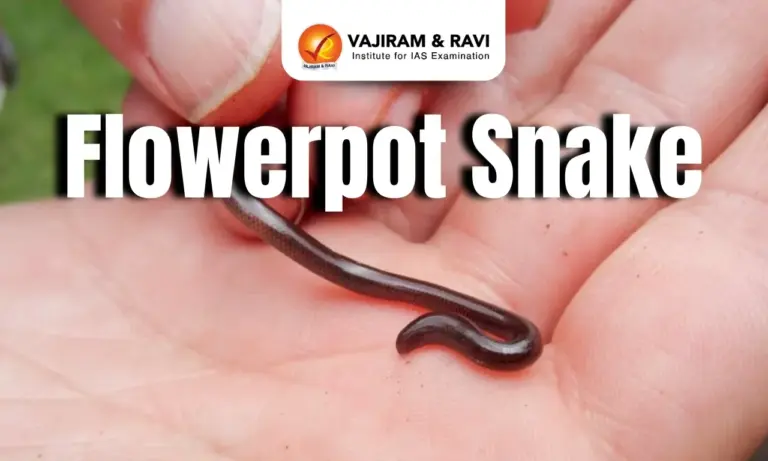
About the News
The flowerpot snake, one of the world’s smallest snakes, has three sets of chromosomes instead of two, and has 40 chromosomes, organised into three subgenomes. By analysing the flowerpot snake’s unique genome, scientists are uncovering how the reptile repairs its DNA and prevents harmful mutations.
- The findings provide insights into genetic repair mechanisms that could deepen our understanding of human gene evolution and also provide insights into human trisomy conditions, such as Down Syndrome.
Flowerpot Snake (Ramphotyphlops braminus) Overview
The Flowerpot Snake, also known as the Brahminy Blind Snake, is a small, harmless species of blind snake. It is commonly found in tropical and subtropical regions, particularly in Southeast Asia, although it has been introduced to other parts of the world as well.
Key Characteristics
- Common Name: Flowerpot Snake (Brahminy Blind Snake)
- Size: One of the smallest snakes in the world, typically growing to a length of 10-20 cm (4-8 inches).
- Non-Venomous: These snakes are completely harmless to humans and are non-venomous.
- Burrower: They spend the majority of their time underground, where they feed on small invertebrates like ants and termites.
Unique Features
- Blindness: The Flowerpot Snake doesn’t have functional eyes, hence the term “blind” in its common name. It relies on other senses to navigate and survive.
- Appearance: Due to their small size and appearance, they are often mistaken for earthworms.
Habitat and Behavior
- Flowerpot Snake Habitat: They are often found in potted plants, which is why they are called flowerpot snakes. They tend to hide in the soil of these plants, making them a frequent discovery by gardeners.
Reproductive and Genetic Uniqueness
- Chromosomal Uniqueness: The Flowerpot Snake is the only known snake species with three sets of chromosomes (trisomy) instead of the usual two.
- Asexual Reproduction: One of the fascinating traits of the Flowerpot Snake is its ability to reproduce asexually, meaning it does not require a mate for reproduction.
Flowerpot Snake FAQs
Q1. Is blind snake poisonous?
No, blind snakes are not poisonous. They are non-venomous and harmless to humans.
Q2. How big are flowerpot snakes?
Flowerpot snakes are small, typically growing to about 6 to 10 inches (15 to 25 cm) in length.
Source: Science Advances






 Last updated on March, 2026
→ UPSC Final Result 2025 is now out.
→ UPSC has released UPSC Toppers List 2025 with the Civil Services final result on its official website.
→ Anuj Agnihotri secured AIR 1 in the UPSC Civil Services Examination 2025.
→ UPSC Marksheet 2025 is now out.
→ UPSC Notification 2026 & UPSC IFoS Notification 2026 is now out on the official website at upsconline.nic.in.
→ UPSC Calendar 2026 has been released.
→ Check out the latest UPSC Syllabus 2026 here.
→ UPSC Prelims 2026 will be conducted on 24th May, 2026 & UPSC Mains 2026 will be conducted on 21st August 2026.
→ The UPSC Selection Process is of 3 stages-Prelims, Mains and Interview.
→ Prepare effectively with Vajiram & Ravi’s UPSC Prelims Test Series 2026 featuring full-length mock tests, detailed solutions, and performance analysis.
→ Enroll in Vajiram & Ravi’s UPSC Mains Test Series 2026 for structured answer writing practice, expert evaluation, and exam-oriented feedback.
→ Join Vajiram & Ravi’s Best UPSC Mentorship Program for personalized guidance, strategy planning, and one-to-one support from experienced mentors.
→ Shakti Dubey secures AIR 1 in UPSC CSE Exam 2024.
→ Also check Best UPSC Coaching in India