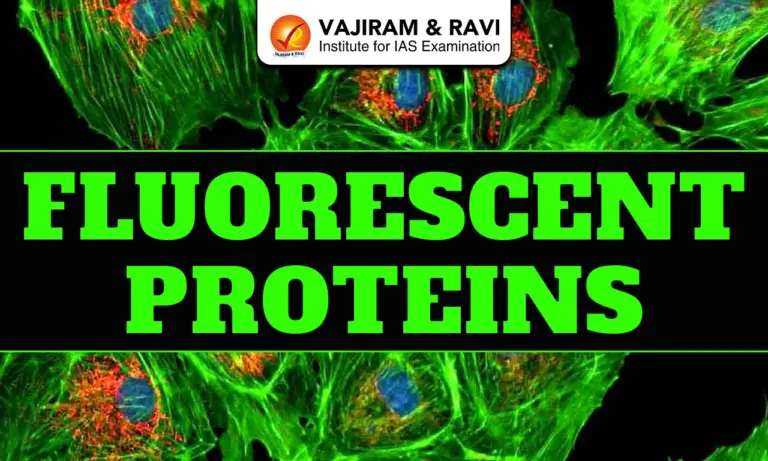
Fluorescent proteins are special proteins that emit visible light when exposed to light of certain wavelengths. They have become powerful tools in modern biology because they help scientists observe processes inside living cells. Originally discovered in marine organisms, these proteins revolutionised medical and biological research and even helped scientists earn the Nobel Prize in 2008.
Fluorescent Proteins Working
- Fluorescent proteins work by absorbing light energy and then releasing it as light of another colour. This glow allows researchers to track the movement of molecules inside cells.
- They are widely used in studying cancer cells, mapping brain neural circuits and understanding protein behaviour inside living organisms.
- Recent research suggests that fluorescent proteins may do more than glow. Some modified fluorescent proteins can act as quantum sensors, meaning they can detect very weak magnetic or radio signals at the molecular level.
Significance of Fluorescent Proteins in Biology
Fluorescent proteins help scientists observe biological processes in real time.
- They are used to track disease cells such as cancer cells.
- They help study communication between neurons in the brain.
- They allow monitoring of protein movement and biochemical reactions.
New research shows that fluorescent proteins can be genetically modified to detect magnetic fields and electron spin behaviour inside cells. This opens the possibility of hybrid quantum-biological technologies.





Fluorescent Protein as Quantum Sensor
Traditionally, quantum technologies were developed in controlled laboratory conditions. Living cells were considered unsuitable because heat and movement were believed to destroy quantum states.
However, new studies show that certain fluorescent proteins can form radical electron pairs whose behaviour is influenced by weak magnetic fields. This allows proteins to respond to magnetic or radio wave signals.
Researchers have successfully demonstrated optical detection of magnetic resonance signals inside living bacteria and human cells at low temperatures and even at room temperature.
Fluorescent Protein Applications
Fluorescent proteins may have important future applications:
- High-precision biological imaging inside living cells
- Real-time monitoring of biochemical reactions
- Drug development and molecular medicine
- Mapping magnetic and electric fields at nanoscale level
- Understanding enzyme reactions and electron transfer processes
These developments can improve disease diagnosis and treatment.
Fluorescent Protein Challenges
- Protein-based quantum sensors are currently less sensitive than solid-state quantum devices.
- Shorter signal coherence time reduces measurement stability.
- Photobleaching can reduce fluorescence over time.
- Technology is still in early experimental stages.

 Last updated on April, 2026
→ UPSC Final Result 2025 is now out.
→ UPSC has released UPSC Toppers List 2025 with the Civil Services final result on its official website.
→ Anuj Agnihotri secured AIR 1 in the UPSC Civil Services Examination 2025.
→ UPSC Marksheet 2025 is now out.
→ UPSC Notification 2026 & UPSC IFoS Notification 2026 is now out on the official website at upsconline.nic.in.
→ UPSC Calendar 2026 has been released.
→ Check out the latest UPSC Syllabus 2026 here.
→ UPSC Prelims 2026 will be conducted on 24th May, 2026 & UPSC Mains 2026 will be conducted on 21st August 2026.
→ The UPSC Selection Process is of 3 stages-Prelims, Mains and Interview.
→ Prepare effectively with Vajiram & Ravi’s UPSC Prelims Test Series 2026 featuring full-length mock tests, detailed solutions, and performance analysis.
→ Enroll in Vajiram & Ravi’s UPSC Mains Test Series 2026 for structured answer writing practice, expert evaluation, and exam-oriented feedback.
→ Join Vajiram & Ravi’s Best UPSC Mentorship Program for personalized guidance, strategy planning, and one-to-one support from experienced mentors.
→ Shakti Dubey secures AIR 1 in UPSC CSE Exam 2024.
→ Also check Best UPSC Coaching in India
Fluorescent Proteins FAQs
Q1. What are fluorescent proteins?+
Q2. Why are fluorescent proteins important?+
Q3. Can fluorescent proteins work as quantum sensors?+
Q4. What are the main applications of fluorescent proteins?+
Q5. What are the challenges of this technology?+
Tags: fluorescent proteins science & technology science & technology notes