What’s in Today’s Article?
- Background
- What is Fog?
- Why is North India Prone to Fogging?
Background
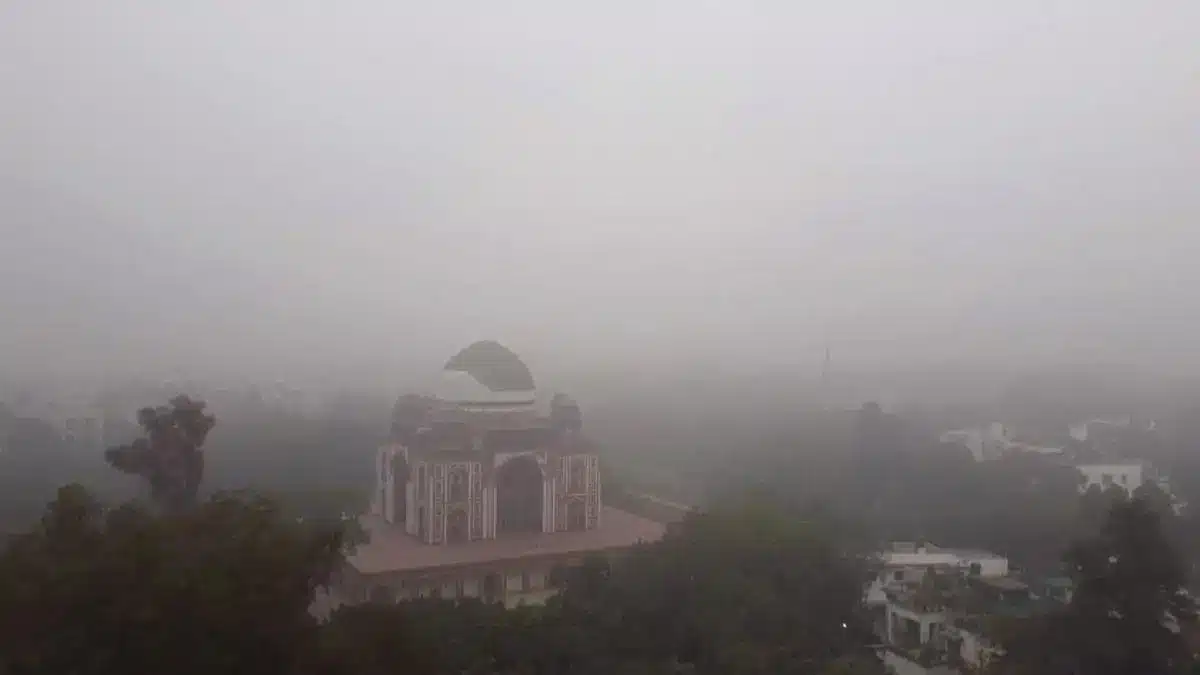
- A thick blanket of fog descended on several states of northern India in the last days of 2023 and first of 2024, creating challenging conditions for residents and travelers alike.
- Some places in the country’s north reported low temperatures and dense fog for the last week of December.
- According to weather reports in late December 2023, minimum temperatures in Punjab, Haryana, and the northern reaches of Rajasthan and Uttar Pradesh hovered around 6-9 degrees C.
- In New Delhi, south Rajasthan, and north Madhya Pradesh, some places recorded minimum temperatures in the range of 10-12 degrees C, according to the India Meteorological Department (IMD).
- In the same time, most of North India also experienced a dense fog that reduced visibility in many areas to as little as 50 metres for several days.
- Haryana, including Chandigarh, plus isolated pockets of Uttarakhand, Uttar Pradesh, Bihar, Rajasthan, and Madhya Pradesh reported fog with visibility reduced to under 200 metres.


What is Fog?

- About
- Fog is a common weather phenomenon.
- It is a collection of small droplets of water produced when evaporated water has cooled down and condensed.
- In simple terms, it is nothing but a thick cloud, but very close to the earth’s surface.
- For a thick fog to form, temperatures should be lower and abundant moisture should be available near the surface.
- Formation
- Fog materialises whenever there is a temperature disparity between the ground and the air.
- This happens frequently during Indian winters: the fog is created when the temperature drops at night and in the early morning, condenses on aerosols present in the atmosphere.
- High humidity, combined with an ample presence of water vapor or moisture, encourages foggy conditions.
- The process by which it cools plays a pivotal role in the formation of fog.
- Fog materialises whenever there is a temperature disparity between the ground and the air.
- Mechanism
- One primary mechanism contributing to fog formation is called Infrared Cooling.
- It typically occurs when the weather is transitioning from summer to winter.
- In the summer, the ground absorbs radiation from the Sun, becomes warmer, and moistens the air passing over it.
- When cooler weather kicks in, this mass of warm, moist air comes in contact with processes that cool it.
- The ‘collision’ prompts the water vapor in the air to condense rapidly, giving rise to fog.
- One primary mechanism contributing to fog formation is called Infrared Cooling.
- Other types
- Another type of fog, known as radiation fog, is prevalent and occurs when an unseasonably warm day with high humidity is followed by rapidly dropping temperatures.
- The specific type of fog, its duration, and its effects are contingent on various environmental conditions.
- For example, there exists a unique type of fog that encourages snow to melt faster.
Why is North India Prone to Fogging?
- The entire Indo-Gangetic plains are prone to formation of fog during winter season, as all the conditions — low temperatures, low wind speed, moisture availability and plenty of aerosols — are present in this region.
- Winds called the Western Disturbances, originating in the Mediterranean, bring in moisture to Northern India.
- Sometimes, the Arabian Sea also elevates the moisture content in the northern region.
- Moreover, the Himalayas in the north act as a barrier, preventing the eastward movement of the fog over the plains, leading to its concentration over the Indo-Gangetic region.
- In Delhi’s case, air pollutants such as particulate matter add to the load, creating smog (smoke fog).
Source: Why did North India fog so heavily last week? | Explained | India Today

 Last updated on Oct, 2026
→ UPSC 2027 Notification will be released on 13 January 2027 at upsconline.nic.in.
→ Check Nobel Prize 2026 Winners List here.
→ Download PIB PRiSM Monthly Magazine 2026 here.
→ Check UPSC Monthly Current Affairs Magazine The Recitals here.
→ Check out the latest UPSC Syllabus here.
→ Download UPSC Model Answers for Mains 2026
→ UPSC Mains Question Paper 2026 is out now for Essay & GS Paper 1, 2, 3 & 4.
→ UPSC Calendar 2027 has been released.
→ Enroll in Vajiram & Ravi’s UPSC Mains Test Series 2027 for structured answer writing practice, expert evaluation, and exam-oriented feedback.
→ Join Vajiram & Ravi’s UPSC Mentorship Program 2027 for personalized guidance, strategy planning, and one-to-one support from experienced mentors.
→ Go through the UPSC Mains Previous Year Papers to enhance your preparation.
→ UPSC has released UPSC Toppers List 2025 with the Civil Services final result on its official website.
→ Also check Best UPSC Coaching in India