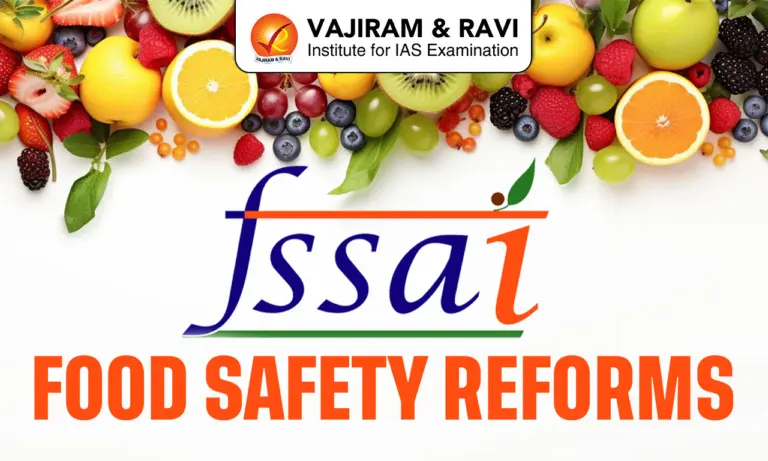
The Ministry of Health and Family Welfare (MoHFW) has approved a set of major regulatory and procedural reforms aimed at improving ease of doing business while maintaining strong food safety standards in the country.
The reforms were finalised after extensive consultations with state governments, union territories, and industry stakeholders, and they follow the suggestions of the High-Level Committee on Non-Financial Regulatory Reforms set up by NITI Aayog.
Key Food Safety Reforms
The Ministry of Health and Family Welfare has introduced several important reforms in the food regulatory framework.
Perpetual Validity of Licences and Registrations
A major reform is the introduction of perpetual validity for FSSAI licences and registrations.
- Earlier, food business operators were required to renew licences periodically, leading to administrative burden.
- Now, licences will remain valid indefinitely, subject to compliance and periodic updates.
- This reduces paperwork, compliance costs, and bureaucratic delays.
- It will also allow regulatory agencies to focus more on monitoring, enforcement and capacity-building activities.
Rationalisation of Turnover Thresholds
The government has also increased the turnover threshold for registration and licensing.
- From April 1, 2026, businesses with an annual turnover of up to Rs 1.5 crore will only need basic registration, compared to the earlier limit of Rs 12 lakh.
- Businesses with a turnover of up to Rs 50 crore will fall under state licensing, while those above this limit will require central licensing.
- It will simplify compliance for micro and small food businesses by reducing paperwork, fees and pre-inspection requirements.
- At the same time, it will strengthen the role of state authorities in overseeing food safety regulations within their jurisdictions.
Deemed Registration for Street Vendors
Another key reform aims to reduce duplicate registrations for street food vendors.
- Street vendors registered under the Street Vendors (Protection of Livelihood and Regulation of Street Vending) Act, 2014 will now be automatically considered registered under FSSAI.
- It will benefit more than 10 lakh street food vendors by removing the need to obtain multiple registrations from different authorities.
- It is expected to reduce the compliance burden and allow vendors to focus more on their livelihoods and maintaining hygiene standards.
Risk-Based Inspection Framework
The government has introduced a technology-driven, risk-based inspection system to make food safety checks smarter and more efficient.
- Inspections will be based on factors such as the type of food, past compliance records, audit performance, and surveillance inputs.
- Compliant businesses will face fewer inspections, while high-risk or non-compliant operators will be checked more closely.
- This ensures focused, transparent, and efficient regulation, reduces unnecessary burden on honest businesses, and allows FSSAI to use resources effectively for enforcement and monitoring.






 Last updated on April, 2026
→ UPSC Final Result 2025 is now out.
→ UPSC has released UPSC Toppers List 2025 with the Civil Services final result on its official website.
→ Anuj Agnihotri secured AIR 1 in the UPSC Civil Services Examination 2025.
→ UPSC Marksheet 2025 is now out.
→ UPSC Notification 2026 & UPSC IFoS Notification 2026 is now out on the official website at upsconline.nic.in.
→ UPSC Calendar 2026 has been released.
→ Check out the latest UPSC Syllabus 2026 here.
→ UPSC Prelims 2026 will be conducted on 24th May, 2026 & UPSC Mains 2026 will be conducted on 21st August 2026.
→ The UPSC Selection Process is of 3 stages-Prelims, Mains and Interview.
→ Prepare effectively with Vajiram & Ravi’s UPSC Prelims Test Series 2026 featuring full-length mock tests, detailed solutions, and performance analysis.
→ Enroll in Vajiram & Ravi’s UPSC Mains Test Series 2026 for structured answer writing practice, expert evaluation, and exam-oriented feedback.
→ Join Vajiram & Ravi’s Best UPSC Mentorship Program for personalized guidance, strategy planning, and one-to-one support from experienced mentors.
→ Shakti Dubey secures AIR 1 in UPSC CSE Exam 2024.
→ Also check Best UPSC Coaching in India
Food Safety Reforms FAQs
Q1. What are the Food Safety Reforms?+
Q2. Why were the Food Safety Reforms needed?+
Q3. What are the key Food Safety Reforms introduced?+
Q4. How do the reforms benefit businesses?+
Q5. What is the overall significance of the Food Safety Reforms?+
Tags: food safety reforms