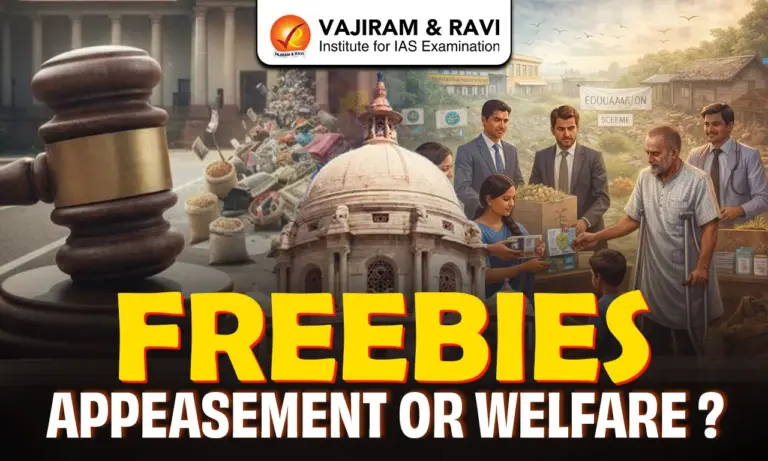
The Supreme Court recently questioned the trend of announcing freebies before elections, saying that giving universal benefits despite fiscal stress may amount to appeasement rather than genuine welfare.
The observations came during the hearing of a petition filed by the Tamil Nadu Power Distribution Corporation challenging Rule 23 of the Electricity Amendment Rules, 2024, which mandates cost-reflective tariffs and no revenue gap between approved expenditure and tariff recovery (except during natural calamities). The Court questioned whether states can continue offering universal free electricity while running revenue deficits.
What are Freebies?
Freebies refer to goods or services provided free of cost or at highly subsidised rates by governments. These may include free electricity, loan waivers, direct cash transfers, free transport, gadgets, or other benefits announced as welfare measures.
Freebies Key features
Key features of freebies are as follows:
- Freebies are generally consumption-oriented rather than productivity-oriented, as they focus more on providing immediate material benefits instead of creating long-term assets or income-generating capacity.
- They are often universal in nature instead of being strictly targeted at the most vulnerable sections, which increases their fiscal burden.
- In many cases, such schemes may not be backed by proper financial planning or sustainable revenue sources, leading to stress on state finances.
- Overall, freebies are typically designed to provide immediate relief to citizens or to serve short-term political and electoral appeal rather than structural economic transformation.




Freebies Recent Examples
- Free electricity up to 200 units per month under Gruha Jyoti Scheme (Karnataka).
- Monthly cash transfer to women under Subhadra Yojana (Odisha).
- Monthly unemployment allowance for graduates and diploma holders under Yuva Nidhi Scheme (Karnataka).
- Direct cash transfer to women heads of households under Mukhyamantri Ladli Behna Yojana (Madhya Pradesh).
- Additional free ration distribution beyond NFSA commitments in several states like Tamil Nadu and Chhattisgarh.
- Farm loan waiver announcements in states such as Punjab and Karnataka.
Arguments in Favour (Welfare Perspective)
From a welfare point of view, these measures are not just political appeasement but genuine support for people in need. In a country where many struggle with poverty and inequality, government help through subsidies and cash transfers can make a real difference in daily life. So, many so-called freebies are actually welfare steps meant to support inclusive growth.
- Constitutional Mandate: The Indian Constitution envisions India as a welfare state. The Directive Principles of State Policy support this idea through Article 38, which directs the State to promote social, economic and political justice and reduce inequalities, and Article 39, which ensures equitable distribution of resources and prevents concentration of wealth.
- Support to the Poor: Free food, education, healthcare, and targeted cash transfers help vulnerable groups survive economic distress.
- Human Development: Subsidies for education, nutrition, and health improve long-term productivity and social mobility.
- Income Support in Crisis: During inflation, pandemics, or unemployment, direct benefit transfers can act as social safety nets.
- Redistributive Justice: Welfare schemes can reduce regional and socio-economic disparities.
From this perspective, not all freebies are wasteful; some are necessary instruments of inclusive growth.
Arguments Against (Appeasement Perspective)
From the appeasement perspective, excessive freebies strain state finances and reduce funds for long-term development like infrastructure and health. Poor targeting and unplanned spending can increase deficits and public debt. Over time, such measures may encourage dependency and prioritise short-term electoral gains over sustainable economic growth.
- Fiscal Burden: Many states operate under revenue deficits. Excessive free schemes reduce funds for infrastructure, hospitals, and schools.
- For Example: As highlighted in the Economic Survey 2025–26, spending on unconditional cash transfers and various populist freebie schemes by states is projected to be around ₹1.7 lakh crore in FY26.
- The combined gross fiscal deficit of states has also increased from 2.6% of GDP in FY22 to about 3.2% in FY25, while their total outstanding liabilities stand at nearly 28.1% of GDP.
- Lack of Distinction Between Affluent and Poor: The Supreme Court questioned the absence of differentiation between those who can afford to pay and those who cannot. It observed that providing universal free electricity without distinguishing between affluent households and marginalised sections may amount to appeasement rather than welfare.
- Unplanned Spending: Justice Joymalya Bagchi said that if states want to give subsidies, they should clearly provide for them in the budget in advance. Announcing benefits suddenly, without proper planning, leads to financial uncertainty and can disturb systems like electricity tariff setting.
- Opportunity Cost of Public Money: The CJI observed that taxpayer money used for universal freebies could otherwise be spent on infrastructure, hospitals, roads, schools and employment generation. Diverting funds for short-term electoral gains may hamper long-term national development.
- Dependency Culture: The Court questioned whether continuous distribution of free food, cash transfers, scooters and utilities may discourage work culture and weaken nation-building by reducing incentives for productive engagement.
- Inter-generational Impact: Mounting public debt today can burden future generations.
Thus, when welfare turns into competitive populism, it risks harming economic stability.
The real question is not whether welfare schemes should exist, but whether they are targeted, transparent, and fiscally sustainable. Essential services for the poor are different from indiscriminate largesse aimed at electoral gains.
Way Forward
- Budgetary Transparency – A three-judge bench presided over by Chief Justice of India Surya Kant suggested that governments seeking to provide subsidies should include them in their planned expenditure.
- Clearly differentiate between essential welfare and populist freebies, based on social utility and long-term impact.
- Target benefits to genuinely vulnerable sections, avoiding universal subsidies for the affluent.
- Integrate all subsidies into transparent budgetary frameworks under FRBM norms.
- Encourage conditional and outcome-based transfers, linking benefits to education, health or skill development.
- Introduce sunset clauses and periodic review mechanisms for schemes.
- Strengthen voter awareness regarding the opportunity cost of excessive freebies.
- Ensure disclosure of fiscal implications in party manifestos.

 Last updated on March, 2026
→ UPSC Final Result 2025 is now out.
→ UPSC has released UPSC Toppers List 2025 with the Civil Services final result on its official website.
→ Anuj Agnihotri secured AIR 1 in the UPSC Civil Services Examination 2025.
→ UPSC Marksheet 2025 is now out.
→ UPSC Notification 2026 & UPSC IFoS Notification 2026 is now out on the official website at upsconline.nic.in.
→ UPSC Calendar 2026 has been released.
→ Check out the latest UPSC Syllabus 2026 here.
→ UPSC Prelims 2026 will be conducted on 24th May, 2026 & UPSC Mains 2026 will be conducted on 21st August 2026.
→ The UPSC Selection Process is of 3 stages-Prelims, Mains and Interview.
→ Prepare effectively with Vajiram & Ravi’s UPSC Prelims Test Series 2026 featuring full-length mock tests, detailed solutions, and performance analysis.
→ Enroll in Vajiram & Ravi’s UPSC Mains Test Series 2026 for structured answer writing practice, expert evaluation, and exam-oriented feedback.
→ Join Vajiram & Ravi’s Best UPSC Mentorship Program for personalized guidance, strategy planning, and one-to-one support from experienced mentors.
→ Shakti Dubey secures AIR 1 in UPSC CSE Exam 2024.
→ Also check Best UPSC Coaching in India
Freebies FAQs
Q1. What are Freebies?+
Q2. How are freebies different from welfare schemes?+
Q3. Are freebies appeasement or welfare?+
Q4. What are the major concerns associated with freebies?+
Q5. What is the Supreme Court’s concern regarding freebies?+
Tags: freebies