Freedom of Satire Latest News
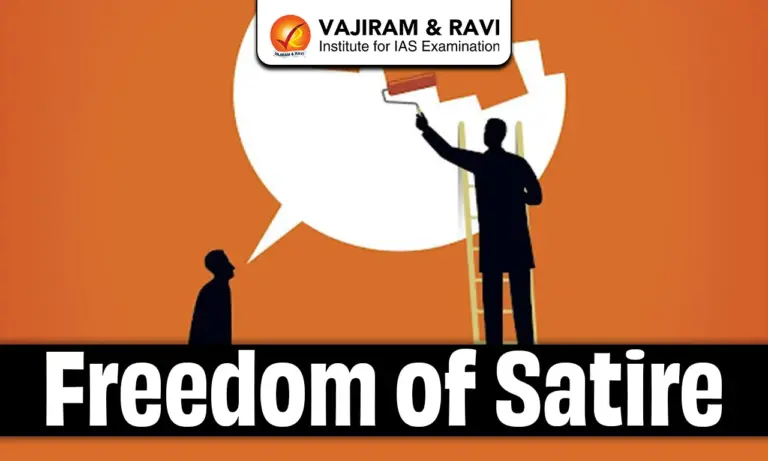
- Access to a satirical cartoon video was recently blocked, citing national security concerns, sparking debate on freedom of satire in India.
Constitutional Basis of Free Speech in India
- Freedom of speech and expression is guaranteed under Article 19(1)(a) of the Constitution of India.
- However, this right is not absolute. Under Article 19(2), the State may impose reasonable restrictions in the interests of sovereignty and integrity of India, security of the State, friendly relations with foreign States, public order, decency, morality, and prevention of incitement to an offence.
- Satire, cartoons, and comedy fall within the broad domain of artistic and political expression protected under Article 19(1)(a).
- Courts have consistently held that democratic discourse must tolerate dissent, exaggeration, irony, and ridicule.




Satire as a Form of Democratic Expression
- The Supreme Court has repeatedly recognised satire as a legitimate artistic tool. In Indibily Creative (P) Ltd. v. State of West Bengal (2019), the Court described satire as an exaggeration that exposes societal absurdities and hypocrisies. It emphasised satire’s “unique ability” to make complex points accessible and impactful.
- Similarly, in D.C. Saxena v. Chief Justice of India (1997), the Court cautioned that suppressing debate on public issues can endanger democratic stability.
- Courts have also observed that satire should be evaluated from the perspective of a “reasonable person” and not a “hypersensitive individual.”
- The Madras High Court in Kama v. M. Jothisorupan (2018) termed political cartoons as a “weapon of ridicule,” meant to sting and provoke thought rather than flatter authority.
Legal Framework for Blocking Online Content
- The recent controversy arises in the context of the Information Technology Act, 2000 and related rules.
- Section 69A of the IT Act
- Section 69A empowers the Union government to block public access to online content on specific grounds aligned with Article 19(2).
- Blocking orders must be reasoned, recorded in writing, and subject to review.
- In Shreya Singhal v. Union of India (2015), the Supreme Court upheld Section 69A but clarified that both intermediaries and originators of content should be heard before blocking, and that restrictions must strictly fall within Article 19(2).
- IT Rules and Amendments
- Amendments to the Information Technology (Intermediary Guidelines and Digital Media Ethics Code) Rules, 2026, reduce the time for social media platforms to remove content deemed illegal from 24-36 hours to three hours.
- The Karnataka High Court upheld the government’s ‘Sahyog’ content-blocking portal, which automates notice transmission to intermediaries. However, concerns have been raised about bypassing procedural safeguards.
- Petitions before the Supreme Court challenge the IT (Procedure and Safeguards for Blocking for Access of Information by Public) Rules, 2009, particularly provisions allowing emergency blocking without prior notice and maintaining confidentiality of blocking orders.
Judicial View on Artistic Freedom
- Indian courts have repeatedly affirmed the importance of artistic and satirical expression.
- In a March 2025 verdict, the Supreme Court observed that 75 years into the Republic, India cannot be so fragile that poetry, stand-up comedy, or artistic expression would automatically incite hatred.
- The Delhi High Court has similarly defended creative liberty, stating that satire exposes societal ills through exaggeration. Globally too, democracies afford cartoons and satire greater latitude, recognising them as essential to public life.
- The Supreme Court has even invoked philosopher Albert Camus to underline that art unites society while tyranny separates it.
Tension Between National Security and Free Expression
- The recent blocking of a satirical cartoon video reportedly featuring the Prime Minister was justified on grounds such as national security, defence, and foreign relations.
- While Article 19(2) permits restrictions, courts insist that such limitations must be reasonable, proportionate, and procedurally fair.
- The key constitutional question is whether satire, by its very nature exaggerated and ironic, can genuinely threaten national security, or whether invoking such grounds in artistic contexts amounts to excessive restriction.
Source: TH

 Last updated on March, 2026
→ UPSC Final Result 2025 is now out.
→ UPSC has released UPSC Toppers List 2025 with the Civil Services final result on its official website.
→ Anuj Agnihotri secured AIR 1 in the UPSC Civil Services Examination 2025.
→ UPSC Marksheet 2025 is now out.
→ UPSC Notification 2026 & UPSC IFoS Notification 2026 is now out on the official website at upsconline.nic.in.
→ UPSC Calendar 2026 has been released.
→ Check out the latest UPSC Syllabus 2026 here.
→ UPSC Prelims 2026 will be conducted on 24th May, 2026 & UPSC Mains 2026 will be conducted on 21st August 2026.
→ The UPSC Selection Process is of 3 stages-Prelims, Mains and Interview.
→ Prepare effectively with Vajiram & Ravi’s UPSC Prelims Test Series 2026 featuring full-length mock tests, detailed solutions, and performance analysis.
→ Enroll in Vajiram & Ravi’s UPSC Mains Test Series 2026 for structured answer writing practice, expert evaluation, and exam-oriented feedback.
→ Join Vajiram & Ravi’s Best UPSC Mentorship Program for personalized guidance, strategy planning, and one-to-one support from experienced mentors.
→ Shakti Dubey secures AIR 1 in UPSC CSE Exam 2024.
→ Also check Best UPSC Coaching in India
Freedom of Satire FAQs
Q1. Under which Article is freedom of speech protected in India?+
Q2. What does Section 69A of the IT Act allow?+
Q3. What did the Supreme Court hold in Shreya Singhal (2015)?+
Q4. How have courts defined satire?+
Q5. Why is satire considered important in a democracy?+
Tags: freedom of satire mains articles upsc current affairs upsc mains current affairs