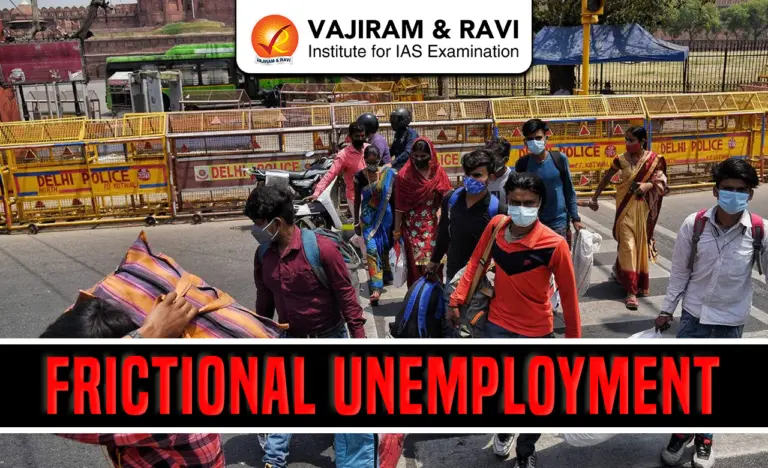
Frictional unemployment refers to a temporary situation where individuals are without work while they are looking for a new job or moving between jobs. It is a short-term and natural part of the labour market. People may leave their current jobs for better opportunities, relocation, or personal reasons, and remain unemployed for some time during this transition. This type of unemployment does not arise due to a shortage of jobs, but because it takes time to match workers with suitable employment.
About Frictional Unemployment
- Frictional unemployment occurs when individuals are temporarily jobless while switching jobs or searching for new opportunities. It is a natural and unavoidable part of the economy, as workers and employers continuously seek better matches.
- Unlike other types of unemployment, frictional unemployment exists even when the economy is strong and operating at full employment. It does not happen because there are not enough jobs, but because it takes time for job seekers and employers to find the best match. This time gap between leaving one job and starting another leads to frictional unemployment.
- For example, a person may leave their current job due to low salary, lack of growth opportunities, poor working conditions, or personal reasons. While searching for a better job, they may remain unemployed for a few weeks or months. Similarly, a student who has just completed education or a person returning to work after a break may take time to find a suitable job. All these situations fall under frictional unemployment.
Frictional Unemployment Key Features
- Short-term in nature: It usually lasts for a brief period until the worker finds a new job.
- Voluntary in many cases: Often occurs because workers choose to leave their jobs in search of better opportunities.
- Present even at full employment: It exists even when most people in the economy are employed.
- Part of a healthy economy: It reflects normal job mobility and flexibility in the labour market.
- Based on job search process: It arises due to the time needed for job searching, application, and hiring.
- Affects different groups: Common among fresh graduates, job changers, and people re-entering the workforce.





Reasons for Frictional Unemployment
Frictional unemployment occurs due to various factors related to the job search process and labour market conditions:
- Mismatch between skills and jobs: Sometimes workers cannot immediately find jobs that match their skills, education, or expectations. This mismatch increases the time taken to get employed.
- Time required for job search: Finding a suitable job takes time. Workers need to search for vacancies, apply, attend interviews, and wait for responses, which creates temporary unemployment.
- Career changes and growth: People often switch careers, industries, or roles to improve their future prospects. This transition period can lead to temporary unemployment.
- Better opportunities: Workers may leave jobs voluntarily in search of higher pay, better working conditions, job satisfaction, or work-life balance.
- Lack of proper information: Job seekers and employers may not have complete or timely information about job openings or available candidates, leading to delays in hiring.
- Geographic mobility: Relocating to a new city or region for personal or professional reasons can create a gap between jobs.
- Entry and re-entry into the workforce: Fresh graduates, homemakers returning to work, or individuals coming back after a career break often take time to find suitable employment.
- Changes in personal preferences: Over time, workers’ preferences regarding job roles, location, salary, or working conditions may change, causing them to leave jobs and search for better options.
Also Read: Types of Unemployment
Frictional Unemployment Impact
Frictional unemployment has both positive and negative effects on individuals as well as the overall economy.
- Positive Impact
- Better job matching: Workers get time to find jobs that suit their skills and interests, leading to higher job satisfaction.
- Improved productivity: When workers are well-matched to their jobs, they perform better, increasing efficiency.
- Career growth: It allows individuals to move to better positions and improve their income and skills.
- Efficient labour market: It helps in proper allocation of human resources across different sectors.
- Encourages skill development: Workers may use this time to upgrade their skills or gain new knowledge.
- Negative Impact
- Loss of income: Workers do not earn during the period they are unemployed.
- Financial stress: It becomes difficult to meet daily expenses, especially if unemployment lasts longer.
- Mental stress: Job uncertainty can cause anxiety, frustration, and loss of confidence.
- Reduced productivity: If many workers remain unemployed for longer periods, overall economic output may be affected.
- Wastage of time and resources: Skills may remain unused during the unemployment period.
Measures to Reduce Frictional Unemployment
Although frictional unemployment cannot be completely eliminated, it can be reduced by improving the efficiency of the job market:
- Better information systems: Providing accurate and timely job information through online job portals, employment exchanges, and mobile apps can reduce the time taken to find jobs.
- Use of technology: Digital platforms, artificial intelligence, and social media can help match job seekers with employers quickly and efficiently.
- Skill development and training: Training programs, vocational education, and upskilling can help workers meet job requirements and reduce mismatch.
- Career guidance and counseling: Proper guidance can help individuals choose suitable career paths and avoid unnecessary job switching.
- Faster recruitment processes: Companies should simplify and speed up hiring procedures to reduce delays in job placement.
- Flexible work options: Providing options like remote work, part-time jobs, and flexible working hours can attract workers and reduce unemployment duration.
- Government support: Government policies can improve labour market conditions by supporting employment services, job fairs, and skill development initiatives.
- Encouraging mobility: Providing support for relocation, such as housing or transport facilities, can help workers move easily to places where jobs are available.

 Last updated on April, 2026
→ UPSC Final Result 2025 is now out.
→ UPSC has released UPSC Toppers List 2025 with the Civil Services final result on its official website.
→ Anuj Agnihotri secured AIR 1 in the UPSC Civil Services Examination 2025.
→ UPSC Marksheet 2025 is now out.
→ UPSC Notification 2026 & UPSC IFoS Notification 2026 is now out on the official website at upsconline.nic.in.
→ UPSC Calendar 2026 has been released.
→ Check out the latest UPSC Syllabus 2026 here.
→ UPSC Prelims 2026 will be conducted on 24th May, 2026 & UPSC Mains 2026 will be conducted on 21st August 2026.
→ The UPSC Selection Process is of 3 stages-Prelims, Mains and Interview.
→ Prepare effectively with Vajiram & Ravi’s UPSC Prelims Test Series 2026 featuring full-length mock tests, detailed solutions, and performance analysis.
→ Enroll in Vajiram & Ravi’s UPSC Mains Test Series 2026 for structured answer writing practice, expert evaluation, and exam-oriented feedback.
→ Join Vajiram & Ravi’s Best UPSC Mentorship Program for personalized guidance, strategy planning, and one-to-one support from experienced mentors.
→ Shakti Dubey secures AIR 1 in UPSC CSE Exam 2024.
→ Also check Best UPSC Coaching in India
Frictional Unemployment FAQs
Q1. What is frictional unemployment?+
Q2. Why does frictional unemployment occur?+
Q3. Does frictional unemployment exist at full employment?+
Q4. Who are mainly affected by frictional unemployment?+
Q5. What are the main causes of frictional unemployment?+
Tags: economy economy notes frictional unemployment