Frozen Embryo Donation Latest News
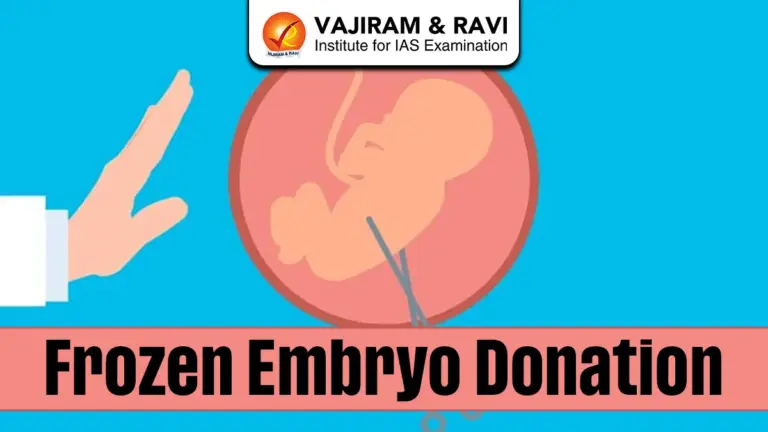
- The Delhi High Court has issued notice on a PIL questioning whether the law can mandate the destruction of viable frozen embryos instead of allowing their donation to infertile couples, even when all parties consent.
- The plea challenges provisions of the Assisted Reproductive Technology (Regulation) Act, 2021 and its Rules, which allow embryos to be created using donor sperm and eggs but prohibit donating unused frozen embryos to another couple for reproductive use.
- Under the existing framework, unused frozen embryos can be stored for up to 10 years. After that, they must either be donated for research or be “allowed to perish”, but cannot be transferred to another infertile couple.
- The plea argues that forcing viable embryos to perish is ethically irrational when willing recipient couples exist.
- The petition questions why the law permits some forms of non-genetic parenthood, such as donor sperm or eggs, while blocking embryo donation, calling this inconsistency a possible legislative oversight.
What the Law Allows
- The Assisted Reproductive Technology (ART) Act, 2021 permits altruistic donation of sperm and eggs under regulated conditions.
- It also allows donor-assisted IVF, including double-donor IVF, where embryos created from donor sperm and donor eggs are implanted in a commissioning couple.
- In donor-assisted and double-donor IVF, the child has no genetic link with either parent. The law explicitly recognises and permits this form of non-genetic parenthood.
- What the law prohibits – Despite allowing donor-based embryo creation, the law does not permit the donation of surplus frozen embryos to another infertile couple for reproductive use.
- Why surplus embryos exist – IVF procedures typically create multiple embryos to improve pregnancy success rates. Not all embryos are implanted, and many remain cryopreserved when couples decide not to pursue further pregnancies.
- Where the restriction applies – It is at this post-IVF stage — when embryos remain unused but viable — that the law restricts their transfer to other couples, limiting their fate to storage, research use, or eventual destruction.





How the prohibition works
- The law does not expressly ban “embryo adoption”, but the restriction arises from how multiple provisions of the ART Act and its Rules operate together.
- Embryos tied to the original couple – Clinics are required to preserve unused embryos only for the commissioning couple. They are prohibited from transferring these embryos to any other person or couple.
- Limited scope for embryo transfer – Embryo transfer is allowed only when the same couple seeks to use its own embryos for personal reproductive purposes, and that too with regulatory approval. Any third-party use is barred.
- Mandatory end-point after 10 years – Under Section 28(2), embryos can be stored for a maximum of 10 years. After this period, embryos must either be:
- allowed to perish, or
- donated to registered research institutions, with consent.
- There is no legal pathway for donating embryos to another infertile couple for pregnancy.
- Consent forms reinforce the restriction – The prescribed consent forms ask couples to choose the fate of embryos in situations like death or separation. However, donation to another couple is not listed as an option, effectively closing that route.
Fresh vs frozen embryos: the core contradiction
- The petition highlights a key inconsistency in how the law treats fresh and frozen embryos.
- What the law allows with fresh embryos – The ART Act permits embryos created using donor sperm and donor eggs to be transferred to a commissioning couple. In such cases, the child has no genetic link to the parents, which the law explicitly accepts.
- Biological equivalence of frozen embryos – Frozen embryos, once thawed, are biologically identical to fresh embryos and are routinely used in IVF treatments with similar success rates.
- Different legal treatment – Despite this equivalence, frozen embryos are barred from being transferred to another couple for reproductive use. They are treated as non-transferable once cryopreserved.
- Alleged ‘double standard’ – The plea argues that while the law accepts genetic non-linearity in fresh donor embryos, it rejects the same principle for existing frozen embryos — creating what the petitioner calls a legal and ethical inconsistency.
The constitutional challenge to the ART law
- The petition questions the validity of the embryo donation ban on constitutional grounds, invoking Articles 14 and 21.
Article 14: equality before law
- The plea argues that the law makes an arbitrary distinction between couples allowed to receive fresh donor embryos and those barred from receiving frozen embryos.
- In both cases, the child has no genetic link to the parents.
- It contends that this classification lacks an intelligible differentia and has no rational link to the objective of the law, thereby violating Article 14.
Article 21: reproductive autonomy
- The petition places reproductive choice within the right to life, dignity and privacy.
- Decisions on whether and how to have a child through assisted reproduction, it argues, are part of individual decisional autonomy.
- Blocking embryo donation intrudes into this freedom.
Compulsory destruction as a core concern
- A central objection is the law’s requirement that unused embryos be “allowed to perish” after 10 years if not used by the original couple.
- The plea calls this a “legislative absurdity”, since viable embryos must be destroyed even when willing and consenting recipient couples exist.
Why the case matters
- The petition highlights the broader social and ethical stakes of the embryo donation debate.
- Scale of infertility in India – Infertility affects an estimated 27–30 million couples in India, making access to assisted reproductive options a significant public health issue.
- Limits of existing options – IVF is costly and often requires multiple cycles, while traditional adoption is marked by long waiting periods and procedural hurdles. This leaves many couples with few viable choices.
- Embryo donation as an alternative – The plea argues that regulated embryo donation could offer a middle path—allowing pregnancy and childbirth for couples who cannot conceive through other means.
- Equity and access concerns – It also flags inequality: wealthier couples can seek embryo donation abroad, while others cannot. This, the petition argues, turns reproductive choice into a function of economic privilege rather than medical need.
Source: IE

 Last updated on March, 2026
→ UPSC Final Result 2025 is now out.
→ UPSC has released UPSC Toppers List 2025 with the Civil Services final result on its official website.
→ Anuj Agnihotri secured AIR 1 in the UPSC Civil Services Examination 2025.
→ UPSC Marksheet 2025 is now out.
→ UPSC Notification 2026 & UPSC IFoS Notification 2026 is now out on the official website at upsconline.nic.in.
→ UPSC Calendar 2026 has been released.
→ Check out the latest UPSC Syllabus 2026 here.
→ UPSC Prelims 2026 will be conducted on 24th May, 2026 & UPSC Mains 2026 will be conducted on 21st August 2026.
→ The UPSC Selection Process is of 3 stages-Prelims, Mains and Interview.
→ Prepare effectively with Vajiram & Ravi’s UPSC Prelims Test Series 2026 featuring full-length mock tests, detailed solutions, and performance analysis.
→ Enroll in Vajiram & Ravi’s UPSC Mains Test Series 2026 for structured answer writing practice, expert evaluation, and exam-oriented feedback.
→ Join Vajiram & Ravi’s Best UPSC Mentorship Program for personalized guidance, strategy planning, and one-to-one support from experienced mentors.
→ Shakti Dubey secures AIR 1 in UPSC CSE Exam 2024.
→ Also check Best UPSC Coaching in India
Frozen Embryo Donation FAQs
Q1. What is the frozen embryo donation case before the Delhi High Court?+
Q2. Why does the ART Act restrict frozen embryo donation?+
Q3. How does the law treat fresh versus frozen embryos differently?+
Q4. What constitutional rights are raised in the frozen embryo donation challenge?+
Q5. Why does frozen embryo donation matter for infertile couples in India?+
Tags: frozen embryo donation mains articles upsc current affairs upsc mains current affairs