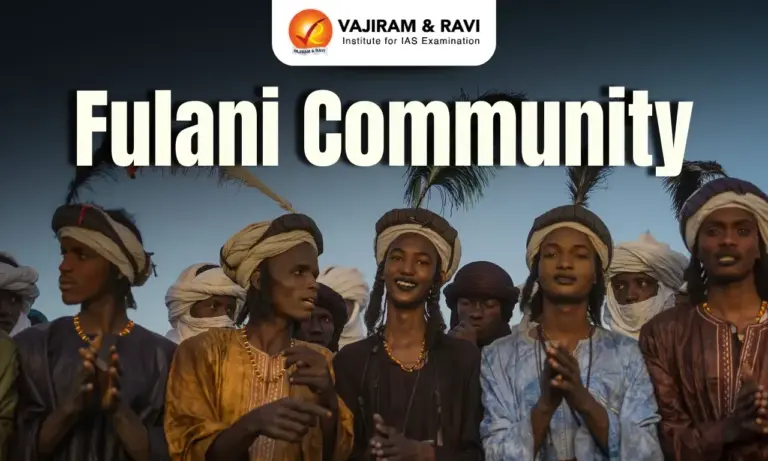
Fulani Community Latest News
A new study has found that the Fulani, one of Africa’s largest pastoral populations, have a history going back to the ‘Green Sahara’ period (12,000–5,000 years before the present).
About Fulani Community
- The Fulani are a large and widely dispersed group of both nomadic herders and sedentary farmers living in the African Sahel/Savannah belt.
- They are concentrated principally in Nigeria, Mali, Guinea, Senegal, and Niger but can also be found in several other countries.
- The Fulani language, known as Fula, is classified within the Atlantic branch of the Niger-Congo language family.
- Fulani are divided into three groups: Makiyaya (herders), Fulanin Soro (those living in towns) and Bararo, which refer to Fulani living in forests. Bararo retain a close cultural connection to ancestral nature belief systems and rituals.





Social Structure of Fulani Community
- The social structure of the pastoral Fulani is egalitarian, in marked contrast to that of other Muslim groups, such as the Hausa.
- They value family and community, with strong kinship ties and clear gender roles.
- Polygamy is practiced, and marriage is an important cultural milestone, often accompanied by elaborate rituals and festivals.
- Their traditions are deeply intertwined with their spirituality, which is influenced by Islam, as well as their connection to the land and nature.
- Fulani women are also known for their skill in weaving and craftsmanship.
- Fulani women are famous for their intricate hairstyles, which are often adorned with beads, cowrie shells, and other decorative elements.
Fulani Community FAQs
Q1: What are the Fulani known for?
Ans: They are well known for the delicate decoration of utilitarian objects such as milk bowls that reflect their nomadic and pastoral lifestyle.
Q2: What is the Fulani caste system?
Ans: The caste system is prevalent in Fulani society which has four categories- traders, nobility, blacksmiths and successors of slaves of rich Fulani people.
Q3: What are Fulani also known as?
Ans: The Fulani people of western and north-central Africa are also called Peuhl and Fula.
Source: DTH

 Last updated on March, 2026
→ UPSC Final Result 2025 is now out.
→ UPSC has released UPSC Toppers List 2025 with the Civil Services final result on its official website.
→ Anuj Agnihotri secured AIR 1 in the UPSC Civil Services Examination 2025.
→ UPSC Marksheet 2025 is now out.
→ UPSC Notification 2026 & UPSC IFoS Notification 2026 is now out on the official website at upsconline.nic.in.
→ UPSC Calendar 2026 has been released.
→ Check out the latest UPSC Syllabus 2026 here.
→ UPSC Prelims 2026 will be conducted on 24th May, 2026 & UPSC Mains 2026 will be conducted on 21st August 2026.
→ The UPSC Selection Process is of 3 stages-Prelims, Mains and Interview.
→ Prepare effectively with Vajiram & Ravi’s UPSC Prelims Test Series 2026 featuring full-length mock tests, detailed solutions, and performance analysis.
→ Enroll in Vajiram & Ravi’s UPSC Mains Test Series 2026 for structured answer writing practice, expert evaluation, and exam-oriented feedback.
→ Join Vajiram & Ravi’s Best UPSC Mentorship Program for personalized guidance, strategy planning, and one-to-one support from experienced mentors.
→ Shakti Dubey secures AIR 1 in UPSC CSE Exam 2024.
→ Also check Best UPSC Coaching in India