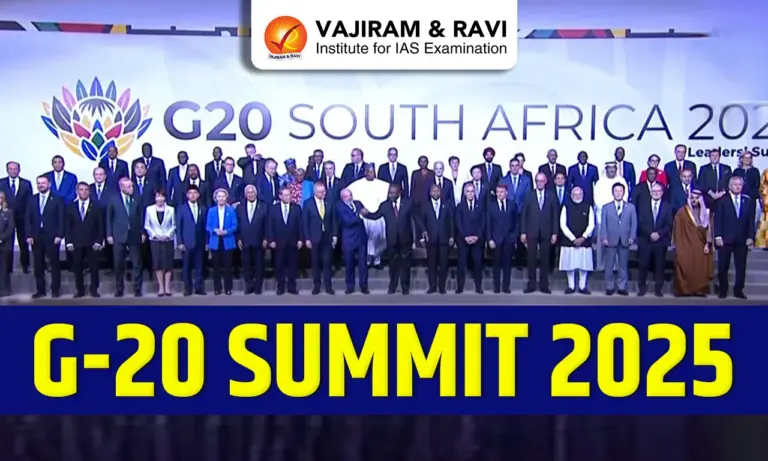
The G20 Summit 2025, hosted in Johannesburg on 22–23 November, was the first time the leaders’ meeting took place on African soil, giving the Global South a more prominent platform. The South African presidency prioritised climate adaptation, debt relief, inclusive industrialisation, and upgrading global governance to better represent developing economies. The summit produced a lengthy Leaders’ Declaration focused on resilience, equity and sustainable development, but it also exposed diplomatic rifts that complicated unanimous endorsement by every guest.
G20 Summit 2025
The 2025 G20 Johannesburg Summit, held on 22-23 November 2025 at the Johannesburg Expo Centre, marked the 20th meeting of the G20 and the first-ever summit hosted on the African continent. South Africa used this opportunity to highlight Africa’s development priorities, global equity, and South-South cooperation. The summit gained attention due to the absence of top leaders from major economies, including China’s Xi Jinping and U.S. President Donald Trump. Despite this, leaders focused on global economic recovery, climate resilience, and digital cooperation.
G20 Summit 2025 Theme
South Africa has selected the G20 Summit 2025 Theme “Solidarity, Equality and Sustainability” for its G20 Presidency, reflecting the group’s original mission and values. The theme emphasises collective action, fairness in global development, and long-term environmental responsibility. It aims to strengthen unity among nations while promoting inclusive and sustainable growth worldwide.





G20 Summit 2025 Outcomes
The 2025 G20 Summit is expected to focus on delivering stronger commitments on global economic stability, climate financing, and digital cooperation under South Africa’s leadership.
- Scale up climate adaptation support and technical assistance for vulnerable countries.
- Strengthen debt sustainability frameworks and creditor coordination.
- Boost food security efforts and support smallholders and supply chains.
- Support digital public infrastructure and AI governance dialogues.
- Advance industrialisation and value-chain development for critical minerals.
G20 Historical Background
The G20 was established in 1999 in the aftermath of the Asian Financial Crisis to bring together major advanced and emerging economies for global economic coordination. Initially a finance ministers’ forum, it evolved into a Leaders’ Summit in 2008 after the Global Financial Crisis.
- Formed in 1999 by G7 finance ministers and central bank governors to prevent future financial crises.
- Initially functioned as a finance ministers’ and central bank governors’ forum before expanding to leaders’ summits in 2008.
- The shift to leaders’ meetings came during the Global Financial Crisis, positioning the G20 at the center of global economic recovery.
- Represents 85% of global GDP, 75% of global trade, and around two-thirds of the world’s population, giving it unmatched influence.
- Membership includes a mix of advanced and emerging economies, ensuring a broad, inclusive approach to global challenges.
- Over the years, the G20 agenda expanded from macroeconomic coordination to climate change, health security, digital transformation, terrorism financing, and sustainable development.
- Played a major role in creating global financial reforms, including Basel III, strengthening financial institutions, and enhancing global regulatory cooperation.
- Supported major global commitments such as the Paris Agreement, the 2030 Agenda for Sustainable Development, and debt relief initiatives for vulnerable nations.
G20 Member Countries List
The G20 Member Countries includes 19 countries: Argentina, Australia, Brazil, Canada, China, France, Germany, India, Indonesia, Italy, Japan, the Republic of Korea, Mexico, Russia, Saudi Arabia, South Africa, Türkiye, the United Kingdom, and the United States, along with the European Union and, since 2023, the African Union as a permanent member.
| G20 Member Countries List | ||
| Member / Bloc | Founding member (finance-level) | Year joined |
|
Argentina |
Yes |
1999 |
|
Australia |
Yes |
1999 |
|
Brazil |
Yes |
1999 |
|
Canada |
Yes |
1999 |
|
China |
Yes |
1999 |
|
France |
Yes |
1999 |
|
Germany |
Yes |
1999 |
|
India |
Yes |
1999 |
|
Indonesia |
Yes |
1999 |
|
Italy |
Yes |
1999 |
|
Japan |
Yes |
1999 |
|
Republic of Korea |
Yes |
1999 |
|
Mexico |
Yes |
1999 |
|
Russia |
Yes |
1999 |
|
Saudi Arabia |
Yes |
1999 |
|
South Africa |
Yes |
1999 |
|
Türkiye |
Yes |
1999 |
|
United Kingdom |
Yes |
1999 |
|
United States |
Yes |
1999 |
|
European Union (institutional) |
Yes (institutional member) |
1999 |
|
African Union (AU) |
No (added later) |
2023 |
G20 Countries Objectives
The G20 Countries aims to promote stable, inclusive, and sustainable global economic growth by coordinating macroeconomic policies among major economies. It works to strengthen financial regulation, ensure resilient supply chains, and support developing countries through equitable reforms.
- Global Economic Stability: Enhance coordination on fiscal, monetary, and structural policies to prevent crises.
- Financial Sector Reforms: Strengthen the stability and regulation of global financial institutions and markets.
- Sustainable Development & SDGs: Mobilize funds and policies for poverty reduction, climate resilience, and green growth.
- International Taxation: Create fair taxation frameworks, including digital tax rules and BEPS (Base Erosion and Profit Shifting) reforms.
- Trade & Investment: Promote open, transparent, and rules-based global trade systems under WTO principles.
- Climate Action: Advance commitments to energy transition, climate finance, and disaster resilience.
- Digital Transformation: Expand digital infrastructure, cybersecurity norms, and AI governance.
- Global Health Security: Enhance pandemic preparedness, vaccine equity, and health system resilience.
- Support for Global South: Improve debt sustainability, development financing, and capacity-building initiatives.
- Food & Energy Security: Strengthen global cooperation to ensure affordable, accessible, and sustainable supplies.
G20 Countries Issues
Despite its global influence, the G20 Countires faces several challenges that hinder coherent and effective decision-making. Geopolitical tensions, competing economic interests, and disagreements on climate finance often slow down consensus-based outcomes. Developing nations demand greater equity and climate justice, while advanced economies differ on commitments related to emissions, trade, and taxation.
- Geopolitical Conflicts: Russia-Ukraine war, US-China tensions, Middle East instability affecting cooperation.
- Climate Finance Gap: Developed nations yet to fully deliver the promised $100 billion/year for climate adaptation and mitigation.
- Debt Crisis in Poor Nations: Rising debt distress in Sub-Saharan Africa, Sri Lanka, Pakistan, etc., with limited G20 consensus on restructuring.
- Global Trade Fragmentation: Protectionism, tariff wars, and supply chain disruptions limiting free trade.
- Inequity Between Members: Advanced economies push innovation goals, while developing economies focus on development finance and energy security.
- Energy Transition Divide: Conflicts over phasing out fossil fuels versus ensuring affordable energy access.
- Digital Inequality: Unequal access to digital infrastructure limits growth in developing economies.
- Slow Decision-Making: Consensus-based system makes rapid global crisis responses difficult.Global Tax Reform Delays: Implementation challenges of OECD’s minimum corporate tax framework.
- Multilateral System Weakening: Overlapping institutions and loss of trust in global governance frameworks.
G20 Countries Way Forward
The G20 must strengthen multilateralism, bridge geopolitical divides, and prioritize inclusive growth to ensure global stability. Future cooperation requires greater climate finance, debt relief mechanisms, and investment in digital transformation to support developing economies.
- Revive Multilateralism: Promote consensus-building and strengthen global governance institutions.
- Debt Relief Mechanisms: Implement faster and more transparent debt restructuring frameworks for vulnerable nations.
- Boost Climate Finance: Ensure predictable funding for mitigation, adaptation, and energy transition.
- Promote Digital Inclusivity: Support global digital infrastructure, cybersecurity cooperation, and AI governance.
- Reform Global Institutions: Restructure IMF quotas, WTO rules, and UN frameworks for better Global South representation.
- Strengthen Supply Chains: Diversify critical sectors like semiconductors, pharmaceuticals, and green technologies.
- Enhance Global Health Security: Expand vaccine manufacturing, disease surveillance, and health-emergency financing.
- Support Sustainable Development: Prioritise SDGs, food security, gender equality, and green infrastructure investment.

 Last updated on March, 2026
→ UPSC Final Result 2025 is now out.
→ UPSC has released UPSC Toppers List 2025 with the Civil Services final result on its official website.
→ Anuj Agnihotri secured AIR 1 in the UPSC Civil Services Examination 2025.
→ UPSC Marksheet 2025 is now out.
→ UPSC Notification 2026 & UPSC IFoS Notification 2026 is now out on the official website at upsconline.nic.in.
→ UPSC Calendar 2026 has been released.
→ Check out the latest UPSC Syllabus 2026 here.
→ UPSC Prelims 2026 will be conducted on 24th May, 2026 & UPSC Mains 2026 will be conducted on 21st August 2026.
→ The UPSC Selection Process is of 3 stages-Prelims, Mains and Interview.
→ Prepare effectively with Vajiram & Ravi’s UPSC Prelims Test Series 2026 featuring full-length mock tests, detailed solutions, and performance analysis.
→ Enroll in Vajiram & Ravi’s UPSC Mains Test Series 2026 for structured answer writing practice, expert evaluation, and exam-oriented feedback.
→ Join Vajiram & Ravi’s Best UPSC Mentorship Program for personalized guidance, strategy planning, and one-to-one support from experienced mentors.
→ Shakti Dubey secures AIR 1 in UPSC CSE Exam 2024.
→ Also check Best UPSC Coaching in India
G20 Summit 2025 FAQs
Q1. Where was the G20 Summit 2025 held?+
Q2. What was the theme of the G20 Summit 2025?+
Q3. Why is the 2025 summit historically significant?+
Q4. Which major leaders did not attend the summit?+
Q5. What were the key focus areas of the 2025 G20 Summit?+
Tags: g20 summit 2025