What’s in today’s article?
- Why in news?
- What is Gaganyaan Mission?
- What is the status of the mission?
- News Summary: Gaganyaan TV-D1 test successful
- The TV-D1 test exercise
Why in news?
- ISRO successfully performed the first test vehicle development flight (TV-D1) for India’s first human space flight Gaganyaan.
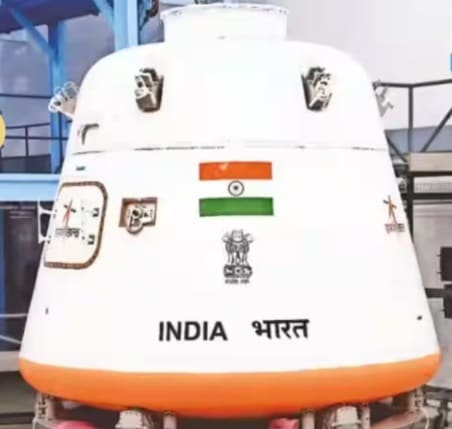
- The Flight Test Vehicle Abort Mission-1 (TV-D1) demonstrated the performance of the Crew Escape System of the Gaganyaan project.





Gaganyaan Mission
- Gaganyaan project envisages demonstration of human spaceflight capability by launching a crew of 3 members to an orbit of 400 km for a 3 days mission and bring them back safely to earth.
- It is part of the Indian Human Spaceflight Programme (IHSP), which was initiated (in 2007) by the ISRO to develop the technology needed to launch crewed orbital spacecraft into low earth orbit (LEO).
- Launch Vehicle Mark-3 (LVM3/GSLV Mk3) rocket – the well proven and reliable heavy lift launcher of ISRO, is identified as the launch vehicle for Gaganyaan mission.
- India’s heaviest rocket consists of solid stage, liquid stage and cryogenic stage.
- All systems in the LVM3 launch vehicle are re-configured to meet human rating requirements and christened Human Rated LVM3/HLVM3.
- Upon its completion, India will become the fourth nation, after the US, Russia, and China, to undertake a manned spaceflight mission.
Status of the mission
- The current schedule is that there will be an unmanned mission in the beginning of next year. This year we will have the abort missions.
- The manned mission is being talked about for the end of 2024 or early 2025.
- ISRO has completed the human rating of the LVM 3 rocket which will be used for the Gaganyaan mission.
- Human rating certification is the certification of a spacecraft or launch vehicle as capable of safely transporting humans.
- Four astronauts from the Indian Air Force have undergone training in Russia. They will undergo further training ahead of the final mission.
News Summary: Gaganyaan TV-D1 test successful
- ISRO achieved a major milestone by successfully executing the Test Flight Abort Mission for the Gaganyaan mission.
The test exercise
- About
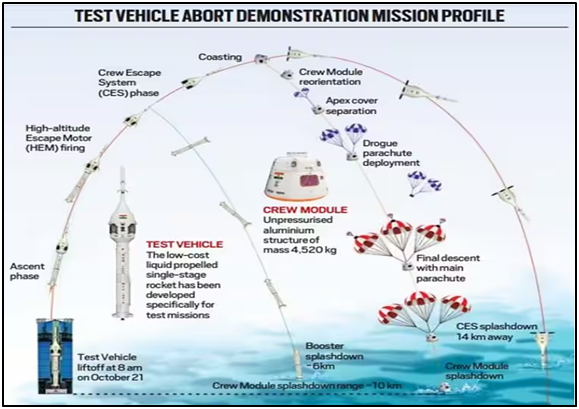
- The brief test flight sequence launched the Crew Escape System (CES) and crew module at an altitude of 17 km.
- This was followed by a safe touchdown in the sea, about 10 km from Sriharikota in the Bay of Bengal.
- The test checked the functioning of systems for separating the crew module from the rocket in case of a mid-flight emergency (abort mission) and the escape of astronauts.

- Objective
- To evaluate various subsystems of the Test Vehicle, including the Crew Escape System and its separation systems.
- To assess crew module characteristics and demonstrate the deceleration system at higher altitudes and its recovery.
- The new Test Vehicle
- The full-fledged test flight of the crew module into space and back will be carried out on the human rated LVM3 rocket.
- However, for the TV-D1 mission, ISRO will use a low-cost basic rocket it has built specifically to test systems.
- The liquid-propelled single-stage test vehicle, or TV-D1, used a modified VIKAS engine.
- What next?
- After the TV-D1 test flight demonstration, the space agency will also be carrying out a test flight with a robot, ‘Vyomitra’, a humanoid astronaut.
Q1) What is Vyomitra?
Vyommitra is a female-looking humanoid robot being developed by the Indian Space Research Organisation (ISRO). The name Vyommitra comes from the Sanskrit words vyoma (space) and mitra (friend).
Q2) What is VIKAS engine?
The Vikas engine is a family of liquid-fueled rocket engines. The acronym stands for Vikram Ambalal Sarabhai. ISRO’s Liquid Propulsion Systems Centre designed the Vikas engine in the 1970s. The design was based on a licensed version of the Viking engine with a chemical pressurisation system.
Source: ISRO | Hindustan Times | Economic Times

 Last updated on March, 2026
→ UPSC Final Result 2025 is now out.
→ UPSC has released UPSC Toppers List 2025 with the Civil Services final result on its official website.
→ Anuj Agnihotri secured AIR 1 in the UPSC Civil Services Examination 2025.
→ UPSC Marksheet 2025 is now out.
→ UPSC Notification 2026 & UPSC IFoS Notification 2026 is now out on the official website at upsconline.nic.in.
→ UPSC Calendar 2026 has been released.
→ Check out the latest UPSC Syllabus 2026 here.
→ UPSC Prelims 2026 will be conducted on 24th May, 2026 & UPSC Mains 2026 will be conducted on 21st August 2026.
→ The UPSC Selection Process is of 3 stages-Prelims, Mains and Interview.
→ Prepare effectively with Vajiram & Ravi’s UPSC Prelims Test Series 2026 featuring full-length mock tests, detailed solutions, and performance analysis.
→ Enroll in Vajiram & Ravi’s UPSC Mains Test Series 2026 for structured answer writing practice, expert evaluation, and exam-oriented feedback.
→ Join Vajiram & Ravi’s Best UPSC Mentorship Program for personalized guidance, strategy planning, and one-to-one support from experienced mentors.
→ Shakti Dubey secures AIR 1 in UPSC CSE Exam 2024.
→ Also check Best UPSC Coaching in India